Council adopts zoning updates to conform with state adaptive-reuse law amid resident questions
August 05, 2025 | Surprise, Maricopa County, Arizona
This article was created by AI summarizing key points discussed. AI makes mistakes, so for full details and context, please refer to the video of the full meeting. Please report any errors so we can fix them. Report an error »
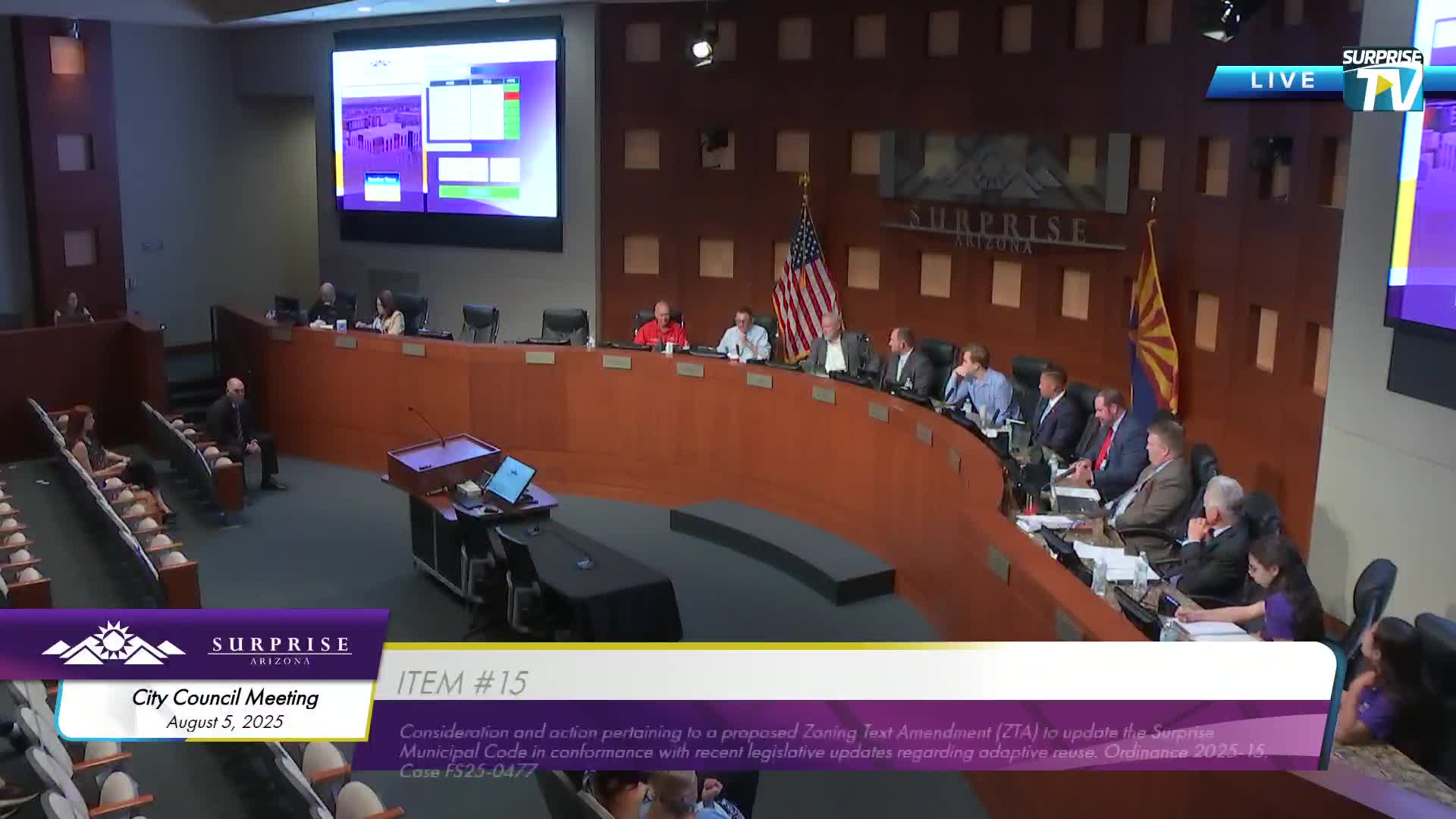
The Surprise City Council voted unanimously Tuesday to adopt a zoning text amendment (Ordinance 2025-15, Case FS25-0477) to bring city code into conformance with recent amendments to the state adaptive-reuse law. Staff said the change implements language in the legislative bills cited in the record and adjusts city infill rules to reflect state definitions and requirements.
City planning staff explained that the state originally passed HB 2,297 to allow adaptive reuse of commercially or economically obsolete buildings into multifamily housing; a subsequent amendment, cited in the meeting as HB 2210, clarified and expanded that statute. Planning staff said the new language requires cities to allow multifamily residential development on at least 10% of existing commercial parcels within the affected infill area and limits local discretion on parcel eligibility, sound-level exclusions and certain setback, height and density rules.
Planning Manager Tiffany (last name not given) said the law affects roughly 22% of Surprise because large portions of the city fall in territory adjacent to a military airport and are excluded from the statute. A resident who spoke at the public hearing expressed confusion and concern that the law "throws the city's control out the window." Council members pressed staff for local context: Councilman Melton and Councilman Haney noted that impacted areas are mostly undeveloped today and that the city will likely not see immediate effects unless commercial development becomes economically obsolete.
Several council members expressed frustration with state preemption. Councilmember Judd asked why the public hearing had been held when the council was compelled to conform; staff and the city attorney said state law and local code require public hearings for zoning text amendments even when the municipality must adopt conforming language.
Why it matters: The ordinance changes how Surprise regulates the conversion of commercial properties to multifamily housing in eligible areas. Staff said the immediate practical impact in Surprise is limited because most affected parcels are undeveloped; still, the changes remove some local discretion and require updates to definitions and infill incentives.
What happens next: The ordinance takes effect after the council’s vote; staff will update definitions and implement the code changes and continue to monitor legislative activity.
City planning staff explained that the state originally passed HB 2,297 to allow adaptive reuse of commercially or economically obsolete buildings into multifamily housing; a subsequent amendment, cited in the meeting as HB 2210, clarified and expanded that statute. Planning staff said the new language requires cities to allow multifamily residential development on at least 10% of existing commercial parcels within the affected infill area and limits local discretion on parcel eligibility, sound-level exclusions and certain setback, height and density rules.
Planning Manager Tiffany (last name not given) said the law affects roughly 22% of Surprise because large portions of the city fall in territory adjacent to a military airport and are excluded from the statute. A resident who spoke at the public hearing expressed confusion and concern that the law "throws the city's control out the window." Council members pressed staff for local context: Councilman Melton and Councilman Haney noted that impacted areas are mostly undeveloped today and that the city will likely not see immediate effects unless commercial development becomes economically obsolete.
Several council members expressed frustration with state preemption. Councilmember Judd asked why the public hearing had been held when the council was compelled to conform; staff and the city attorney said state law and local code require public hearings for zoning text amendments even when the municipality must adopt conforming language.
Why it matters: The ordinance changes how Surprise regulates the conversion of commercial properties to multifamily housing in eligible areas. Staff said the immediate practical impact in Surprise is limited because most affected parcels are undeveloped; still, the changes remove some local discretion and require updates to definitions and infill incentives.
What happens next: The ordinance takes effect after the council’s vote; staff will update definitions and implement the code changes and continue to monitor legislative activity.
View the Full Meeting & All Its Details
This article offers just a summary. Unlock complete video, transcripts, and insights as a Founder Member.
✓
Watch full, unedited meeting videos
✓
Search every word spoken in unlimited transcripts
✓
AI summaries & real-time alerts (all government levels)
✓
Permanent access to expanding government content
30-day money-back guarantee
