McPherson County announces start of adult drug court program with first hearing Sept. 9
August 18, 2025 | McPherson County, Kansas
This article was created by AI summarizing key points discussed. AI makes mistakes, so for full details and context, please refer to the video of the full meeting. Please report any errors so we can fix them. Report an error »
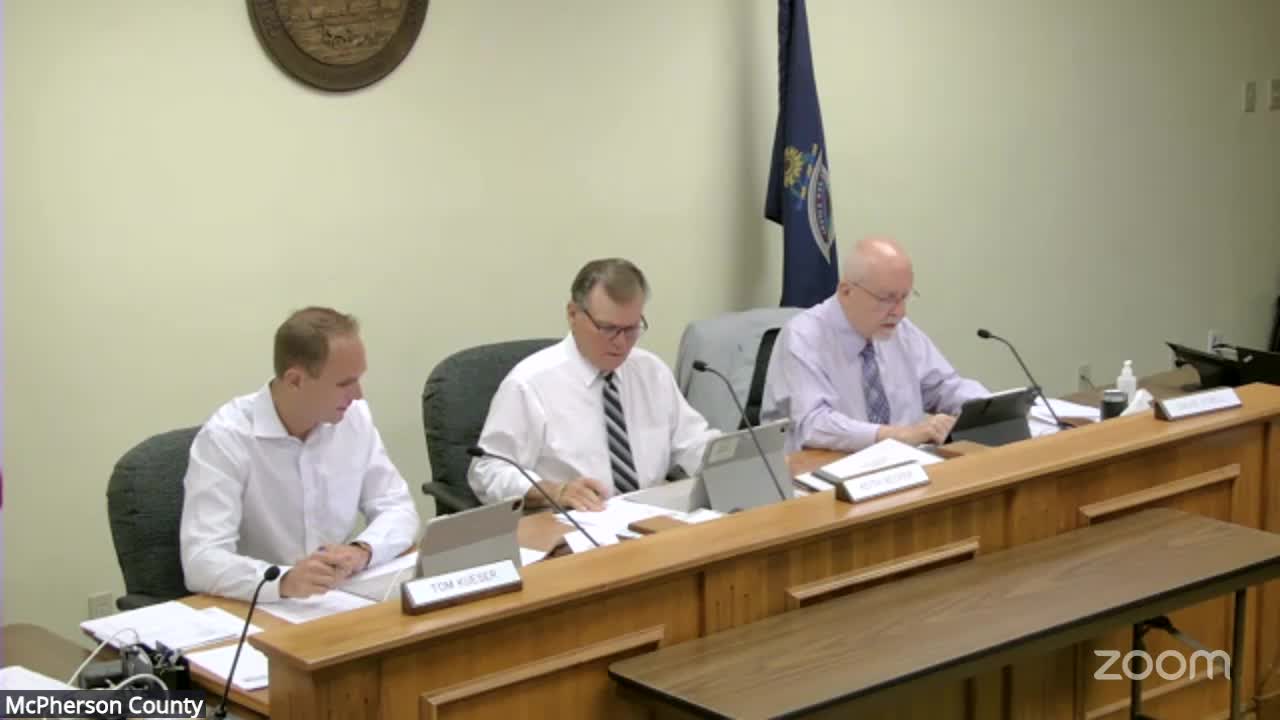
McPherson County will launch an adult drug court program focused on high‑risk, high‑needs individuals convicted of felony offenses linked to substance use, the county heard Aug. 18.
Ninth Judicial District Judge Jason Blaine, who helped start the Harvey County drug court and has participated in that program since 2021, told commissioners the McPherson program will begin with a narrow intake and expand over time. “Our first court session will be September 9. We will meet at 01:00,” Blaine said. He described the drug court model as team‑based, intensive and focused on immediate judicial responses and wraparound services: “We meet with the participants every other week…we have immediate responses. If they're showing that they're using again, we can make adjustments. The court can issue sanctions and get that immediate response to get people back on track.”
Blaine said the program will start with about five participants and aims to grow to 25–30 regular participants over several years, similar to Harvey County’s experience. Participants must apply and the initial focus will be people already convicted of a felony involving controlled substances who have not succeeded on regular probation. The program is organized into phases and typically requires 14–18 months for a participant to progress through all phases, though individuals may remain longer depending on progress.
The county received an initial Drug Endangered Children (DEC) grant to get the program started; the DEC funding was described as extended through the current year and staff said they are tracking additional federal and state grant opportunities, including Bureau of Justice Assistance and SAMHSA programs. Christie Schrader was identified as the program administrator and will handle reporting and coordination with court services. Blaine said the Supreme Court and state budget actions in Kansas have recently supported specialty courts, which could provide future funding avenues.
Local stakeholders described Harvey County’s drug court outcomes as improved since implementation; a county participant noted Harvey County’s success rate rose to about 84% for those completing the program. Blaine said the court will partner with probation, defense counsel (funded in part by grants), treatment providers, mental‑health partners (including Prairie View and CKF) and law enforcement for staffing and wraparound services. Follow‑up tracking is planned to measure recidivism and whether graduates reoffend within one or two years.
No formal action by the board was required; the presentation served as an informational update and to identify reporting and administration roles prior to the program launch.
Ninth Judicial District Judge Jason Blaine, who helped start the Harvey County drug court and has participated in that program since 2021, told commissioners the McPherson program will begin with a narrow intake and expand over time. “Our first court session will be September 9. We will meet at 01:00,” Blaine said. He described the drug court model as team‑based, intensive and focused on immediate judicial responses and wraparound services: “We meet with the participants every other week…we have immediate responses. If they're showing that they're using again, we can make adjustments. The court can issue sanctions and get that immediate response to get people back on track.”
Blaine said the program will start with about five participants and aims to grow to 25–30 regular participants over several years, similar to Harvey County’s experience. Participants must apply and the initial focus will be people already convicted of a felony involving controlled substances who have not succeeded on regular probation. The program is organized into phases and typically requires 14–18 months for a participant to progress through all phases, though individuals may remain longer depending on progress.
The county received an initial Drug Endangered Children (DEC) grant to get the program started; the DEC funding was described as extended through the current year and staff said they are tracking additional federal and state grant opportunities, including Bureau of Justice Assistance and SAMHSA programs. Christie Schrader was identified as the program administrator and will handle reporting and coordination with court services. Blaine said the Supreme Court and state budget actions in Kansas have recently supported specialty courts, which could provide future funding avenues.
Local stakeholders described Harvey County’s drug court outcomes as improved since implementation; a county participant noted Harvey County’s success rate rose to about 84% for those completing the program. Blaine said the court will partner with probation, defense counsel (funded in part by grants), treatment providers, mental‑health partners (including Prairie View and CKF) and law enforcement for staffing and wraparound services. Follow‑up tracking is planned to measure recidivism and whether graduates reoffend within one or two years.
No formal action by the board was required; the presentation served as an informational update and to identify reporting and administration roles prior to the program launch.
View the Full Meeting & All Its Details
This article offers just a summary. Unlock complete video, transcripts, and insights as a Founder Member.
✓
Watch full, unedited meeting videos
✓
Search every word spoken in unlimited transcripts
✓
AI summaries & real-time alerts (all government levels)
✓
Permanent access to expanding government content
30-day money-back guarantee
