Larimer County staff outlines state mandates, timelines and funding options for housing, land-use and building-code changes
August 18, 2025 | Larimer County, Colorado
This article was created by AI summarizing key points discussed. AI makes mistakes, so for full details and context, please refer to the video of the full meeting. Please report any errors so we can fix them. Report an error »
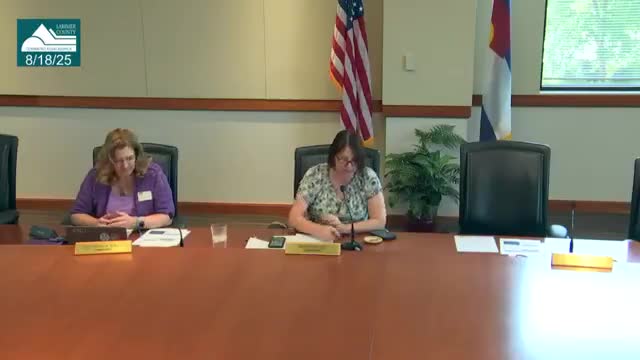
Rebecca Everett, Larimer County’s Community Development Director, told the Board of County Commissioners on Aug. 18 that county staff are tracking recent state actions and executive direction that affect county land use, housing and building-code responsibilities. “I'm here today to provide an update on recent legislation that affects the Community Development Department in particular, including how we are intending to meet the deadlines for various mandates,” Everett said.
The update grouped several topics the county must address to remain eligible for some state funding and to comply with new requirements: removing residential occupancy limits based on family relationship (already implemented by the county as of July 1, 2024), limiting local minimum parking requirements near high-frequency transit, adopting an expedited review process for affordable housing projects, completing a county housing needs assessment and housing action plan, and completing comprehensive plan updates to add a water-supply element and a strategic growth element.
Why this matters: Governor Jared Polis issued an executive order in May that instructs state agencies to prioritize funding to local governments that are either in compliance or in progress on a set of “strategic growth” obligations. Everett told the board that the Colorado Department of Local Affairs will maintain a compliance list and that state funding from agencies such as the Colorado Department of Transportation, Colorado Energy Office and Department of Local Affairs may be prioritized based on that status.
Most urgent items and deadlines
- Expedited-review process for affordable housing: adopting a process by Dec. 31, 2025, would make the county eligible for a guaranteed Proposition 123 incentive payment of $50,000 for jurisdictions that adopt such a process. Everett said staff is drafting code language to guarantee a 90-day review for qualifying affordable housing projects and intends to present related code changes and a resolution of Board support.
- Housing needs assessment and housing action plan: SB24-174 requires a housing needs assessment (deadline cited in the presentation as Dec. 31, 2026) and a housing action plan by Jan. 1, 2028. Everett said Larimer County contracted with Fort Collins and Loveland for a regional housing needs assessment and expects the assessment to be finished well before the statutory deadline.
- Comprehensive plan updates: SB24-174 also requires updates to add a water-supply element and a strategic growth element by Dec. 31, 2026. Staff has not yet identified funding or a final scope for the comprehensive-plan update and is monitoring forthcoming state guidance.
Building-code and safety-related items
- Regional building codes for factory-built structures (SB25002): staff reported compliance with the initial benchmark and said statewide rulemaking will define the regional code by July 1, 2026. Building official Eric Fried will monitor and comment during rule development.
- Statewide wildfire (WUI) code: staff included the wildfire resiliency code in the county's 2024 building-code package and plans for compliance by the April 1, 2026 deadline.
- Statewide electric/solar-ready and low energy/carbon codes: staff said the electric and solar-ready requirements are included in the current building-code package; the low energy/carbon code will apply any time the county updates codes after July 2026.
- Water-conservation and nonfunctional turf prohibition (SB24-005): the county is preparing code changes for compliance by Jan. 1, 2026; environmental planner Scott Benton is leading that work.
Practical clarifications and next steps
Matt Lafferty, the county principal planner, described the planned parking-code edit as straightforward: “We'll go into our parking section of our code, which is where we find our minimum standards, and we'll just adopt some language that says what is exempted from our regulations.” Everett and Lafferty said draft code language will be routed to the Planning Commission and returned to the Board of County Commissioners for approval or modification, as required by state law.
Leslie Ellis, director of Community Planning, Infrastructure & Resources, and other staff told the board they will monitor rulemaking for the factory-built and wildfire codes, coordinate with Loveland Fire Rescue Authority on wildfire code work, and continue to analyze resource needs for the comprehensive-plan update. Several commissioners asked staff to show, in the 2026 work plan, which existing county projects might be delayed if staff time is redirected to meet mandated compliance dates.
Funding and grants
Staff outlined grants that could support compliance work: the Proposition 123 incentive (guaranteed $50,000 for jurisdictions that adopt an expedited affordable-housing review), a housing-planning grant program created under SB24-174 (25% local match), and a Colorado Water Conservation Board grant for a groundwater study for which the county has applied (county requested $300,000 with a proposed $100,000 match). Everett said staff will pursue appropriate grants and return to the board to prioritize spending if awards are made.
What the board said
Commissioners generally expressed support for prioritizing compliance with the statutory deadlines while urging staff to clearly identify trade-offs in the 2026 work plan. One commissioner asked staff to track statewide rulemaking closely and to provide cost estimates (for example, the county will ask the building official to provide cost estimates for implementing wildfire and low-energy code requirements). No formal vote was recorded on any item during this discussion.
Looking ahead: staff will prepare proposed code amendments, seek Planning Commission input where required, pursue available grants, and return to the Board with draft code language and a proposed 2026 work plan that calls out items shifted or delayed due to compliance needs.
The update grouped several topics the county must address to remain eligible for some state funding and to comply with new requirements: removing residential occupancy limits based on family relationship (already implemented by the county as of July 1, 2024), limiting local minimum parking requirements near high-frequency transit, adopting an expedited review process for affordable housing projects, completing a county housing needs assessment and housing action plan, and completing comprehensive plan updates to add a water-supply element and a strategic growth element.
Why this matters: Governor Jared Polis issued an executive order in May that instructs state agencies to prioritize funding to local governments that are either in compliance or in progress on a set of “strategic growth” obligations. Everett told the board that the Colorado Department of Local Affairs will maintain a compliance list and that state funding from agencies such as the Colorado Department of Transportation, Colorado Energy Office and Department of Local Affairs may be prioritized based on that status.
Most urgent items and deadlines
- Expedited-review process for affordable housing: adopting a process by Dec. 31, 2025, would make the county eligible for a guaranteed Proposition 123 incentive payment of $50,000 for jurisdictions that adopt such a process. Everett said staff is drafting code language to guarantee a 90-day review for qualifying affordable housing projects and intends to present related code changes and a resolution of Board support.
- Housing needs assessment and housing action plan: SB24-174 requires a housing needs assessment (deadline cited in the presentation as Dec. 31, 2026) and a housing action plan by Jan. 1, 2028. Everett said Larimer County contracted with Fort Collins and Loveland for a regional housing needs assessment and expects the assessment to be finished well before the statutory deadline.
- Comprehensive plan updates: SB24-174 also requires updates to add a water-supply element and a strategic growth element by Dec. 31, 2026. Staff has not yet identified funding or a final scope for the comprehensive-plan update and is monitoring forthcoming state guidance.
Building-code and safety-related items
- Regional building codes for factory-built structures (SB25002): staff reported compliance with the initial benchmark and said statewide rulemaking will define the regional code by July 1, 2026. Building official Eric Fried will monitor and comment during rule development.
- Statewide wildfire (WUI) code: staff included the wildfire resiliency code in the county's 2024 building-code package and plans for compliance by the April 1, 2026 deadline.
- Statewide electric/solar-ready and low energy/carbon codes: staff said the electric and solar-ready requirements are included in the current building-code package; the low energy/carbon code will apply any time the county updates codes after July 2026.
- Water-conservation and nonfunctional turf prohibition (SB24-005): the county is preparing code changes for compliance by Jan. 1, 2026; environmental planner Scott Benton is leading that work.
Practical clarifications and next steps
Matt Lafferty, the county principal planner, described the planned parking-code edit as straightforward: “We'll go into our parking section of our code, which is where we find our minimum standards, and we'll just adopt some language that says what is exempted from our regulations.” Everett and Lafferty said draft code language will be routed to the Planning Commission and returned to the Board of County Commissioners for approval or modification, as required by state law.
Leslie Ellis, director of Community Planning, Infrastructure & Resources, and other staff told the board they will monitor rulemaking for the factory-built and wildfire codes, coordinate with Loveland Fire Rescue Authority on wildfire code work, and continue to analyze resource needs for the comprehensive-plan update. Several commissioners asked staff to show, in the 2026 work plan, which existing county projects might be delayed if staff time is redirected to meet mandated compliance dates.
Funding and grants
Staff outlined grants that could support compliance work: the Proposition 123 incentive (guaranteed $50,000 for jurisdictions that adopt an expedited affordable-housing review), a housing-planning grant program created under SB24-174 (25% local match), and a Colorado Water Conservation Board grant for a groundwater study for which the county has applied (county requested $300,000 with a proposed $100,000 match). Everett said staff will pursue appropriate grants and return to the board to prioritize spending if awards are made.
What the board said
Commissioners generally expressed support for prioritizing compliance with the statutory deadlines while urging staff to clearly identify trade-offs in the 2026 work plan. One commissioner asked staff to track statewide rulemaking closely and to provide cost estimates (for example, the county will ask the building official to provide cost estimates for implementing wildfire and low-energy code requirements). No formal vote was recorded on any item during this discussion.
Looking ahead: staff will prepare proposed code amendments, seek Planning Commission input where required, pursue available grants, and return to the Board with draft code language and a proposed 2026 work plan that calls out items shifted or delayed due to compliance needs.
View the Full Meeting & All Its Details
This article offers just a summary. Unlock complete video, transcripts, and insights as a Founder Member.
✓
Watch full, unedited meeting videos
✓
Search every word spoken in unlimited transcripts
✓
AI summaries & real-time alerts (all government levels)
✓
Permanent access to expanding government content
30-day money-back guarantee
