State presents plans for new Rochester courthouse at 296 Rochester Hill Road; project under way
August 18, 2025 | Rochester Boards & Committees, Rochester City , Strafford County, New Hampshire
This article was created by AI summarizing key points discussed. AI makes mistakes, so for full details and context, please refer to the video of the full meeting. Please report any errors so we can fix them. Report an error »
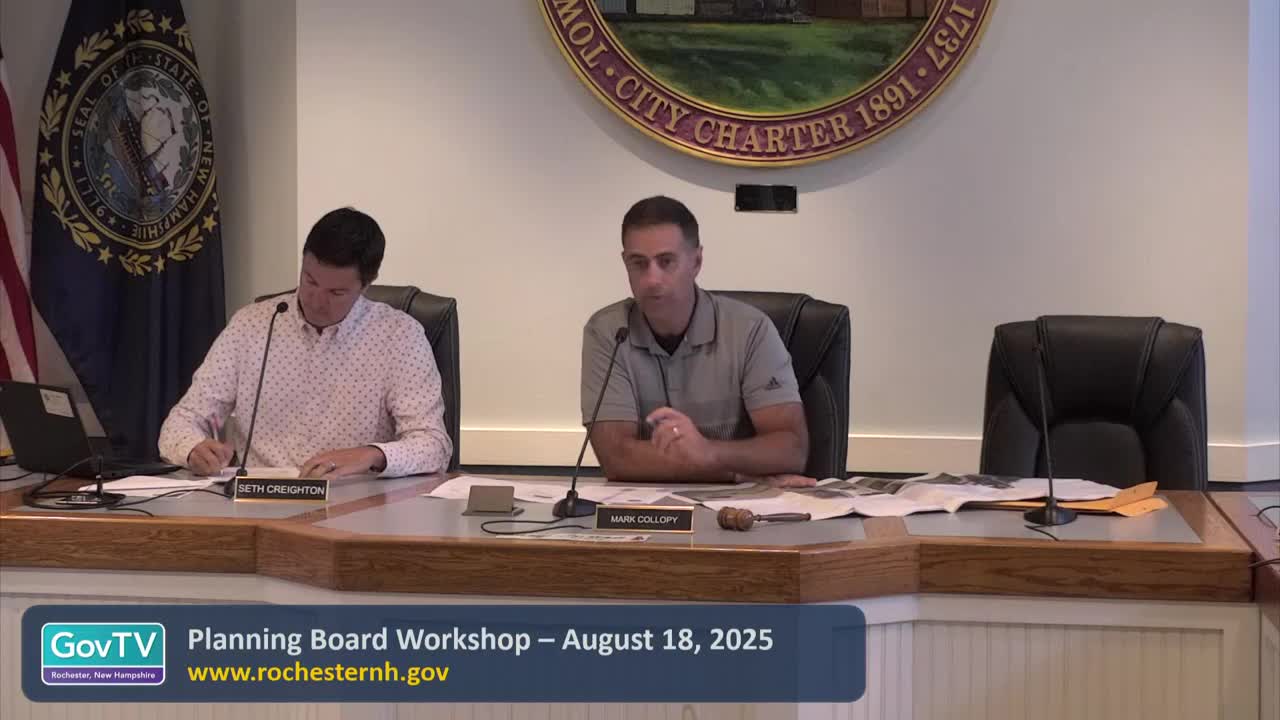
State representatives told the Rochester Planning Board on Aug. 18, 2025, that a new courthouse at 296 Rochester Hill Road is under construction and is expected to consolidate the district, family and probate functions currently split between downtown Rochester and the Strafford County complex.
The project is a two‑story building with a partial basement totaling about 32,000 square feet, officials said, and is funded by a state capital appropriation of $17,500,000 from the FY 2024‑25 biennium; the state reported the project was approved by the Governor and Executive Council on March 12, 2025.
The briefing mattered because the site is adjacent to Rochester Airport, includes holding cells and a sally port, involves wetlands and stormwater controls, and will change how people travel to court, city staff and the state said.
Sarah Lineberry, superintendent of the Bureau of Port Cities Facilities for the New Hampshire Department of Administrative Services, said the building will include four courtrooms, public-service counters, clerk’s offices, judges’ chambers, separate public and staff parking, a security check at the front entrance and a lower-level cell block for detainees. “The new Rochester circuit court is currently under construction,” Lineberry said.
Steven, a representative of engineering firm BHB, walked the board through site elements and said the design positions the courthouse to avoid wetlands and property setbacks, reuses an existing single-family curb cut on Rochester Hill Road, and will rely on underground detention and surface infiltration basins to treat and slow runoff. “The storm report, which was approved by NHDS, covers all that,” Steven said; the transcript uses the acronym “NHDS” for the state permitting authority that approved the site’s alteration‑of‑terrain permit.
Steven said the project team has coordinated with the New Hampshire Department of Transportation and with aeronautics and Federal Aviation Administration reviewers because the parcel lies in a runway protection area; he told the board that proposed exterior lighting will be downward‑pointing and that the team would confirm no uplighting for flagpoles. “All of them should be downward pointing and compliant with the regulations,” he said.
Board members and members of the public raised operational and safety questions. A board member asked whether the state needs an easement to grade across a city‑owned parcel to the north; Steven said grading encroachments exist and that easements are either in place or being negotiated. Another board member asked about a retaining wall within inches of a wetland; Steven said the contractor intends to install the wall from the top using segmental block construction and will deploy erosion controls at the wetland edge.
Fire and police department comments were discussed. The board referenced National Fire Protection Association distances for hydrant placement — a maximum 400‑foot distance from a hydrant to the closest point of a building and a maximum 500‑foot spacing between hydrants — and Steven said a proposed hydrant on the west side of the building will serve the fire‑department connection while the team follows up with the fire department on final placement. Police questions centered on access control and building‑mounted cameras; Lineberry said the building will have an extensive camera system and estimated roughly 90 cameras for interior and exterior coverage, and that fencing had been discussed but was not currently proposed.
Public commenters raised process and access concerns. Ray Wayman of Ida Circle asked why a public hearing was held after construction had already started and described the timing as “nonsense.” The planning board and staff replied that state projects are presented to municipal bodies under state law, that the presentation in this forum is informational and a statutory courtesy because state facilities are generally exempt from local permitting, and that the city and state can follow up on technical questions.
Board members and city staff asked the state to provide additional detail on several items: confirmation of light fixture types in the runway protection zone, final traffic report items being coordinated with DOT, documentation that the job meets local MS4 stormwater requirements, detailed fire protection plans (including fire alarm and Knox box solutions), and a confirmation of sight‑and‑sound separation in juvenile versus adult holding cells in the lower level. Steven and Lineberry said they would follow up with project manager Keith Hemingway and the design team to supply that information to the board.
No formal action or vote by the planning board was required or taken; the meeting functioned as the public presentation and hearing required by state statute. The state team said the project is slated for completion in mid‑June 2026 and that staff would provide additional, detailed responses to the board’s technical questions.
The project is a two‑story building with a partial basement totaling about 32,000 square feet, officials said, and is funded by a state capital appropriation of $17,500,000 from the FY 2024‑25 biennium; the state reported the project was approved by the Governor and Executive Council on March 12, 2025.
The briefing mattered because the site is adjacent to Rochester Airport, includes holding cells and a sally port, involves wetlands and stormwater controls, and will change how people travel to court, city staff and the state said.
Sarah Lineberry, superintendent of the Bureau of Port Cities Facilities for the New Hampshire Department of Administrative Services, said the building will include four courtrooms, public-service counters, clerk’s offices, judges’ chambers, separate public and staff parking, a security check at the front entrance and a lower-level cell block for detainees. “The new Rochester circuit court is currently under construction,” Lineberry said.
Steven, a representative of engineering firm BHB, walked the board through site elements and said the design positions the courthouse to avoid wetlands and property setbacks, reuses an existing single-family curb cut on Rochester Hill Road, and will rely on underground detention and surface infiltration basins to treat and slow runoff. “The storm report, which was approved by NHDS, covers all that,” Steven said; the transcript uses the acronym “NHDS” for the state permitting authority that approved the site’s alteration‑of‑terrain permit.
Steven said the project team has coordinated with the New Hampshire Department of Transportation and with aeronautics and Federal Aviation Administration reviewers because the parcel lies in a runway protection area; he told the board that proposed exterior lighting will be downward‑pointing and that the team would confirm no uplighting for flagpoles. “All of them should be downward pointing and compliant with the regulations,” he said.
Board members and members of the public raised operational and safety questions. A board member asked whether the state needs an easement to grade across a city‑owned parcel to the north; Steven said grading encroachments exist and that easements are either in place or being negotiated. Another board member asked about a retaining wall within inches of a wetland; Steven said the contractor intends to install the wall from the top using segmental block construction and will deploy erosion controls at the wetland edge.
Fire and police department comments were discussed. The board referenced National Fire Protection Association distances for hydrant placement — a maximum 400‑foot distance from a hydrant to the closest point of a building and a maximum 500‑foot spacing between hydrants — and Steven said a proposed hydrant on the west side of the building will serve the fire‑department connection while the team follows up with the fire department on final placement. Police questions centered on access control and building‑mounted cameras; Lineberry said the building will have an extensive camera system and estimated roughly 90 cameras for interior and exterior coverage, and that fencing had been discussed but was not currently proposed.
Public commenters raised process and access concerns. Ray Wayman of Ida Circle asked why a public hearing was held after construction had already started and described the timing as “nonsense.” The planning board and staff replied that state projects are presented to municipal bodies under state law, that the presentation in this forum is informational and a statutory courtesy because state facilities are generally exempt from local permitting, and that the city and state can follow up on technical questions.
Board members and city staff asked the state to provide additional detail on several items: confirmation of light fixture types in the runway protection zone, final traffic report items being coordinated with DOT, documentation that the job meets local MS4 stormwater requirements, detailed fire protection plans (including fire alarm and Knox box solutions), and a confirmation of sight‑and‑sound separation in juvenile versus adult holding cells in the lower level. Steven and Lineberry said they would follow up with project manager Keith Hemingway and the design team to supply that information to the board.
No formal action or vote by the planning board was required or taken; the meeting functioned as the public presentation and hearing required by state statute. The state team said the project is slated for completion in mid‑June 2026 and that staff would provide additional, detailed responses to the board’s technical questions.
View the Full Meeting & All Its Details
This article offers just a summary. Unlock complete video, transcripts, and insights as a Founder Member.
✓
Watch full, unedited meeting videos
✓
Search every word spoken in unlimited transcripts
✓
AI summaries & real-time alerts (all government levels)
✓
Permanent access to expanding government content
30-day money-back guarantee
