Ouray County commissioners direct staff to draft lodging-tax ballot language focused on housing, child care and public safety
August 06, 2025 | Ouray County, Colorado
This article was created by AI summarizing key points discussed. AI makes mistakes, so for full details and context, please refer to the video of the full meeting. Please report any errors so we can fix them. Report an error »
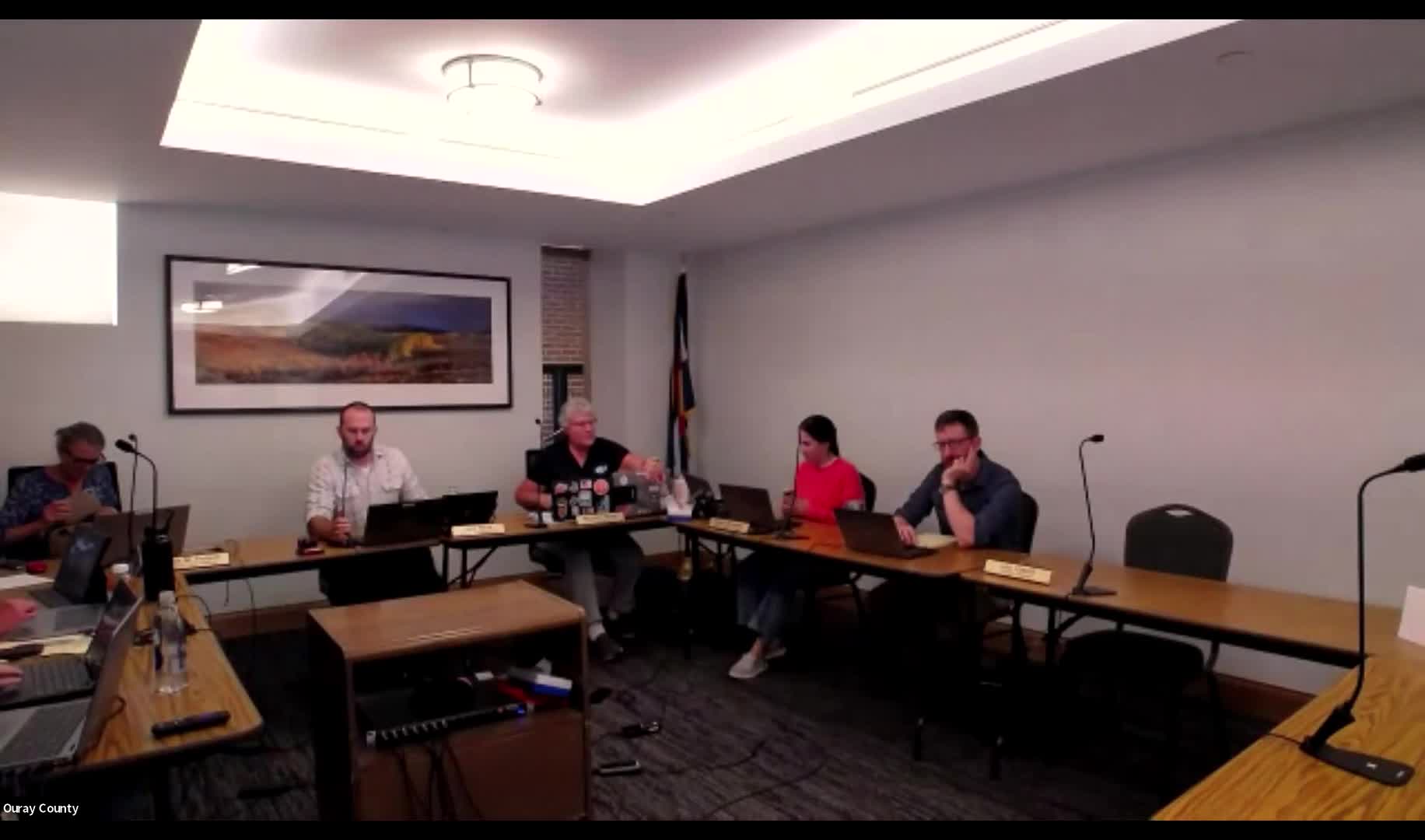
On Aug. 6, 2025, the Ouray County Board of Commissioners held a work session to discuss whether to place a county lodging tax on a coordinated election ballot and directed staff to prepare draft ballot language focused on housing and child care for the tourism workforce and on enhancing public safety.
The discussion centered on three questions: do commissioners want to put a lodging tax on the ballot; what specific language should appear on the ballot; and which registered electors would vote (unincorporated voters only or also municipalities). County staff and commissioners cited a recent state law that permits counties to adopt a lodging tax of up to 6 percent and noted that municipalities that already levy a lodging tax would not be subject to a new county levy but the statute is unclear about whether such municipalities would vote on the measure.
Commissioner Jake Nauer said he favored moving forward and asked staff to prepare draft language. Commissioner Lynn Padgett said the key question was not only whether the county could enact a lodging tax but whether it would have a meaningful, demonstrable impact on local priorities: "What are our local priorities that we have that are unfunded that could best benefit from a dedicated revenue source?" Padgett also urged the board to avoid asking voters for revenue that would not be felt in the community.
County staff reviewed earlier revenue estimates run for a 2 percent unincorporated-county lodging tax, which were roughly $50,000–$63,000 annually. Commissioners and staff observed that a 6 percent levy could raise in the neighborhood of $180,000–$200,000 per year in the unincorporated county, depending on which accommodations are included; the board noted that statute requires 10 percent of lodging-tax revenue be set aside for advertising and tourism marketing, leaving up to 90 percent for the listed program uses.
Commissioners and staff debated the allowable uses in the statute. The newest law expands allowable county uses to include housing and child care for the tourism-related workforce (including seasonal workers) and additional uses such as public infrastructure maintenance and funding for law enforcement, fire protection and emergency medical services. Several commissioners said they favored limiting the initial ballot language to two purposes—housing/child care and enhancing public safety—rather than a wider set of uses.
A recurring implementation question was whether the county could, and should, include campgrounds, resorts or other accommodation types such as glamping Airstreams, KOA campgrounds or outfitters who bundle lodging with guiding services. Staff pointed to the Colorado Department of Revenue guidance and to statutory definitions (statute cited in meeting materials as 39-26-10211 and related DOR guidance) that treat ‘rooms or accommodations’ broadly and that county practice and state guidance will determine the scope.
The board asked staff to get legal and clerks-office confirmation on whether the question would be presented only to unincorporated-area registered electors or to include municipalities that would be subject to the new tax. Commissioners also asked staff to consult with counties that have campgrounds and statutory lodging taxes (for example, San Juan and Gunnison were named) and to pull sample ballot language from other counties that have passed lodging-tax measures.
Action and next steps decided at the session included: staff will prepare a draft resolution and ballot question using statutory language that emphasizes housing/child care and enhanced public safety for review at the next work session; staff will research whether campgrounds and state parks would be taxable and whether municipalities that already have lodging taxes would vote on the county measure; and staff will provide revenue estimates and sample language from other counties. The board noted the certified-ballot-content deadline of Sept. 4 and requested an accelerated timeline.
Commissioners emphasized the need to decide what problem the tax is intended to solve before asking voters and to identify a committee or community champions who could support outreach and education if the board moves forward. No formal vote took place at the work session; the board’s direction was recorded as a staff referral to draft ballot language and return with analyses and options.
Background and context: commissioners recalled a 2023 state change expanding allowable lodging-tax uses to include housing and child care and noted prior county work calculating small revenue totals at 2 percent. Commissioners also discussed the county’s limited previous experience raising similar ballot measures and the county’s split geography—municipalities such as Ridgeway and Ouray already have lodging taxes at different rates, raising questions about ballot styles and revenue distribution.
The board set a schedule to review draft language in a subsequent work session and asked county staff to coordinate with municipal and state contacts to clarify statutory and administrative questions.
The discussion centered on three questions: do commissioners want to put a lodging tax on the ballot; what specific language should appear on the ballot; and which registered electors would vote (unincorporated voters only or also municipalities). County staff and commissioners cited a recent state law that permits counties to adopt a lodging tax of up to 6 percent and noted that municipalities that already levy a lodging tax would not be subject to a new county levy but the statute is unclear about whether such municipalities would vote on the measure.
Commissioner Jake Nauer said he favored moving forward and asked staff to prepare draft language. Commissioner Lynn Padgett said the key question was not only whether the county could enact a lodging tax but whether it would have a meaningful, demonstrable impact on local priorities: "What are our local priorities that we have that are unfunded that could best benefit from a dedicated revenue source?" Padgett also urged the board to avoid asking voters for revenue that would not be felt in the community.
County staff reviewed earlier revenue estimates run for a 2 percent unincorporated-county lodging tax, which were roughly $50,000–$63,000 annually. Commissioners and staff observed that a 6 percent levy could raise in the neighborhood of $180,000–$200,000 per year in the unincorporated county, depending on which accommodations are included; the board noted that statute requires 10 percent of lodging-tax revenue be set aside for advertising and tourism marketing, leaving up to 90 percent for the listed program uses.
Commissioners and staff debated the allowable uses in the statute. The newest law expands allowable county uses to include housing and child care for the tourism-related workforce (including seasonal workers) and additional uses such as public infrastructure maintenance and funding for law enforcement, fire protection and emergency medical services. Several commissioners said they favored limiting the initial ballot language to two purposes—housing/child care and enhancing public safety—rather than a wider set of uses.
A recurring implementation question was whether the county could, and should, include campgrounds, resorts or other accommodation types such as glamping Airstreams, KOA campgrounds or outfitters who bundle lodging with guiding services. Staff pointed to the Colorado Department of Revenue guidance and to statutory definitions (statute cited in meeting materials as 39-26-10211 and related DOR guidance) that treat ‘rooms or accommodations’ broadly and that county practice and state guidance will determine the scope.
The board asked staff to get legal and clerks-office confirmation on whether the question would be presented only to unincorporated-area registered electors or to include municipalities that would be subject to the new tax. Commissioners also asked staff to consult with counties that have campgrounds and statutory lodging taxes (for example, San Juan and Gunnison were named) and to pull sample ballot language from other counties that have passed lodging-tax measures.
Action and next steps decided at the session included: staff will prepare a draft resolution and ballot question using statutory language that emphasizes housing/child care and enhanced public safety for review at the next work session; staff will research whether campgrounds and state parks would be taxable and whether municipalities that already have lodging taxes would vote on the county measure; and staff will provide revenue estimates and sample language from other counties. The board noted the certified-ballot-content deadline of Sept. 4 and requested an accelerated timeline.
Commissioners emphasized the need to decide what problem the tax is intended to solve before asking voters and to identify a committee or community champions who could support outreach and education if the board moves forward. No formal vote took place at the work session; the board’s direction was recorded as a staff referral to draft ballot language and return with analyses and options.
Background and context: commissioners recalled a 2023 state change expanding allowable lodging-tax uses to include housing and child care and noted prior county work calculating small revenue totals at 2 percent. Commissioners also discussed the county’s limited previous experience raising similar ballot measures and the county’s split geography—municipalities such as Ridgeway and Ouray already have lodging taxes at different rates, raising questions about ballot styles and revenue distribution.
The board set a schedule to review draft language in a subsequent work session and asked county staff to coordinate with municipal and state contacts to clarify statutory and administrative questions.
Don't Miss a Word: See the Full Meeting!
Go beyond summaries. Unlock every video, transcript, and key insight with a Founder Membership.
✓
Get instant access to full meeting videos
✓
Search and clip any phrase from complete transcripts
✓
Receive AI-powered summaries & custom alerts
✓
Enjoy lifetime, unrestricted access to government data
30-day money-back guarantee
