Council advances major update to architecture and building-design standards; debate over base-material requirement
August 05, 2025 | Lee's Summit, Jackson County, Missouri
This article was created by AI summarizing key points discussed. AI makes mistakes, so for full details and context, please refer to the video of the full meeting. Please report any errors so we can fix them. Report an error »
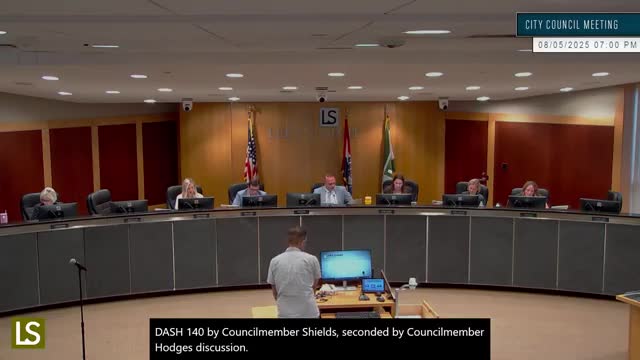
The Lee's Summit City Council on Aug. 4 advanced amendments to the Unified Development Ordinance (UDO) related to architecture and building-design standards to a second reading after an extended presentation and council discussion.
Adair Bright, senior planner, and Abby Eckberg of Confluence presented the draft update, which reorganizes design standards around building types (for example single-family, commercial, industrial), clarifies expectations for durable materials and 4-sided architecture, and provides material-class tables (Class 1–4) to guide acceptable facade and roof materials. The update also addresses entries, roof and wall articulation and the visual treatment of mechanical equipment and trash enclosures.
Eckberg described outreach that included stakeholder interviews with builders and architects, Planning Commission briefings and a meeting with the Home Builders Association. She said public comments emphasized quality materials, material variety and design flexibility.
A key area of council discussion and Planning Commission input concerned the “base” of buildings. Planning Commissioners recommended adding language that would require the base of all buildings to use materials from Class 1, 2 or 3 — or to include a protective feature — to reduce deterioration and maintenance problems with lower-grade materials.
Council members and staff discussed what a “protective feature” could be; staff suggested examples such as bollards, planting beds, landscape islands or other measures that prevent vehicle or maintenance equipment damage and water/weed intrusion. Council member Shields requested that if the amendment is adopted staff add a brief definition or examples to the code to clarify the term.
Other adjustments reflected stakeholder feedback: the draft raised maximum permitted garage-door width from 50% to 60% on single-family homes and added an option to recess a third-car garage for aesthetic balance; it clarified when overhead glass doors are appropriate for industrial versus commercial uses and added tables that map building types to preferred material classes.
Council member Carlisle read the ordinance to move the UDO amendments to second reading as bill 25-141; the motion passed unanimously. Council and staff agreed to continue fine-tuning language — including an explicit explanation of what qualifies as a protective base feature — before final adoption.
Adair Bright, senior planner, and Abby Eckberg of Confluence presented the draft update, which reorganizes design standards around building types (for example single-family, commercial, industrial), clarifies expectations for durable materials and 4-sided architecture, and provides material-class tables (Class 1–4) to guide acceptable facade and roof materials. The update also addresses entries, roof and wall articulation and the visual treatment of mechanical equipment and trash enclosures.
Eckberg described outreach that included stakeholder interviews with builders and architects, Planning Commission briefings and a meeting with the Home Builders Association. She said public comments emphasized quality materials, material variety and design flexibility.
A key area of council discussion and Planning Commission input concerned the “base” of buildings. Planning Commissioners recommended adding language that would require the base of all buildings to use materials from Class 1, 2 or 3 — or to include a protective feature — to reduce deterioration and maintenance problems with lower-grade materials.
Council members and staff discussed what a “protective feature” could be; staff suggested examples such as bollards, planting beds, landscape islands or other measures that prevent vehicle or maintenance equipment damage and water/weed intrusion. Council member Shields requested that if the amendment is adopted staff add a brief definition or examples to the code to clarify the term.
Other adjustments reflected stakeholder feedback: the draft raised maximum permitted garage-door width from 50% to 60% on single-family homes and added an option to recess a third-car garage for aesthetic balance; it clarified when overhead glass doors are appropriate for industrial versus commercial uses and added tables that map building types to preferred material classes.
Council member Carlisle read the ordinance to move the UDO amendments to second reading as bill 25-141; the motion passed unanimously. Council and staff agreed to continue fine-tuning language — including an explicit explanation of what qualifies as a protective base feature — before final adoption.
View the Full Meeting & All Its Details
This article offers just a summary. Unlock complete video, transcripts, and insights as a Founder Member.
✓
Watch full, unedited meeting videos
✓
Search every word spoken in unlimited transcripts
✓
AI summaries & real-time alerts (all government levels)
✓
Permanent access to expanding government content
30-day money-back guarantee
