Council tables ordinance-cleanup on liquor licensing after heated debate over 100–300-foot rule
August 05, 2025 | Lee's Summit, Jackson County, Missouri
This article was created by AI summarizing key points discussed. AI makes mistakes, so for full details and context, please refer to the video of the full meeting. Please report any errors so we can fix them. Report an error »
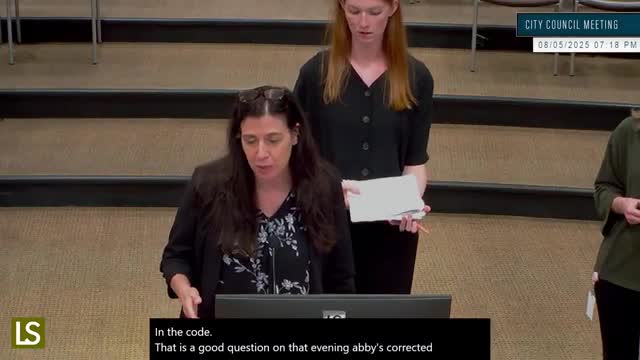
The Lee's Summit City Council on Aug. 4 held an extended debate on whether to tighten city liquor-license rules that govern how close a retailer may be to a church or school. Council ultimately voted to table the matter and send it back to the Community and Economic Development Committee (CEDC) for further study.
Council member Rader proposed substitute language that would make it unlawful to sell, dispense or give away alcoholic beverages within 300 feet of any church, school or building regularly used for religious worship. Rader said the change was intended to protect children and to provide a clear, bright-line rule rather than a discretionary range.
“The responsibility to protect the young children in this community as much as legally possible,” Rader said, arguing a hard 300-foot ban would reduce the risk of minors accessing alcohol near churches and schools.
Opponents on council cautioned that the city's current ordinance gives the city discretion between 100 and 300 feet and that the council can and should continue case-by-case review. Council Member Shields noted a local church had expressed no opposition to a recent license application and asked whether a blanket ban was necessary in every circumstance.
Chief of Police Travis Forbes told the council the department supports public-safety measures and noted existing enforcement tools — including compliance stings and proactive enforcement of laws prohibiting sales to minors — but said proximity can increase risks because nearby stores can become gathering spots for youth.
Legal staff and the city attorney's office advised the council that the state authorizes local regulation up to 300 feet and that the substitute language was legally available; however the police chief and staff also suggested the city should clean up the ordinance language and consider improved notice procedures for faith-based organizations and schools when license applications are submitted.
After several motions, withdrawals and a prolonged procedural exchange, the council voted to table the ordinance and send the matter to CEDC for further work on boundaries, notice requirements, and comparisons to peer cities. The tabling motion passed unanimously.
Council member Rader proposed substitute language that would make it unlawful to sell, dispense or give away alcoholic beverages within 300 feet of any church, school or building regularly used for religious worship. Rader said the change was intended to protect children and to provide a clear, bright-line rule rather than a discretionary range.
“The responsibility to protect the young children in this community as much as legally possible,” Rader said, arguing a hard 300-foot ban would reduce the risk of minors accessing alcohol near churches and schools.
Opponents on council cautioned that the city's current ordinance gives the city discretion between 100 and 300 feet and that the council can and should continue case-by-case review. Council Member Shields noted a local church had expressed no opposition to a recent license application and asked whether a blanket ban was necessary in every circumstance.
Chief of Police Travis Forbes told the council the department supports public-safety measures and noted existing enforcement tools — including compliance stings and proactive enforcement of laws prohibiting sales to minors — but said proximity can increase risks because nearby stores can become gathering spots for youth.
Legal staff and the city attorney's office advised the council that the state authorizes local regulation up to 300 feet and that the substitute language was legally available; however the police chief and staff also suggested the city should clean up the ordinance language and consider improved notice procedures for faith-based organizations and schools when license applications are submitted.
After several motions, withdrawals and a prolonged procedural exchange, the council voted to table the ordinance and send the matter to CEDC for further work on boundaries, notice requirements, and comparisons to peer cities. The tabling motion passed unanimously.
View the Full Meeting & All Its Details
This article offers just a summary. Unlock complete video, transcripts, and insights as a Founder Member.
✓
Watch full, unedited meeting videos
✓
Search every word spoken in unlimited transcripts
✓
AI summaries & real-time alerts (all government levels)
✓
Permanent access to expanding government content
30-day money-back guarantee
