Lee's Summit committee continues debate over municipal judge pay and plan for mental‑health docket
August 18, 2025 | Lee's Summit, Jackson County, Missouri
This article was created by AI summarizing key points discussed. AI makes mistakes, so for full details and context, please refer to the video of the full meeting. Please report any errors so we can fix them. Report an error »
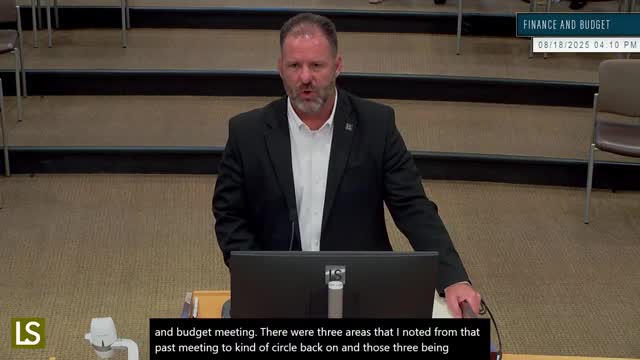
Finance and Budget Committee leaders and the city’s municipal judges on Aug. 18 continued a months‑long discussion about whether judges can receive extra compensation during their elected terms for new duties such as supervising court staff and designing specialty dockets for mental‑health and substance‑use cases.
Committee Chair Shields and other members heard from the two municipal judges about current caseload pressures and the legwork required to create either an informal treatment docket or a formal, OSCA‑recognized specialty court. The committee did not take formal action at the meeting because Mayor Pro Tem Berton Lopez recused, leaving the panel without a quorum for any vote on the matter. Committee members agreed to send a detailed proposal and background materials to the full City Council for discussion.
Why it matters: Committee members and judges said the city’s growth has increased court workload and created recurring public‑safety and social‑service needs that local treatment dockets could address. City staff and judges estimated that designing and staffing a formal specialty court would require several months of planning, community partners and outside funding, and that supervisory responsibilities and implementation work are distinct from merely redistributing existing cases across more court days.
At the meeting, City Manager Mark Dunning summarized legal guidance received from outside counsel and explained the two legal questions the committee had asked staff to clarify: what counts as “additional duties” for pay purposes under Missouri law, and whether developing or operating specialty dockets (drug court, mental‑health court) would qualify as additional duties. Dunning said outside counsel advised that simply splitting existing dockets across more days, without adding new responsibilities, is not by itself a new duty. By contrast, he said, the work to design, implement and operate a specialty court is additional work and therefore would qualify as additional duties.
Municipal judges disputed that a new court day is merely a scheduling change. "We are not asking for raises. We are asking that we get additional dockets so that people aren't sitting there for three hours, so that we can do our job," one municipal judge said during the meeting. The judges described a range of newer activities they have taken on in recent years, from supervising court staff to coordinating electronic monitoring options and partnering with service providers, and they argued those duties were not part of the job as it existed when they were elected.
Judges and committee members described two broad paths to a treatment docket: an informal/local diversion model that uses community partners (case managers, treatment providers and probation officers) but does not pursue OSCA certification, and a formal OSCA‑certified treatment court with an established steering committee, formal policies and potentially multi‑year participant tracks. Judges and outside partners told the committee formal specialty courts typically need a steering committee, prosecutor and defense participation, treatment providers, case managers, law enforcement support and funding. One city attendee estimated a formal option would take roughly 4–6 months to assemble the initial steering committee and operating plan, with a longer timeframe to enroll participants regularly.
Funding and partnerships: Judges and committee members said funding sources could include Office of State Courts Administrator (OSCA) treatment‑court grants, Department of Mental Health funds and local partner agencies. Rediscover (a local behavioral‑health provider) was named as a likely local partner for case management and clinical services; Rediscover staff told the judges they were willing to participate and could help identify funding sources.
Next steps and staff direction: Because the committee lacked a quorum for a vote on amendments or salary language, members agreed to ask staff to prepare a written memo and a more fleshed‑out proposal that outlines: the specific additional duties the judges would be asked to perform; an implementation timeline for informal and formal dockets; potential funding sources and partner roles; and recommended compensation options to present to the full City Council. During discussion some committee members suggested an interim compensation range (committee discussion referenced a 20–25% figure as a potential starting point for negotiating additional compensation tied to supervisory duties and the work of establishing specialty dockets), but no dollar figure or percent was approved at the meeting.
What remains unresolved: The committee and judges disagreed over whether adding a court day alone constitutes an "additional duty" under Missouri law; outside counsel's opinion — as summarized by staff — said merely redistributing existing caseloads across additional days is not a new duty. That legal interpretation was contested by the judges at the meeting. Committee members said the full City Council should review the legal advice alongside the operational proposal before any formal change to compensation or docket schedules is made.
For now, the committee directed staff to assemble documentation and bring the issue to the full City Council for a decision that would consider the legal opinion, implementation costs, partner commitments and options for when a new base salary — if any — should take effect.
Committee Chair Shields and other members heard from the two municipal judges about current caseload pressures and the legwork required to create either an informal treatment docket or a formal, OSCA‑recognized specialty court. The committee did not take formal action at the meeting because Mayor Pro Tem Berton Lopez recused, leaving the panel without a quorum for any vote on the matter. Committee members agreed to send a detailed proposal and background materials to the full City Council for discussion.
Why it matters: Committee members and judges said the city’s growth has increased court workload and created recurring public‑safety and social‑service needs that local treatment dockets could address. City staff and judges estimated that designing and staffing a formal specialty court would require several months of planning, community partners and outside funding, and that supervisory responsibilities and implementation work are distinct from merely redistributing existing cases across more court days.
At the meeting, City Manager Mark Dunning summarized legal guidance received from outside counsel and explained the two legal questions the committee had asked staff to clarify: what counts as “additional duties” for pay purposes under Missouri law, and whether developing or operating specialty dockets (drug court, mental‑health court) would qualify as additional duties. Dunning said outside counsel advised that simply splitting existing dockets across more days, without adding new responsibilities, is not by itself a new duty. By contrast, he said, the work to design, implement and operate a specialty court is additional work and therefore would qualify as additional duties.
Municipal judges disputed that a new court day is merely a scheduling change. "We are not asking for raises. We are asking that we get additional dockets so that people aren't sitting there for three hours, so that we can do our job," one municipal judge said during the meeting. The judges described a range of newer activities they have taken on in recent years, from supervising court staff to coordinating electronic monitoring options and partnering with service providers, and they argued those duties were not part of the job as it existed when they were elected.
Judges and committee members described two broad paths to a treatment docket: an informal/local diversion model that uses community partners (case managers, treatment providers and probation officers) but does not pursue OSCA certification, and a formal OSCA‑certified treatment court with an established steering committee, formal policies and potentially multi‑year participant tracks. Judges and outside partners told the committee formal specialty courts typically need a steering committee, prosecutor and defense participation, treatment providers, case managers, law enforcement support and funding. One city attendee estimated a formal option would take roughly 4–6 months to assemble the initial steering committee and operating plan, with a longer timeframe to enroll participants regularly.
Funding and partnerships: Judges and committee members said funding sources could include Office of State Courts Administrator (OSCA) treatment‑court grants, Department of Mental Health funds and local partner agencies. Rediscover (a local behavioral‑health provider) was named as a likely local partner for case management and clinical services; Rediscover staff told the judges they were willing to participate and could help identify funding sources.
Next steps and staff direction: Because the committee lacked a quorum for a vote on amendments or salary language, members agreed to ask staff to prepare a written memo and a more fleshed‑out proposal that outlines: the specific additional duties the judges would be asked to perform; an implementation timeline for informal and formal dockets; potential funding sources and partner roles; and recommended compensation options to present to the full City Council. During discussion some committee members suggested an interim compensation range (committee discussion referenced a 20–25% figure as a potential starting point for negotiating additional compensation tied to supervisory duties and the work of establishing specialty dockets), but no dollar figure or percent was approved at the meeting.
What remains unresolved: The committee and judges disagreed over whether adding a court day alone constitutes an "additional duty" under Missouri law; outside counsel's opinion — as summarized by staff — said merely redistributing existing caseloads across additional days is not a new duty. That legal interpretation was contested by the judges at the meeting. Committee members said the full City Council should review the legal advice alongside the operational proposal before any formal change to compensation or docket schedules is made.
For now, the committee directed staff to assemble documentation and bring the issue to the full City Council for a decision that would consider the legal opinion, implementation costs, partner commitments and options for when a new base salary — if any — should take effect.
View the Full Meeting & All Its Details
This article offers just a summary. Unlock complete video, transcripts, and insights as a Founder Member.
✓
Watch full, unedited meeting videos
✓
Search every word spoken in unlimited transcripts
✓
AI summaries & real-time alerts (all government levels)
✓
Permanent access to expanding government content
30-day money-back guarantee
