Legal and police staff tell committee existing disorderly conduct, trespass and harassment codes are adequate
August 13, 2025 | Lee's Summit, Jackson County, Missouri
This article was created by AI summarizing key points discussed. AI makes mistakes, so for full details and context, please refer to the video of the full meeting. Please report any errors so we can fix them. Report an error »
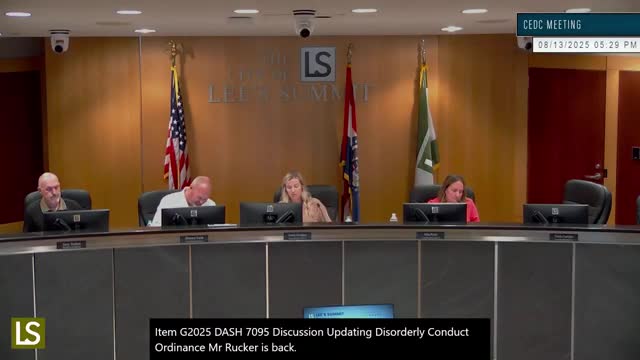
City legal staff, the prosecutor and police presented the committee with a review of disorderly conduct, drunk-in-public and prowling-related ordinances and concluded that existing city code and state-based trespass and harassment provisions cover the behaviors the committee raised.
Mr. Rucker said the focus of enforcement is not mere intoxication but “acting a fool because you're intoxicated” and emphasized that the ordinances target disruptive conduct. The packet pointed committee members to existing municipal provisions — assault, harassment, disturbing the peace and first- and second-degree trespass — and to the harassment ordinance’s reach for communications that knowingly cause emotional distress.
Police staff and the city prosecutor said officers have two routes if they see a fact pattern that is not straightforward: elevate to the chain of command or consult the prosecutor to choose the best charge. The committee heard that many nuisance concerns reported during the meeting (for example, an individual making people uncomfortable in a business) are already subject to trespass and harassment statutes when property owners ask individuals to leave and the individual refuses.
Outcome: Staff recommended no immediate ordinance changes; the committee accepted the analysis and did not direct a code amendment. Members asked staff to report back if officers identify repeat fact patterns that are not adequately addressed by existing law.
Mr. Rucker said the focus of enforcement is not mere intoxication but “acting a fool because you're intoxicated” and emphasized that the ordinances target disruptive conduct. The packet pointed committee members to existing municipal provisions — assault, harassment, disturbing the peace and first- and second-degree trespass — and to the harassment ordinance’s reach for communications that knowingly cause emotional distress.
Police staff and the city prosecutor said officers have two routes if they see a fact pattern that is not straightforward: elevate to the chain of command or consult the prosecutor to choose the best charge. The committee heard that many nuisance concerns reported during the meeting (for example, an individual making people uncomfortable in a business) are already subject to trespass and harassment statutes when property owners ask individuals to leave and the individual refuses.
Outcome: Staff recommended no immediate ordinance changes; the committee accepted the analysis and did not direct a code amendment. Members asked staff to report back if officers identify repeat fact patterns that are not adequately addressed by existing law.
View the Full Meeting & All Its Details
This article offers just a summary. Unlock complete video, transcripts, and insights as a Founder Member.
✓
Watch full, unedited meeting videos
✓
Search every word spoken in unlimited transcripts
✓
AI summaries & real-time alerts (all government levels)
✓
Permanent access to expanding government content
30-day money-back guarantee
