Attorney General: hundreds charged in Medicaid‑behavioral health investigations, large forfeitures recovered
August 18, 2025 | Health and Human Services, Senate, Committees, Legislative, Arizona
This article was created by AI summarizing key points discussed. AI makes mistakes, so for full details and context, please refer to the video of the full meeting. Please report any errors so we can fix them. Report an error »
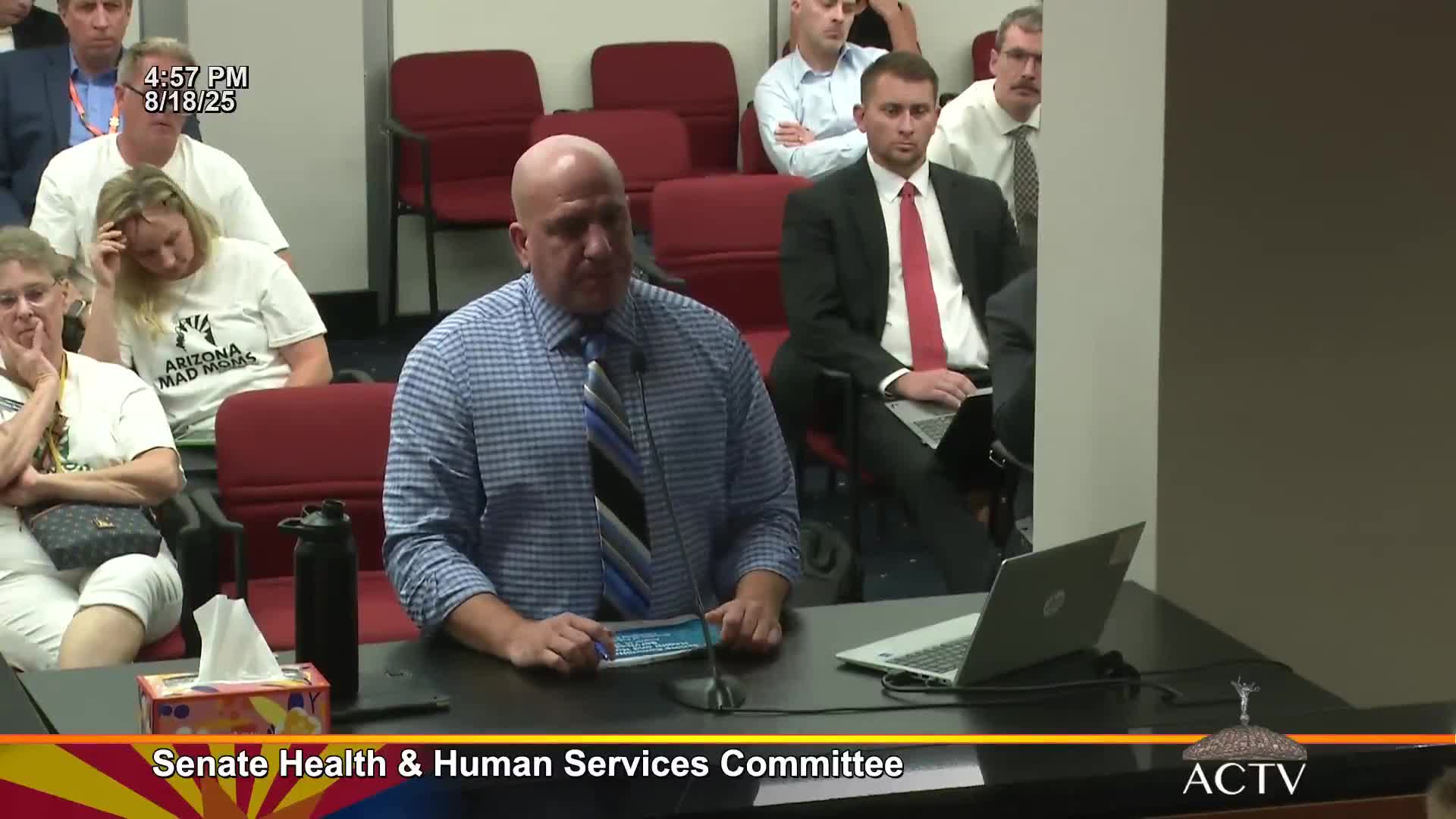
Nick Klingerman, head of the Attorney General's criminal division, told the Senate Health and Human Services Committee that the AG's Medicaid fraud unit has pursued a large national‑scale fraud network tied to behavioral health billing.
Klingerman said the office prosecutes criminal misconduct and works with federal partners and local law enforcement. "We are the only statewide, prosecuting entity in Arizona," he said, describing the state unit's role as a Medicaid fraud control unit under federal arrangements.
What the AG described
Klingerman said the office has opened scores of criminal matters related to behavioral health billing and patient brokering. He told the committee his office had charged roughly 150–160 people in behavioral‑health‑related indictments, including corporations, and said about 56 matters had been resolved by sentencing or plea. He also said law enforcement has seized cash and assets and that forfeitures have returned funds to the state: "We've seized over a $140,000,000 in cash," he said, and the office has forfeited roughly $100,000,000 to date.
Klingerman described a range of criminal conduct his investigators have documented: forged or nonexistent medical records, ghost billing (billing for patients who were not present), duplicative billing across providers, and patient brokering where recruiters received money in exchange for placing people in facilities. He described an undercover investigation that established a fictitious provider to demonstrate how brokers and facilities coordinated, and said his office has used search warrants, witness interviews and financial records to build criminal cases.
Patient brokering and outcomes
Klingerman highlighted patient brokering prosecutions and trials. He said one recent trial produced the first patient‑brokering conviction in state court under the statute noted during testimony and that the defendant received a prison sentence. He said his office has charged a large number of people for patient brokering across multiple investigations and is coordinating with federal partners and other states.
How the committee can help
Klingerman asked for continued support for staffing and investigative resources. He told the committee the unit recently received additional appropriations that are federally matched and said faster access to seized funds or adjustments to forfeiture processes would speed recovery for victims and taxpayers.
Ending
The AG's office characterized the investigations as resource intensive and dependent on witness testimony, financial forensics and interagency cooperation. Klingerman said the unit will continue investigations, prosecutions and forfeiture actions to recover public funds and hold fraud perpetrators accountable.
Klingerman said the office prosecutes criminal misconduct and works with federal partners and local law enforcement. "We are the only statewide, prosecuting entity in Arizona," he said, describing the state unit's role as a Medicaid fraud control unit under federal arrangements.
What the AG described
Klingerman said the office has opened scores of criminal matters related to behavioral health billing and patient brokering. He told the committee his office had charged roughly 150–160 people in behavioral‑health‑related indictments, including corporations, and said about 56 matters had been resolved by sentencing or plea. He also said law enforcement has seized cash and assets and that forfeitures have returned funds to the state: "We've seized over a $140,000,000 in cash," he said, and the office has forfeited roughly $100,000,000 to date.
Klingerman described a range of criminal conduct his investigators have documented: forged or nonexistent medical records, ghost billing (billing for patients who were not present), duplicative billing across providers, and patient brokering where recruiters received money in exchange for placing people in facilities. He described an undercover investigation that established a fictitious provider to demonstrate how brokers and facilities coordinated, and said his office has used search warrants, witness interviews and financial records to build criminal cases.
Patient brokering and outcomes
Klingerman highlighted patient brokering prosecutions and trials. He said one recent trial produced the first patient‑brokering conviction in state court under the statute noted during testimony and that the defendant received a prison sentence. He said his office has charged a large number of people for patient brokering across multiple investigations and is coordinating with federal partners and other states.
How the committee can help
Klingerman asked for continued support for staffing and investigative resources. He told the committee the unit recently received additional appropriations that are federally matched and said faster access to seized funds or adjustments to forfeiture processes would speed recovery for victims and taxpayers.
Ending
The AG's office characterized the investigations as resource intensive and dependent on witness testimony, financial forensics and interagency cooperation. Klingerman said the unit will continue investigations, prosecutions and forfeiture actions to recover public funds and hold fraud perpetrators accountable.
Don't Miss a Word: See the Full Meeting!
Go beyond summaries. Unlock every video, transcript, and key insight with a Founder Membership.
✓
Get instant access to full meeting videos
✓
Search and clip any phrase from complete transcripts
✓
Receive AI-powered summaries & custom alerts
✓
Enjoy lifetime, unrestricted access to government data
30-day money-back guarantee
