Arizona Department of Health Services explains licensing role and sober‑living rule changes
August 18, 2025 | Health and Human Services, Senate, Committees, Legislative, Arizona
This article was created by AI summarizing key points discussed. AI makes mistakes, so for full details and context, please refer to the video of the full meeting. Please report any errors so we can fix them. Report an error »
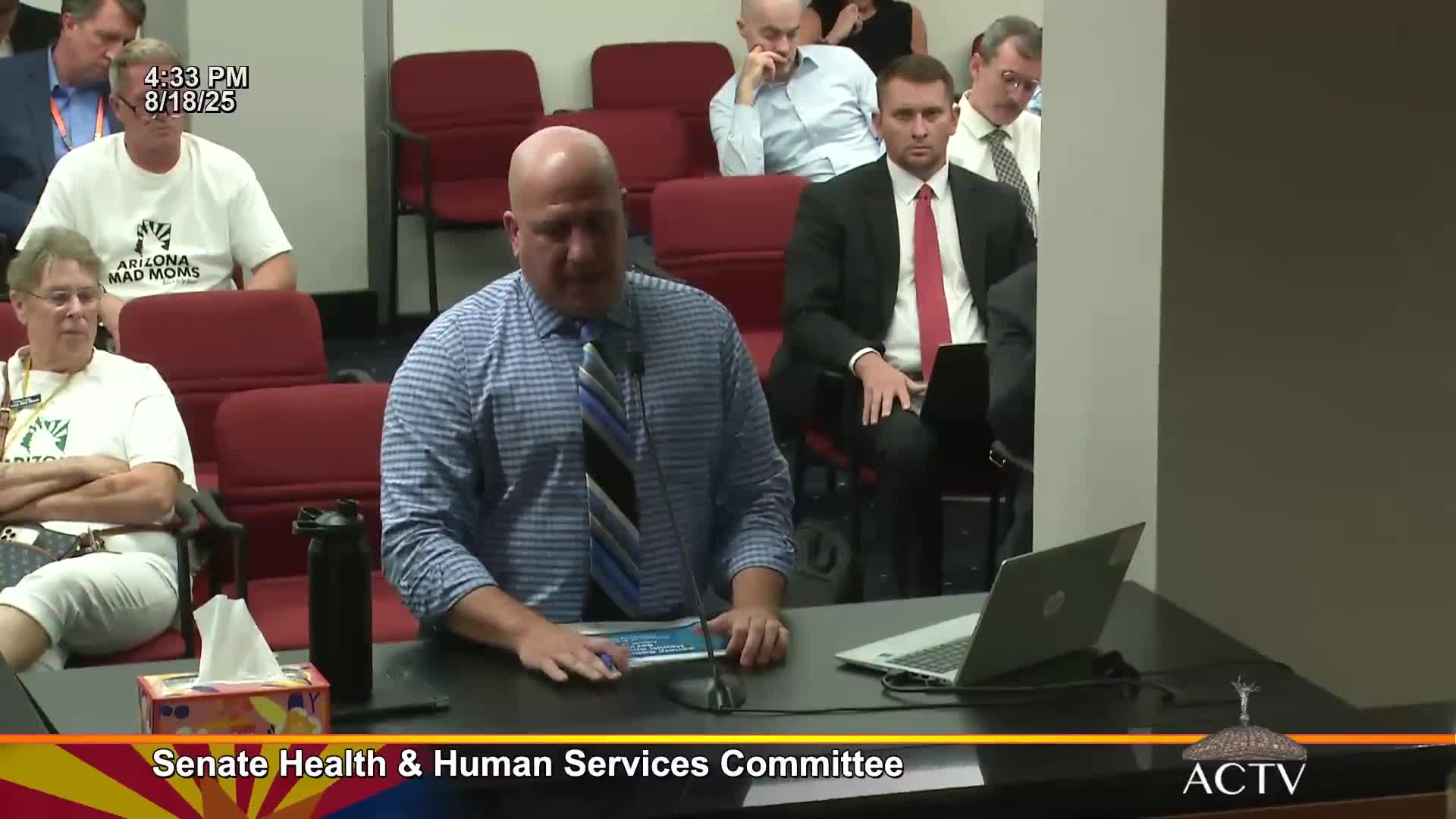
Tom Salo, assistant director for the Arizona Department of Health Services' Division of Licensing, briefed the Senate Health and Human Services Committee on how DHS licenses health care facilities, the department's inspection routines and recent statutory changes that affect sober living homes and behavioral health residential facilities.
"Everything that we do is in statute," Salo told the committee, and he outlined the department's authority and limits. He said DHS has roughly 270 employees, manages several hundred licensed behavioral health facilities of different types, and recently moved many licensing functions into an electronic licensing system to speed applications and make records public through the department's AZCareCheck site.
Key points from DHS testimony
- Licensing and application workflow: Salo said his division now performs "60–90 day touch points" with new licensees to provide technical assistance early, conducts unannounced compliance inspections (annual for most HCIs unless deficiency‑free) and posts inspection histories and enforcement actions on AZCareCheck.
- Sober living and behavioral health residential definitions: Salo described statutory changes that expand the sober‑living definition and align enforcement tools more closely with other health care institutions. The new provisions increase civil monetary penalties in some cases, add fingerprinting requirements and make certain licensing records and enforcement visible to the department; he stressed that addresses for certified sober‑living homes remain confidential by statute.
- Complaint intake and prioritization: DHS explained its intake matrix used to triage complaints, with the highest priorities (immediate jeopardy) receiving the fastest on‑site responses. Salo said complaint volume has increased markedly in recent years and that DHS uses triage and priority protocols to assign resources.
What DHS does not do
Salo told the committee DHS' licensing role is limited to health and safety and that criminal investigations and Medicaid billing oversight are outside DHS' licensing authority. He said zoning, billing fraud and criminal prosecution fall to other agencies, though DHS will investigate complaints that fall within its statutory jurisdiction and pursue administrative enforcement when the evidence supports it.
Ending
Committee members requested copies of DHS' compliance officer training materials and additional documentation about complaint volumes, enforcement outcomes and the department's Tucson and Flagstaff staffing. DHS said it could provide the committee with the requested materials and noted that the department is updating rules and processes where statute permits.
"Everything that we do is in statute," Salo told the committee, and he outlined the department's authority and limits. He said DHS has roughly 270 employees, manages several hundred licensed behavioral health facilities of different types, and recently moved many licensing functions into an electronic licensing system to speed applications and make records public through the department's AZCareCheck site.
Key points from DHS testimony
- Licensing and application workflow: Salo said his division now performs "60–90 day touch points" with new licensees to provide technical assistance early, conducts unannounced compliance inspections (annual for most HCIs unless deficiency‑free) and posts inspection histories and enforcement actions on AZCareCheck.
- Sober living and behavioral health residential definitions: Salo described statutory changes that expand the sober‑living definition and align enforcement tools more closely with other health care institutions. The new provisions increase civil monetary penalties in some cases, add fingerprinting requirements and make certain licensing records and enforcement visible to the department; he stressed that addresses for certified sober‑living homes remain confidential by statute.
- Complaint intake and prioritization: DHS explained its intake matrix used to triage complaints, with the highest priorities (immediate jeopardy) receiving the fastest on‑site responses. Salo said complaint volume has increased markedly in recent years and that DHS uses triage and priority protocols to assign resources.
What DHS does not do
Salo told the committee DHS' licensing role is limited to health and safety and that criminal investigations and Medicaid billing oversight are outside DHS' licensing authority. He said zoning, billing fraud and criminal prosecution fall to other agencies, though DHS will investigate complaints that fall within its statutory jurisdiction and pursue administrative enforcement when the evidence supports it.
Ending
Committee members requested copies of DHS' compliance officer training materials and additional documentation about complaint volumes, enforcement outcomes and the department's Tucson and Flagstaff staffing. DHS said it could provide the committee with the requested materials and noted that the department is updating rules and processes where statute permits.
Don't Miss a Word: See the Full Meeting!
Go beyond summaries. Unlock every video, transcript, and key insight with a Founder Membership.
✓
Get instant access to full meeting videos
✓
Search and clip any phrase from complete transcripts
✓
Receive AI-powered summaries & custom alerts
✓
Enjoy lifetime, unrestricted access to government data
30-day money-back guarantee
