Huntington Park pauses citywide user-fee overhaul after council questions on parking and hardship protections
August 18, 2025 | Huntington Park, Los Angeles County, California
This article was created by AI summarizing key points discussed. AI makes mistakes, so for full details and context, please refer to the video of the full meeting. Please report any errors so we can fix them. Report an error »
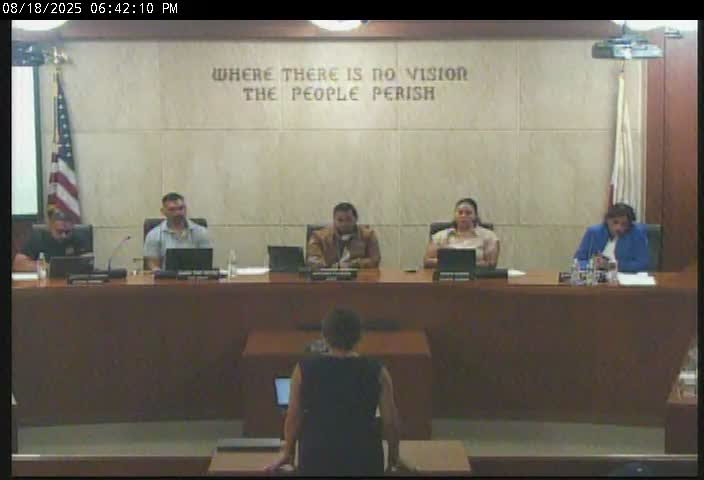
A consultant presentation and public hearing on a citywide user-fee study prompted Huntington Park council members and residents to press for more detail about specific dollar increases, hardship relief and phased implementation. After public comment and council debate, the council voted unanimously on Aug. 18 to table the item for further staff analysis.
Wheldon Financial Services presented the firm’s user-fee study and explained the methodology used to calculate “full cost” hourly rates and cost recovery for roughly a thousand fees across city departments. The consultant said the study identifies many fees that are currently subsidized by the general fund and suggested raising some fees to recover more of the operating cost, while noting that recreation and community services often remain intentionally subsidized.
The consultant summarized department-level findings: suggested increases across finance, building, planning, parks and recreation and public works; a recommended annual inflation adjustment; and a 5-year cadence for updates. “In a user fee study, there's 2 primary objectives. The first is to determine the full cost of all the services that you're providing,” the consultant said. The presentation listed example changes including a recommended average increase for certain finance fees and proposed converting some flat-fee inspections to hourly rates.
Public commenters and council members focused on parking fines and the social impact of increases. A council member noted that a parking fine in Huntington Park is currently $55 and that the consultant recommended raising it to $75; council members and public speakers urged the city to consider residents’ incomes, phased increases and hardship waivers. “If a ticket is $80 … am I paying Internet this month or am I paying this parking ticket?” one council member asked, reflecting public concern that single-step large increases could burden low-income residents.
Council members also asked for regional comparisons. The consultant said Huntington Park fees are generally low compared with many other cities and that an increase would bring fees closer to the full cost of providing services, but stressed the primary justification for a fee change must be a cost-based analysis rather than comparison with neighboring cities.
Council members and staff proposed several requests to return with changes: separate consideration for parking fees (possible phased rollout), creation of hardship or income-based waivers, veteran and senior exemptions or discounts, and use of any new revenue to fund programs that help low‑income residents access permits or services (for example, assistance for homeowners seeking ADUs). Council direction included asking staff to provide specific dollar amounts (not only percentages), to outline phased implementation options and to return with policy options for waiver or subsidy programs.
No fee changes were adopted at the Aug. 18 meeting. The council voted 5–0 to table the item while staff compiles the additional analyses and policy options requested by council members.
Wheldon Financial Services presented the firm’s user-fee study and explained the methodology used to calculate “full cost” hourly rates and cost recovery for roughly a thousand fees across city departments. The consultant said the study identifies many fees that are currently subsidized by the general fund and suggested raising some fees to recover more of the operating cost, while noting that recreation and community services often remain intentionally subsidized.
The consultant summarized department-level findings: suggested increases across finance, building, planning, parks and recreation and public works; a recommended annual inflation adjustment; and a 5-year cadence for updates. “In a user fee study, there's 2 primary objectives. The first is to determine the full cost of all the services that you're providing,” the consultant said. The presentation listed example changes including a recommended average increase for certain finance fees and proposed converting some flat-fee inspections to hourly rates.
Public commenters and council members focused on parking fines and the social impact of increases. A council member noted that a parking fine in Huntington Park is currently $55 and that the consultant recommended raising it to $75; council members and public speakers urged the city to consider residents’ incomes, phased increases and hardship waivers. “If a ticket is $80 … am I paying Internet this month or am I paying this parking ticket?” one council member asked, reflecting public concern that single-step large increases could burden low-income residents.
Council members also asked for regional comparisons. The consultant said Huntington Park fees are generally low compared with many other cities and that an increase would bring fees closer to the full cost of providing services, but stressed the primary justification for a fee change must be a cost-based analysis rather than comparison with neighboring cities.
Council members and staff proposed several requests to return with changes: separate consideration for parking fees (possible phased rollout), creation of hardship or income-based waivers, veteran and senior exemptions or discounts, and use of any new revenue to fund programs that help low‑income residents access permits or services (for example, assistance for homeowners seeking ADUs). Council direction included asking staff to provide specific dollar amounts (not only percentages), to outline phased implementation options and to return with policy options for waiver or subsidy programs.
No fee changes were adopted at the Aug. 18 meeting. The council voted 5–0 to table the item while staff compiles the additional analyses and policy options requested by council members.
Don't Miss a Word: See the Full Meeting!
Go beyond summaries. Unlock every video, transcript, and key insight with a Founder Membership.
✓
Get instant access to full meeting videos
✓
Search and clip any phrase from complete transcripts
✓
Receive AI-powered summaries & custom alerts
✓
Enjoy lifetime, unrestricted access to government data
30-day money-back guarantee
