Dearborn officials defend city�camera-sharing program after public privacy concerns
August 13, 2025 | Dearborn, Wayne County, Michigan
This article was created by AI summarizing key points discussed. AI makes mistakes, so for full details and context, please refer to the video of the full meeting. Please report any errors so we can fix them. Report an error »
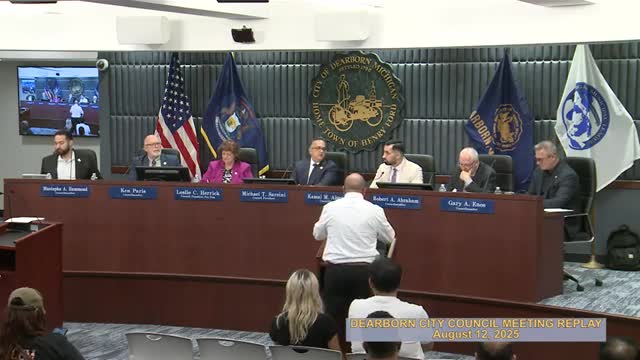
Council members and city officials defended a recently approved camera-sharing program after residents at the Aug. 12 Dearborn City Council meeting said the system could threaten privacy.
The dispute centers on FUSIS, a camera-access platform associated with Axon, the company that supplies the city's body-worn cameras. Residents and some speakers warned that linking private business and residential video feeds to police could enable pervasive surveillance; city officials said the system is voluntary, limited to live access only during emergency 911 calls and does not provide unfettered or persistent police viewing.
Why it matters: The program affects how private camera footage can be used by police during emergencies and has drawn vocal public attention in part because of broader national debates over surveillance technology.
What was said and by whom
- Resident Neji Elmodheji criticized the council for approving what he described as a "$720,000 contract with Axon/FUSIS" and asked whether there is evidence the software reduces crime, saying, "I don't wanna live in a society ... where the government ... has drones flying 24/7." (Neji Elmodheji, Resident)
- Mayor Abdullah Hammoud defended the contract and the program, saying businesses choose to opt in and that live access is only provided "when a 911 call comes in, then we get to turn on and see what's happening before we get there." He added, "If our officers are responding ... this is only a reactive" tool. (Mayor Abdullah Hammoud)
- Police Chief Lisa Shaheen said the program is not active surveillance and that "the permissions are entirely controlled by the person that voluntarily opts in," adding, "the only time we have access is when somebody's called 911 because they need our help." (Chief Lisa Shaheen)
- Councilmember Art Perez, who said he voted in favor of the contract, said he had reviewed the issue and asked for a six-month report on implementation and usage, explaining he wanted to "be thorough in my determination whether I think FUSIS would be good for the police department and the city of Dearborn." (Councilmember Art Perez)
Program scope and safeguards described in the meeting
- City officials repeatedly said the program is voluntary for private businesses and homeowners: owners must sign up to grant any access.
- Chief Shaheen and the mayor said Axon/FUSIS does not grant the city ownership of participant video, the city cannot download or permanently store feeds through the platform by default, and no facial-recognition component is part of FUSIS as described at the meeting.
- Officials framed the service as a real-time, narrowly timed aid that can provide officers with situational awareness while responding to active emergencies; they contrasted this with 24/7 city-owned camera programs.
Open questions and public concerns
Residents and speakers pressed officials on whether the system could be misused, whether data is retained, and whether the software uses any form of artificial intelligence that could be applied beyond immediate emergency response. Officials repeatedly said the system grants only short, live windows of access tied to 911 calls and that broader data access would require the usual legal steps.
Context and background
Mayor and council speakers noted Axon supplies body-worn cameras to most U.S. police departments; the mayor said FUSIS was acquired by Axon the prior year. Several speakers compared the system to other cities' programs and argued that Dearborn's approach preserves more privacy because private owners retain control over their camera feeds.
What comes next
Council members asked for ongoing updates: at least one member requested a six-month implementation report showing how many businesses signed up and how the system was used. Officials said the contract and program can be evaluated and discontinued if it does not meet expectations.
Ending note
City leaders urged residents with concerns to ask questions at public meetings and to speak directly to participating businesses if they prefer those businesses not to opt in. "If you feel that this is a surveillance aspect, go around, knock on these businesses' doors, and tell them don't sign up for it," the mayor said.
The dispute centers on FUSIS, a camera-access platform associated with Axon, the company that supplies the city's body-worn cameras. Residents and some speakers warned that linking private business and residential video feeds to police could enable pervasive surveillance; city officials said the system is voluntary, limited to live access only during emergency 911 calls and does not provide unfettered or persistent police viewing.
Why it matters: The program affects how private camera footage can be used by police during emergencies and has drawn vocal public attention in part because of broader national debates over surveillance technology.
What was said and by whom
- Resident Neji Elmodheji criticized the council for approving what he described as a "$720,000 contract with Axon/FUSIS" and asked whether there is evidence the software reduces crime, saying, "I don't wanna live in a society ... where the government ... has drones flying 24/7." (Neji Elmodheji, Resident)
- Mayor Abdullah Hammoud defended the contract and the program, saying businesses choose to opt in and that live access is only provided "when a 911 call comes in, then we get to turn on and see what's happening before we get there." He added, "If our officers are responding ... this is only a reactive" tool. (Mayor Abdullah Hammoud)
- Police Chief Lisa Shaheen said the program is not active surveillance and that "the permissions are entirely controlled by the person that voluntarily opts in," adding, "the only time we have access is when somebody's called 911 because they need our help." (Chief Lisa Shaheen)
- Councilmember Art Perez, who said he voted in favor of the contract, said he had reviewed the issue and asked for a six-month report on implementation and usage, explaining he wanted to "be thorough in my determination whether I think FUSIS would be good for the police department and the city of Dearborn." (Councilmember Art Perez)
Program scope and safeguards described in the meeting
- City officials repeatedly said the program is voluntary for private businesses and homeowners: owners must sign up to grant any access.
- Chief Shaheen and the mayor said Axon/FUSIS does not grant the city ownership of participant video, the city cannot download or permanently store feeds through the platform by default, and no facial-recognition component is part of FUSIS as described at the meeting.
- Officials framed the service as a real-time, narrowly timed aid that can provide officers with situational awareness while responding to active emergencies; they contrasted this with 24/7 city-owned camera programs.
Open questions and public concerns
Residents and speakers pressed officials on whether the system could be misused, whether data is retained, and whether the software uses any form of artificial intelligence that could be applied beyond immediate emergency response. Officials repeatedly said the system grants only short, live windows of access tied to 911 calls and that broader data access would require the usual legal steps.
Context and background
Mayor and council speakers noted Axon supplies body-worn cameras to most U.S. police departments; the mayor said FUSIS was acquired by Axon the prior year. Several speakers compared the system to other cities' programs and argued that Dearborn's approach preserves more privacy because private owners retain control over their camera feeds.
What comes next
Council members asked for ongoing updates: at least one member requested a six-month implementation report showing how many businesses signed up and how the system was used. Officials said the contract and program can be evaluated and discontinued if it does not meet expectations.
Ending note
City leaders urged residents with concerns to ask questions at public meetings and to speak directly to participating businesses if they prefer those businesses not to opt in. "If you feel that this is a surveillance aspect, go around, knock on these businesses' doors, and tell them don't sign up for it," the mayor said.
Don't Miss a Word: See the Full Meeting!
Go beyond summaries. Unlock every video, transcript, and key insight with a Founder Membership.
✓
Get instant access to full meeting videos
✓
Search and clip any phrase from complete transcripts
✓
Receive AI-powered summaries & custom alerts
✓
Enjoy lifetime, unrestricted access to government data
30-day money-back guarantee
