City officials explain limits on splitting indoor and outdoor water charges after resident inquiry
August 13, 2025 | Dearborn, Wayne County, Michigan
This article was created by AI summarizing key points discussed. AI makes mistakes, so for full details and context, please refer to the video of the full meeting. Please report any errors so we can fix them. Report an error »
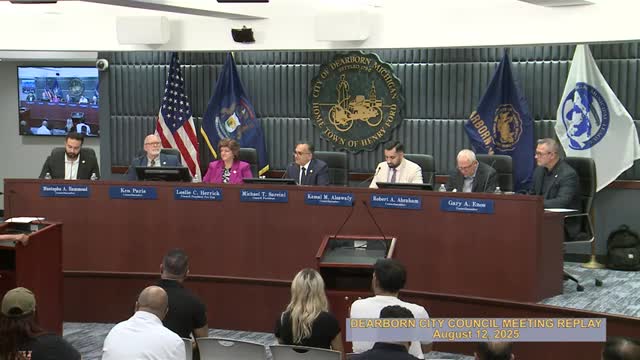
A Dearborn resident asked the City Council on Aug. 12 whether homeowners could avoid high summer sewer charges by installing a separate meter for outdoor water use; city staff replied that technical, regulatory and cost hurdles make that uncommon.
Lede: Resident Michelle Tocco asked if the city offers reduced sewer charges for summertime outdoor water use; city officials responded that state rate rules and the local water authority require charging for water provided and that separating indoor and outdoor use generally requires a separate service line and proof the water does not return to the sewer.
Nut graf: The exchange highlighted an oft-repeated municipal problem: water infrastructure and billing rules are set by state regulators and regional suppliers, and local staff have limited ability to create summer discounts when the outgoing water enters the sewer system.
Details from the meeting
- Michelle Tocco said elderly neighbors were concerned about large summer bills from outdoor watering and asked whether separate meters or discounts exist. "Is there any way that we could get discounts on that water bill for the outdoor usage?" she asked. (Michelle Tocco, Resident)
- Mayor Abdullah Hammoud and Council President Cerini replied that water rates are set by higher authorities and the city does not profit from water fees. The mayor said "the water rates are controlled by the state and by [the Great Lakes Water Authority], and we do not profit on them." (Mayor Abdullah Hammoud)
- Tim Hawkins, director of the Department of Public Works, said separate meters are possible only when a property has a separate service line for outdoor irrigation; installing a separate service typically requires bringing a new line and meter because "the line coming to your house is designed for your interior use." (Tim Hawkins, Director, Department of Public Works)
- City legal counsel added that even where separate meters existed historically, the resident still would have to demonstrate that outdoor water did not enter the city sewer system because sewage charges assume water used inside a property returns to the sewer. "You still had to demonstrate that the water use was not going back into the city sewer because that's what's assumed with the main line," the attorney said.
What officials said about policy and cost
Officials described three constraints:
- Regulatory and supplier control: the city sets rates within state and regional frameworks and does not "profit" from water fees.
- Technical/engineering limits: existing service lines were not designed for two meters; adding a second line and meter can be costly and often impractical.
- Proof of non-return: sewer charges assume incoming water becomes sewage; the burden would be on property owners to demonstrate that outdoor water does not return to sewer systems (evaporation or infiltration that avoids the sewer is difficult to certify).
What residents should do
Officials invited residents to consult with Public Works and the city's legal office for case-specific questions; Director Hawkins said the department continues to review the issue and past ordinances on separate services.
Ending: City leaders emphasized they aim to keep rates as low as feasible while complying with state and regional rules and maintaining the municipal water system.
Lede: Resident Michelle Tocco asked if the city offers reduced sewer charges for summertime outdoor water use; city officials responded that state rate rules and the local water authority require charging for water provided and that separating indoor and outdoor use generally requires a separate service line and proof the water does not return to the sewer.
Nut graf: The exchange highlighted an oft-repeated municipal problem: water infrastructure and billing rules are set by state regulators and regional suppliers, and local staff have limited ability to create summer discounts when the outgoing water enters the sewer system.
Details from the meeting
- Michelle Tocco said elderly neighbors were concerned about large summer bills from outdoor watering and asked whether separate meters or discounts exist. "Is there any way that we could get discounts on that water bill for the outdoor usage?" she asked. (Michelle Tocco, Resident)
- Mayor Abdullah Hammoud and Council President Cerini replied that water rates are set by higher authorities and the city does not profit from water fees. The mayor said "the water rates are controlled by the state and by [the Great Lakes Water Authority], and we do not profit on them." (Mayor Abdullah Hammoud)
- Tim Hawkins, director of the Department of Public Works, said separate meters are possible only when a property has a separate service line for outdoor irrigation; installing a separate service typically requires bringing a new line and meter because "the line coming to your house is designed for your interior use." (Tim Hawkins, Director, Department of Public Works)
- City legal counsel added that even where separate meters existed historically, the resident still would have to demonstrate that outdoor water did not enter the city sewer system because sewage charges assume water used inside a property returns to the sewer. "You still had to demonstrate that the water use was not going back into the city sewer because that's what's assumed with the main line," the attorney said.
What officials said about policy and cost
Officials described three constraints:
- Regulatory and supplier control: the city sets rates within state and regional frameworks and does not "profit" from water fees.
- Technical/engineering limits: existing service lines were not designed for two meters; adding a second line and meter can be costly and often impractical.
- Proof of non-return: sewer charges assume incoming water becomes sewage; the burden would be on property owners to demonstrate that outdoor water does not return to sewer systems (evaporation or infiltration that avoids the sewer is difficult to certify).
What residents should do
Officials invited residents to consult with Public Works and the city's legal office for case-specific questions; Director Hawkins said the department continues to review the issue and past ordinances on separate services.
Ending: City leaders emphasized they aim to keep rates as low as feasible while complying with state and regional rules and maintaining the municipal water system.
View the Full Meeting & All Its Details
This article offers just a summary. Unlock complete video, transcripts, and insights as a Founder Member.
✓
Watch full, unedited meeting videos
✓
Search every word spoken in unlimited transcripts
✓
AI summaries & real-time alerts (all government levels)
✓
Permanent access to expanding government content
30-day money-back guarantee
