Residents press city to resurface Lansing Avenue; officials cite funding, lead-line and FEMA mitigation work
August 13, 2025 | Dearborn, Wayne County, Michigan
This article was created by AI summarizing key points discussed. AI makes mistakes, so for full details and context, please refer to the video of the full meeting. Please report any errors so we can fix them. Report an error »
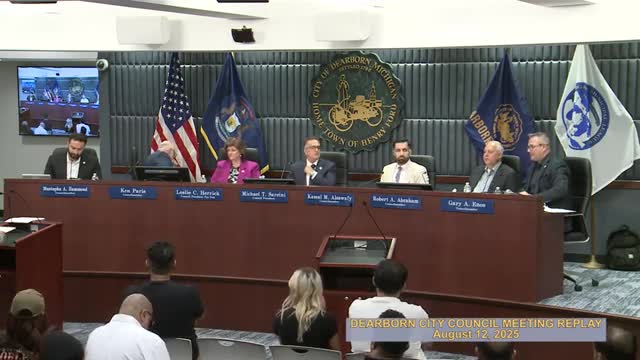
A Dearborn resident pressed the City Council on Aug. 12 to move up resurfacing of Lansing Avenue, a street he described as severely deteriorated; city staff said competing infrastructure priorities, lead service-line replacement requirements and state funding formulas forced the change.
Lede: Adib Mozap told the council Lansing Avenue (between Maple and Schaefer) is "in a very poor condition" and said residents were told the street would be resurfaced in 2025; city staff said the project was reprogrammed to 2026 after updated engineering ratings, the need to address water-main breaks and state-mandated lead-line replacements.
Nut graf: The exchange underlines a common municipal trade-off: limited road funds and expanding underground infrastructure requirements (lead-line replacement and stormwater mitigation) can delay visible repaving projects even when surface conditions appear urgent to residents.
What residents said
- "Lansing Avenue between Maple and Schaefer is in a very poor condition with enormous deep potholes," said Adib Mozap, who asked the council and administration to reconsider funding and move the project into 2025. He cited city budget documents showing a local road fund balance and said residents had been told the work would happen sooner. (Adib Mozap, Resident)
How the city explained the delay
- Tim Hawkins, director of the Department of Public Works, said the city uses a multi-factor evaluation for paving that now includes the increased frequency of water-main breaks. "The issue that we had is ... our Act 51 ... is not matching the dollar amount to replace the roads as it has been in the past," Hawkins said, adding that water-main breaks and a state-mandated program to replace lead service lines altered project priorities.
- Hawkins and the mayor explained that lead-line replacement is an unfunded state mandate administered by the Michigan Department of Environment, Great Lakes, and Energy (EGLE), and that matching underground repairs and lead-line work are often coordinated with resurfacing projects.
- The director said Lansing will be included in the work slated for 2026 and that the project timing was changed because bids and bulk projects are planned months in advance and the city must match the most pressing technical needs across neighborhoods.
Related city action: FEMA Hazard Mitigation work
- Separately on the consent agenda, the council authorized additional expenditures of $448,380 to Applied Science Inc. to complete design of four grade-protection stations as part of the city's FEMA Hazard Mitigation Grant Program response to repeated basement flooding in several neighborhoods. Public Works staff said the stations will help with modeling and mitigation and will be installed in areas impacted by prior flooding.
Clarifying details from the meeting
- Lansing Avenue: 3 lead service lines identified in the area; project pushed to 2026.
- City street fund balance (as cited by resident): $4.4 million end of prior year and projected $5.2 million this year (resident cited budget website figures during public comment).
- Water-main break frequency: staff said the city had months with as many as 60 breaks in an area and that annual totals can vary widely.
What residents can expect
The city said it will share engineering evaluations and the selection criteria used to prioritize streets. Staff also noted they are underway on large-area projects on Schaefer and Prospect that include underground improvements and that alley, catch-basin and other small-pavement repairs are being scheduled where hazards exist.
Ending: Residents pressed for faster action; staff acknowledged the surface condition but said the comprehensive engineering envelope (including underground utilities and state mandates) determines the project schedule. The council approved the consent agenda items that fund further design and mitigation work.
Lede: Adib Mozap told the council Lansing Avenue (between Maple and Schaefer) is "in a very poor condition" and said residents were told the street would be resurfaced in 2025; city staff said the project was reprogrammed to 2026 after updated engineering ratings, the need to address water-main breaks and state-mandated lead-line replacements.
Nut graf: The exchange underlines a common municipal trade-off: limited road funds and expanding underground infrastructure requirements (lead-line replacement and stormwater mitigation) can delay visible repaving projects even when surface conditions appear urgent to residents.
What residents said
- "Lansing Avenue between Maple and Schaefer is in a very poor condition with enormous deep potholes," said Adib Mozap, who asked the council and administration to reconsider funding and move the project into 2025. He cited city budget documents showing a local road fund balance and said residents had been told the work would happen sooner. (Adib Mozap, Resident)
How the city explained the delay
- Tim Hawkins, director of the Department of Public Works, said the city uses a multi-factor evaluation for paving that now includes the increased frequency of water-main breaks. "The issue that we had is ... our Act 51 ... is not matching the dollar amount to replace the roads as it has been in the past," Hawkins said, adding that water-main breaks and a state-mandated program to replace lead service lines altered project priorities.
- Hawkins and the mayor explained that lead-line replacement is an unfunded state mandate administered by the Michigan Department of Environment, Great Lakes, and Energy (EGLE), and that matching underground repairs and lead-line work are often coordinated with resurfacing projects.
- The director said Lansing will be included in the work slated for 2026 and that the project timing was changed because bids and bulk projects are planned months in advance and the city must match the most pressing technical needs across neighborhoods.
Related city action: FEMA Hazard Mitigation work
- Separately on the consent agenda, the council authorized additional expenditures of $448,380 to Applied Science Inc. to complete design of four grade-protection stations as part of the city's FEMA Hazard Mitigation Grant Program response to repeated basement flooding in several neighborhoods. Public Works staff said the stations will help with modeling and mitigation and will be installed in areas impacted by prior flooding.
Clarifying details from the meeting
- Lansing Avenue: 3 lead service lines identified in the area; project pushed to 2026.
- City street fund balance (as cited by resident): $4.4 million end of prior year and projected $5.2 million this year (resident cited budget website figures during public comment).
- Water-main break frequency: staff said the city had months with as many as 60 breaks in an area and that annual totals can vary widely.
What residents can expect
The city said it will share engineering evaluations and the selection criteria used to prioritize streets. Staff also noted they are underway on large-area projects on Schaefer and Prospect that include underground improvements and that alley, catch-basin and other small-pavement repairs are being scheduled where hazards exist.
Ending: Residents pressed for faster action; staff acknowledged the surface condition but said the comprehensive engineering envelope (including underground utilities and state mandates) determines the project schedule. The council approved the consent agenda items that fund further design and mitigation work.
View the Full Meeting & All Its Details
This article offers just a summary. Unlock complete video, transcripts, and insights as a Founder Member.
✓
Watch full, unedited meeting videos
✓
Search every word spoken in unlimited transcripts
✓
AI summaries & real-time alerts (all government levels)
✓
Permanent access to expanding government content
30-day money-back guarantee
