House Appropriations advances bill to delay Colorado AI requirements to June 30, 2026
August 25, 2025 | Appropriations, HOUSE OF REPRESENTATIVES, Committees, Legislative, Colorado
This article was created by AI summarizing key points discussed. AI makes mistakes, so for full details and context, please refer to the video of the full meeting. Please report any errors so we can fix them. Report an error »
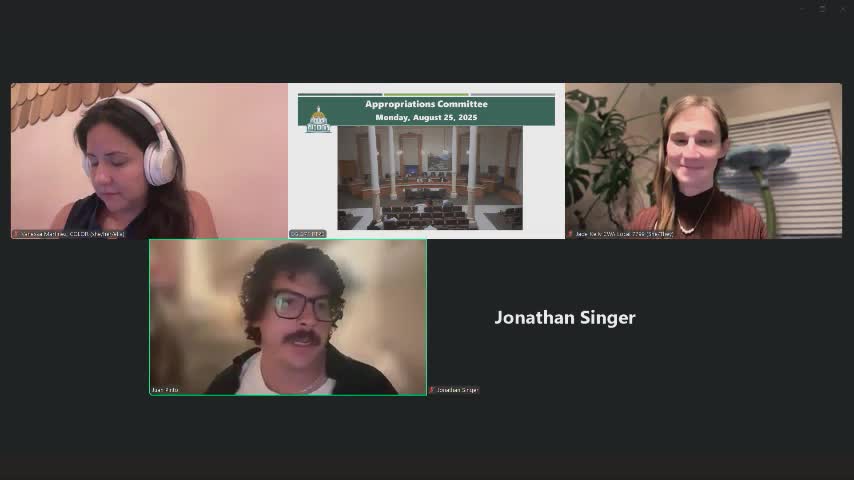
The House Appropriations Committee on Saturday voted 8-3 to advance a strike-below version of Senate Bill 4, a measure that would postpone parts of Senate Bill 24-205’s requirements from Feb. 1, 2026, to June 30, 2026.
The committee adopted Amendment L040, which the sponsor said was needed to change the bill title and remove language referencing an appropriation, and then moved the amended bill to the Committee of the Whole with a favorable recommendation. The vote on the motion to advance the bill was recorded as eight in favor and three opposed.
Senate Bill 24-205, passed in 2024, requires certain disclosures and impact assessments when automated decision systems — commonly described as AI — are used for consequential decisions such as hiring, lending and housing. Assistant Majority Leader Bacon, a House sponsor of the strike-below, told the committee the amendment before members is “a strike below to simply extend the requirements of Senate Bill 24-205 to be implemented until June 2026.” She said sponsors sought more time to negotiate shared liability between deployers (organizations that use AI) and developers (those who create it).
Bacon also described the policy aims and negotiation history: the original law ordered disclosures to users, impact assessments of deployed systems and required developers to disclose the purpose and intended scope of their systems. She said the sponsors tried but were unable to reach agreement on how to apportion liability for discriminatory outcomes between deployers and developers, and that the extension is intended to provide more time to reach that balance.
Witness testimony split along predictable lines. Representatives of school districts and education associations urged the delay so districts could finish implementation and community engagement. Matt Cook, representing the Colorado Association of School Boards, said CASB supports the bill “as amended” and asked the committee for a yes vote, saying additional time will allow districts to engage with communities and lawmakers.
Several consumer- and civil-rights-oriented witnesses pushed the committee to keep the original transparency and accountability provisions intact. Serena O’Duro, policy manager at Data & Society Research Institute, said she was “disappointed that SB 4 has been severely weakened into a date extension” and called for the original AI Sunshine Act provisions, noting the draft would channel enforcement through the Colorado Consumer Protection Act and would not create a private right of action.
Workers’ and community advocates voiced strong opposition to delay. Jade Kelly, president of Communications Workers of America Local 7799, testified in a neutral-to-opposed posture toward the strike-below and urged lawmakers not to delay protections for people the union represents, saying tech surveillance and harms are “not hypothetical” and are already affecting marginalized groups. Jonathan Singer of the Boulder Chamber of Commerce and business groups urged caution and supported the delay in part, saying companies have raised implementation concerns and some employers are reconsidering investment decisions because of the statute’s immediate requirements.
Technical and academic testimony underscored the challenges of bias and verification. Jed Brown, associate professor of computer science at CU Boulder, described efforts in Amsterdam to detect and correct algorithmic bias and argued that the original transparency and verification requirements provide a minimum level of scrutiny that governments should adopt.
Representative Janet Titone, who said she had been a prime sponsor and later removed her name, opposed moving the amended bill forward and criticized the process, saying the negotiations collapsed when major technology companies rejected liability proposals. She said she would vote against the amended measure because it “kicks the can down the road.”
Committee action: Amendment L040 was moved by the vice chair and seconded; members raised no objections and the amendment was adopted by voice vote. Representative Velasco seconded the motion to send the bill to the Committee of the Whole; the recorded roll call on that motion showed eight votes in favor and three opposed (Tatone, Weinberg and the chair recorded as voting no), and the clerk declared the bill passed to the Committee of the Whole.
The strike-below before the committee removes the prior bill text and replaces it with language that changes the implementation date from Feb. 1, 2026, to June 30, 2026, and drops references to an appropriation. Committee and panel testimony repeatedly noted disagreement over how liability for discriminatory outcomes should be allocated between deployers and developers, and several witnesses said the delay should be used to keep the core disclosure and accountability principles of SB 24-205 in place rather than to repeal them.
What’s next: The bill, as amended, will go to the Committee of the Whole for further consideration. If enacted, the strike-below would not repeal SB 24-205 but would postpone the law’s implementation date to give lawmakers and stakeholders more time to negotiate remaining issues, including liability-sharing protocols and implementation timelines.
Votes at a glance: The committee adopted Amendment L040 (no recorded roll call) and voted 8–3 to move Senate Bill 4, as amended, to the Committee of the Whole with a favorable recommendation.
The committee adopted Amendment L040, which the sponsor said was needed to change the bill title and remove language referencing an appropriation, and then moved the amended bill to the Committee of the Whole with a favorable recommendation. The vote on the motion to advance the bill was recorded as eight in favor and three opposed.
Senate Bill 24-205, passed in 2024, requires certain disclosures and impact assessments when automated decision systems — commonly described as AI — are used for consequential decisions such as hiring, lending and housing. Assistant Majority Leader Bacon, a House sponsor of the strike-below, told the committee the amendment before members is “a strike below to simply extend the requirements of Senate Bill 24-205 to be implemented until June 2026.” She said sponsors sought more time to negotiate shared liability between deployers (organizations that use AI) and developers (those who create it).
Bacon also described the policy aims and negotiation history: the original law ordered disclosures to users, impact assessments of deployed systems and required developers to disclose the purpose and intended scope of their systems. She said the sponsors tried but were unable to reach agreement on how to apportion liability for discriminatory outcomes between deployers and developers, and that the extension is intended to provide more time to reach that balance.
Witness testimony split along predictable lines. Representatives of school districts and education associations urged the delay so districts could finish implementation and community engagement. Matt Cook, representing the Colorado Association of School Boards, said CASB supports the bill “as amended” and asked the committee for a yes vote, saying additional time will allow districts to engage with communities and lawmakers.
Several consumer- and civil-rights-oriented witnesses pushed the committee to keep the original transparency and accountability provisions intact. Serena O’Duro, policy manager at Data & Society Research Institute, said she was “disappointed that SB 4 has been severely weakened into a date extension” and called for the original AI Sunshine Act provisions, noting the draft would channel enforcement through the Colorado Consumer Protection Act and would not create a private right of action.
Workers’ and community advocates voiced strong opposition to delay. Jade Kelly, president of Communications Workers of America Local 7799, testified in a neutral-to-opposed posture toward the strike-below and urged lawmakers not to delay protections for people the union represents, saying tech surveillance and harms are “not hypothetical” and are already affecting marginalized groups. Jonathan Singer of the Boulder Chamber of Commerce and business groups urged caution and supported the delay in part, saying companies have raised implementation concerns and some employers are reconsidering investment decisions because of the statute’s immediate requirements.
Technical and academic testimony underscored the challenges of bias and verification. Jed Brown, associate professor of computer science at CU Boulder, described efforts in Amsterdam to detect and correct algorithmic bias and argued that the original transparency and verification requirements provide a minimum level of scrutiny that governments should adopt.
Representative Janet Titone, who said she had been a prime sponsor and later removed her name, opposed moving the amended bill forward and criticized the process, saying the negotiations collapsed when major technology companies rejected liability proposals. She said she would vote against the amended measure because it “kicks the can down the road.”
Committee action: Amendment L040 was moved by the vice chair and seconded; members raised no objections and the amendment was adopted by voice vote. Representative Velasco seconded the motion to send the bill to the Committee of the Whole; the recorded roll call on that motion showed eight votes in favor and three opposed (Tatone, Weinberg and the chair recorded as voting no), and the clerk declared the bill passed to the Committee of the Whole.
The strike-below before the committee removes the prior bill text and replaces it with language that changes the implementation date from Feb. 1, 2026, to June 30, 2026, and drops references to an appropriation. Committee and panel testimony repeatedly noted disagreement over how liability for discriminatory outcomes should be allocated between deployers and developers, and several witnesses said the delay should be used to keep the core disclosure and accountability principles of SB 24-205 in place rather than to repeal them.
What’s next: The bill, as amended, will go to the Committee of the Whole for further consideration. If enacted, the strike-below would not repeal SB 24-205 but would postpone the law’s implementation date to give lawmakers and stakeholders more time to negotiate remaining issues, including liability-sharing protocols and implementation timelines.
Votes at a glance: The committee adopted Amendment L040 (no recorded roll call) and voted 8–3 to move Senate Bill 4, as amended, to the Committee of the Whole with a favorable recommendation.
View the Full Meeting & All Its Details
This article offers just a summary. Unlock complete video, transcripts, and insights as a Founder Member.
✓
Watch full, unedited meeting videos
✓
Search every word spoken in unlimited transcripts
✓
AI summaries & real-time alerts (all government levels)
✓
Permanent access to expanding government content
30-day money-back guarantee
