Council approves capacity study for wastewater plant amid Caledonia Spirits request; state loan subsidy covers half
August 28, 2025 | Montpelier City, Washington County, Vermont
This article was created by AI summarizing key points discussed. AI makes mistakes, so for full details and context, please refer to the video of the full meeting. Please report any errors so we can fix them. Report an error »
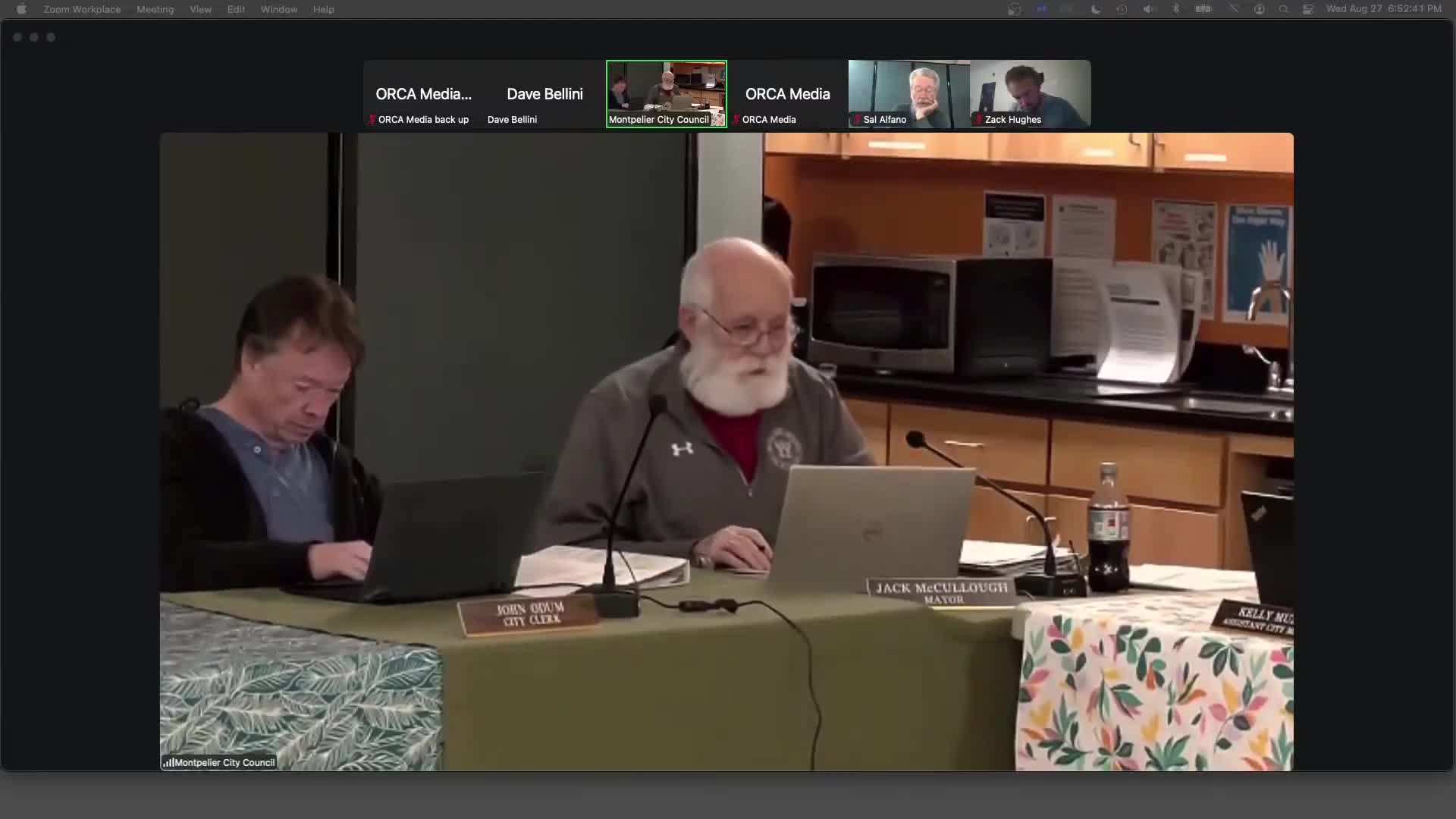
The Montpelier City Council approved Aug. 26 a capacity study to assess how much organic loading the city’s wastewater treatment plant can accept before upgrades are required. Staff said the study is prompted in part by a request from local distillery Caledonia Spirits for additional organic allocation.
Why it matters: The plant has ample hydraulic capacity but the city needs an up‑to‑date measurement of biological/organic capacity before granting allocations to industrial users or approving expanded hauled waste receipt. Knowing organic capacity affects decisions on economic development, hauled leachate revenue and residential growth planning.
Public Works Director Monica (presenting) said the plant’s average flow is about 2,000,000 gallons per day and the plant has handled flows over 10,000,000 gallons per day without hydraulic limits; the outstanding question is biological oxygen demand and the plant’s ability to treat higher-strength organics. The last study dated to the early 1980s and staff said upgrades since then make the permit‑rated capacity unclear.
Finance and utilities staff explained funding: the study qualifies as a preliminary engineering report under the State Clean Water Revolving Loan Fund. The state provides a subsidy for such projects (up to $100,000 or 50% in some cases), meaning about half the contract would be forgiven; staff estimated the forgivable portion at roughly $75,000 and the city’s share would be the remaining half, to be financed at favorable loan terms (staff indicated about 1% over 20 years for typical loans).
Councilor Jim asked why the study was being advanced now; staff said the distillery request was a proximate driver but the study is broadly useful to evaluate competing future uses of organic capacity, including housing growth and hauled leachate. Council approved the contract to proceed with the study by voice vote.
Ending: Staff will execute the contract under the revolving‑loan program, proceed with the preliminary engineering/capacity study, and return with findings to inform allocation and future project planning.
Why it matters: The plant has ample hydraulic capacity but the city needs an up‑to‑date measurement of biological/organic capacity before granting allocations to industrial users or approving expanded hauled waste receipt. Knowing organic capacity affects decisions on economic development, hauled leachate revenue and residential growth planning.
Public Works Director Monica (presenting) said the plant’s average flow is about 2,000,000 gallons per day and the plant has handled flows over 10,000,000 gallons per day without hydraulic limits; the outstanding question is biological oxygen demand and the plant’s ability to treat higher-strength organics. The last study dated to the early 1980s and staff said upgrades since then make the permit‑rated capacity unclear.
Finance and utilities staff explained funding: the study qualifies as a preliminary engineering report under the State Clean Water Revolving Loan Fund. The state provides a subsidy for such projects (up to $100,000 or 50% in some cases), meaning about half the contract would be forgiven; staff estimated the forgivable portion at roughly $75,000 and the city’s share would be the remaining half, to be financed at favorable loan terms (staff indicated about 1% over 20 years for typical loans).
Councilor Jim asked why the study was being advanced now; staff said the distillery request was a proximate driver but the study is broadly useful to evaluate competing future uses of organic capacity, including housing growth and hauled leachate. Council approved the contract to proceed with the study by voice vote.
Ending: Staff will execute the contract under the revolving‑loan program, proceed with the preliminary engineering/capacity study, and return with findings to inform allocation and future project planning.
Don't Miss a Word: See the Full Meeting!
Go beyond summaries. Unlock every video, transcript, and key insight with a Founder Membership.
✓
Get instant access to full meeting videos
✓
Search and clip any phrase from complete transcripts
✓
Receive AI-powered summaries & custom alerts
✓
Enjoy lifetime, unrestricted access to government data
30-day money-back guarantee
