State emergency managers urge new regional capacity for post‑fire watershed recovery
July 02, 2025 | Water & Natural Resources, Interim, Committees, Legislative, New Mexico
This article was created by AI summarizing key points discussed. AI makes mistakes, so for full details and context, please refer to the video of the full meeting. Please report any errors so we can fix them. Report an error »
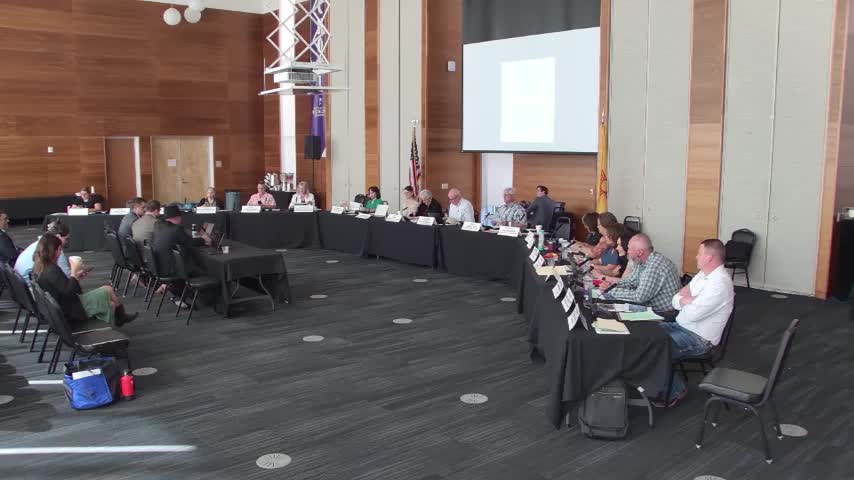
New Mexico emergency managers told the House Water & Natural Resources Committee that the state needs sustained funding and regional capacity to respond to cascading hazards that follow large wildfires: post‑fire debris flows, sediment movement and increased flood risk.
“Fire and water do not know jurisdictional boundaries,” Dr. Jeremy Kloss of the New Mexico Department of Homeland Security and Emergency Management said. He told lawmakers that federal programs are often structured around single hazards and federal boundaries, leaving state and local agencies responsible for cross‑jurisdictional post‑fire impacts.
Kloss said DHSEM uses federal Burned Area Emergency Response (BAER) and USGS debris‑flow maps where they apply, and that his office builds “common operating pictures” — geospatial layers that help identify priority areas and pinch points from the top of a watershed to downstream infrastructure. Those tools inform mitigation projects funded in part with FEMA hazard mitigation grants (HMGP), he said.
Kloss described a recent pilot method approved by FEMA that uses drones, LiDAR and point‑cloud analysis to identify hazardous standing trees across burned landscapes — a faster, lower‑cost alternative to manually tagging every tree for federal public assistance projects. “We shot a laser down through the tree canopy and did point clouds … we actually identified all individual trees,” he said, adding that FEMA’s acceptance should make large‑scale hazardous‑tree projects more feasible.
Kloss also warned of shrinking recovery windows and limits in federal assistance: Fire Management Assistance Grants and other federal reimbursements can be slow, and some federal programs do not fund private‑property debris removal. DHSEM officials said they have integrated incident management teams, State Forestry, The Nature Conservancy and local emergency managers to speed early burn‑severity mapping and pre‑position assets such as sandbags and swift‑water teams.
Committee members asked about whether the U.S. Forest Service could be engaged to provide sawyer crews; Kloss said federal funding rules and matching constraints make using federal crews complicated for some projects and that “we're gonna have to develop” regional or state vehicles to coordinate across authorities.
Kloss closed by urging a regional network and a sustained state practitioner network to avoid leaving states holding recovery responsibilities if federal attention and funding diminish.
“Fire and water do not know jurisdictional boundaries,” Dr. Jeremy Kloss of the New Mexico Department of Homeland Security and Emergency Management said. He told lawmakers that federal programs are often structured around single hazards and federal boundaries, leaving state and local agencies responsible for cross‑jurisdictional post‑fire impacts.
Kloss said DHSEM uses federal Burned Area Emergency Response (BAER) and USGS debris‑flow maps where they apply, and that his office builds “common operating pictures” — geospatial layers that help identify priority areas and pinch points from the top of a watershed to downstream infrastructure. Those tools inform mitigation projects funded in part with FEMA hazard mitigation grants (HMGP), he said.
Kloss described a recent pilot method approved by FEMA that uses drones, LiDAR and point‑cloud analysis to identify hazardous standing trees across burned landscapes — a faster, lower‑cost alternative to manually tagging every tree for federal public assistance projects. “We shot a laser down through the tree canopy and did point clouds … we actually identified all individual trees,” he said, adding that FEMA’s acceptance should make large‑scale hazardous‑tree projects more feasible.
Kloss also warned of shrinking recovery windows and limits in federal assistance: Fire Management Assistance Grants and other federal reimbursements can be slow, and some federal programs do not fund private‑property debris removal. DHSEM officials said they have integrated incident management teams, State Forestry, The Nature Conservancy and local emergency managers to speed early burn‑severity mapping and pre‑position assets such as sandbags and swift‑water teams.
Committee members asked about whether the U.S. Forest Service could be engaged to provide sawyer crews; Kloss said federal funding rules and matching constraints make using federal crews complicated for some projects and that “we're gonna have to develop” regional or state vehicles to coordinate across authorities.
Kloss closed by urging a regional network and a sustained state practitioner network to avoid leaving states holding recovery responsibilities if federal attention and funding diminish.
Don't Miss a Word: See the Full Meeting!
Go beyond summaries. Unlock every video, transcript, and key insight with a Founder Membership.
✓
Get instant access to full meeting videos
✓
Search and clip any phrase from complete transcripts
✓
Receive AI-powered summaries & custom alerts
✓
Enjoy lifetime, unrestricted access to government data
30-day money-back guarantee
