Loudon officials and New Hampshire Motor Speedway debate demo-ride safety, marshal requirement and permit process
September 04, 2025 | Loudon, Merrimack County , New Hampshire
This article was created by AI summarizing key points discussed. AI makes mistakes, so for full details and context, please refer to the video of the full meeting. Please report any errors so we can fix them. Report an error »
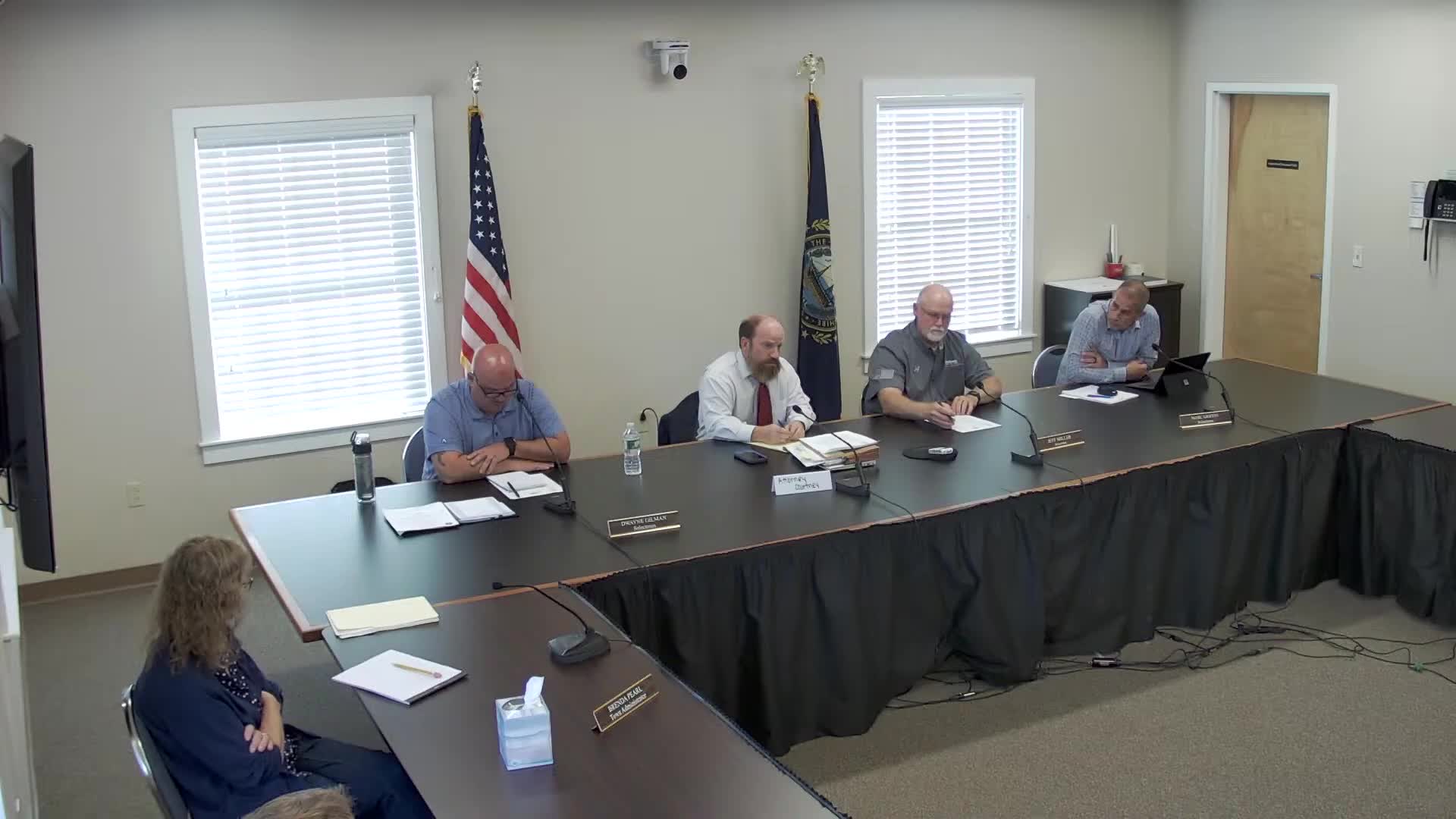
Loudon Board of Selectmen members met with representatives from New Hampshire Motor Speedway on Sept. 3 to discuss safety concerns, permitting and public communication tied to the track’s motorcycle demo rides during bike week. The town sought clarification about a permit condition that would require marshals on demo rides; Speedway officials said vendors would not participate if marshals were mandatory.
Why it matters: the demo rides traverse town roads and residents on Lower Ridge Road and Route 106 have raised safety and driveway-visibility concerns. The permit conditions the selectmen can add to a special permit could affect whether vendors such as Harley-Davidson and Indian participate, and therefore could have economic impacts for the speedway and Loudon.
The meeting opened with town leaders saying three topics were on the table: the demo-ride marshal requirement, emergency-services fees, and permits for flat-track and fireworks. The discussion focused on the marshal condition placed on a special-event/hawkers-and-peddlers permit and competing views of the public-safety data that led the town to add the condition.
David McGrath, general manager of New Hampshire Motor Speedway, and Matt Goslant, the track’s vice president of operations, told the board the demo-ride program has run for 12 years and that major vendors would stop participating if marshals were required. McGrath said, “better than 90% of the motorcycles rolling into our property and being packed are heavy baggers by experienced riders who get off and wanna ride the latest new Harley Davidson.” He and other Speedway representatives said education and enforcement, not a marshal mandate, were the best ways to address safety concerns.
Dan Flanders, Chief of Police, disputed some of the Speedway’s framing and described the department’s enforcement work during demo rides. “In this year, 2025, the Loudoun Police Department was much more heavy handed in handing out citations. And that was a direct order from me,” Flanders said, adding the department concentrated stops and citations during demo-ride hours and collected speed data.
Town and Speedway witnesses disagreed about the event statistics cited in a June 19 town letter. A Speedway attorney and representatives said year-to-year totals for the entire motorcycle week were broadly consistent (the transcript records their comments listing totals they attributed to prior event weeks). The police chief said his department’s internal count—conducted during demo-ride hours and verified by license plate—identified the bulk of the stops as directly tied to the demo rides and that the 2025 enforcement effort produced more citations than prior years because of an explicit enforcement directive.
The parties also debated the basis for the town’s authority to add conditions. Town officials said the special application flows through the fire chief, police chief, road agent, planning and zoning representatives and the selectmen at a board-of-permit meeting and that town ordinances for hawkers and peddlers and the board-of-permit procedures permit the selectmen to add reasonable conditions to permits. Speedway representatives said their special-event form was intended mainly to cover hawkers-and-peddlers fees and inspections and was not meant to act as a permissions gate for on-track operations.
Both sides agreed that communication had been insufficient in the months leading up to the event. The selectmen said they received the permit after the 30-day review window in the town ordinance; Speedway representatives said they submit an annual calendar of events early each year and that the particular condition in the June letter arrived halfway through bike week. As an immediate next step, the parties agreed to pursue a follow-up process focused on public-safety measures that do not depend on the marshal requirement: additional enforcement, signage, citation notification to vendors, and a planned meeting between the police chief and Speedway operations staff.
The board did not vote to remove or keep the marshal condition at the meeting. Instead, selectmen signaled they would reconsider the condition for the 2026 season after a focused follow-up with public-safety officials and Speedway representatives. The board and the Speedway also agreed to improve lines of communication going forward.
The selectmen took a separate, routine motion at the end of the meeting to adjourn.
Why it matters: the demo rides traverse town roads and residents on Lower Ridge Road and Route 106 have raised safety and driveway-visibility concerns. The permit conditions the selectmen can add to a special permit could affect whether vendors such as Harley-Davidson and Indian participate, and therefore could have economic impacts for the speedway and Loudon.
The meeting opened with town leaders saying three topics were on the table: the demo-ride marshal requirement, emergency-services fees, and permits for flat-track and fireworks. The discussion focused on the marshal condition placed on a special-event/hawkers-and-peddlers permit and competing views of the public-safety data that led the town to add the condition.
David McGrath, general manager of New Hampshire Motor Speedway, and Matt Goslant, the track’s vice president of operations, told the board the demo-ride program has run for 12 years and that major vendors would stop participating if marshals were required. McGrath said, “better than 90% of the motorcycles rolling into our property and being packed are heavy baggers by experienced riders who get off and wanna ride the latest new Harley Davidson.” He and other Speedway representatives said education and enforcement, not a marshal mandate, were the best ways to address safety concerns.
Dan Flanders, Chief of Police, disputed some of the Speedway’s framing and described the department’s enforcement work during demo rides. “In this year, 2025, the Loudoun Police Department was much more heavy handed in handing out citations. And that was a direct order from me,” Flanders said, adding the department concentrated stops and citations during demo-ride hours and collected speed data.
Town and Speedway witnesses disagreed about the event statistics cited in a June 19 town letter. A Speedway attorney and representatives said year-to-year totals for the entire motorcycle week were broadly consistent (the transcript records their comments listing totals they attributed to prior event weeks). The police chief said his department’s internal count—conducted during demo-ride hours and verified by license plate—identified the bulk of the stops as directly tied to the demo rides and that the 2025 enforcement effort produced more citations than prior years because of an explicit enforcement directive.
The parties also debated the basis for the town’s authority to add conditions. Town officials said the special application flows through the fire chief, police chief, road agent, planning and zoning representatives and the selectmen at a board-of-permit meeting and that town ordinances for hawkers and peddlers and the board-of-permit procedures permit the selectmen to add reasonable conditions to permits. Speedway representatives said their special-event form was intended mainly to cover hawkers-and-peddlers fees and inspections and was not meant to act as a permissions gate for on-track operations.
Both sides agreed that communication had been insufficient in the months leading up to the event. The selectmen said they received the permit after the 30-day review window in the town ordinance; Speedway representatives said they submit an annual calendar of events early each year and that the particular condition in the June letter arrived halfway through bike week. As an immediate next step, the parties agreed to pursue a follow-up process focused on public-safety measures that do not depend on the marshal requirement: additional enforcement, signage, citation notification to vendors, and a planned meeting between the police chief and Speedway operations staff.
The board did not vote to remove or keep the marshal condition at the meeting. Instead, selectmen signaled they would reconsider the condition for the 2026 season after a focused follow-up with public-safety officials and Speedway representatives. The board and the Speedway also agreed to improve lines of communication going forward.
The selectmen took a separate, routine motion at the end of the meeting to adjourn.
Don't Miss a Word: See the Full Meeting!
Go beyond summaries. Unlock every video, transcript, and key insight with a Founder Membership.
✓
Get instant access to full meeting videos
✓
Search and clip any phrase from complete transcripts
✓
Receive AI-powered summaries & custom alerts
✓
Enjoy lifetime, unrestricted access to government data
30-day money-back guarantee
