Brighton council approves reimbursement agreement for Bromley Farms, tying developer payback to impact fees
August 19, 2025 | Brighton, Adams County, Colorado
This article was created by AI summarizing key points discussed. AI makes mistakes, so for full details and context, please refer to the video of the full meeting. Please report any errors so we can fix them. Report an error »
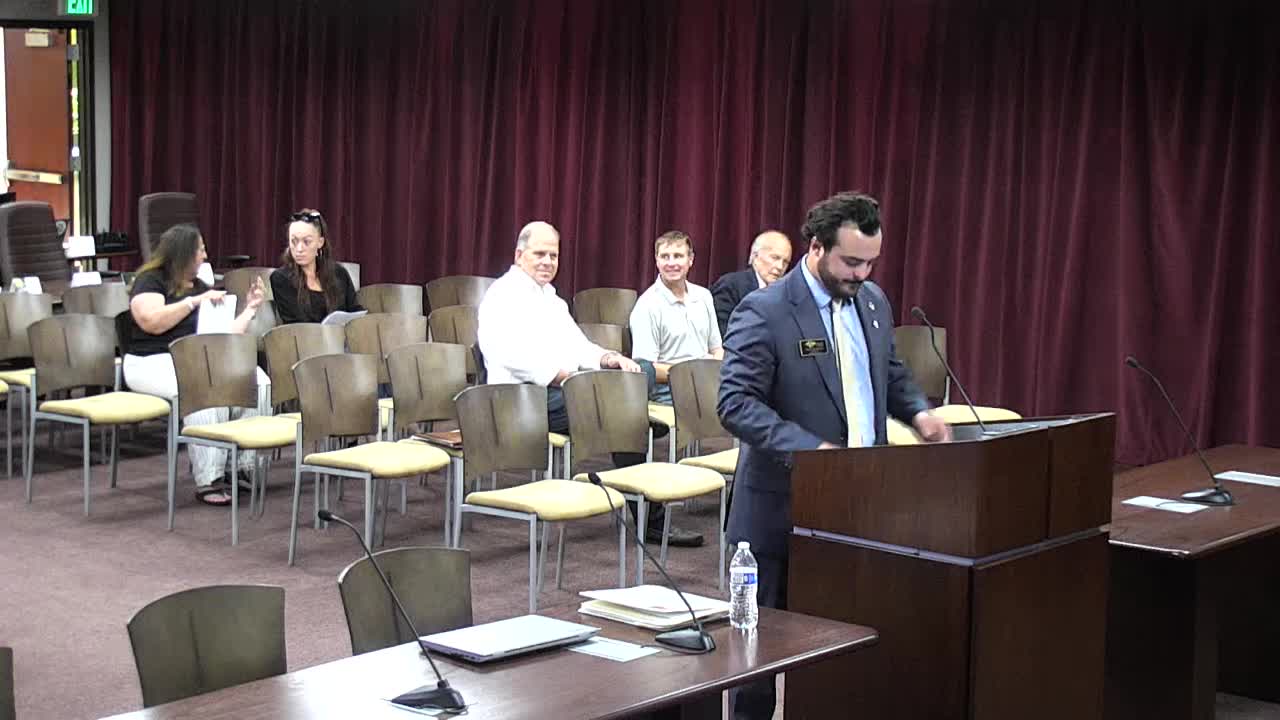
Senior Planner Nick DeMario presented a construction and reimbursement agreement for the Bromley Farms subdivision (about 139.79 acres) on Aug. 19, 2025. The agreement requires the developer to design and construct several off‑site improvements and allows the city to reimburse the developer from specified development impact fees up to certain limits. Council voted 8‑0 to approve the resolution.
What the agreement covers: The developer will design and construct improvements including portions of Bromley Lane adjacent to city properties, Chambers Road south of the site, a traffic signal at South 15th Avenue and Bromley Lane (city to reimburse 50% of the cost), a regional stormwater outfall with reimbursement by percentage for segments adjacent to city responsibilities, a pond between the historic farm and the Oasis (city reimbursement: 6% of design/construction costs), trail connections to the Oasis, a pedestrian bridge across a ditch on Chambers Road, and activation improvements within dedicated open space including soft trails and a dog park.
Funding and limits: Reimbursements are limited to the actual cost of the improvements or the total impact fees collected for the stated fee categories, whichever is less. The agreement ties reimbursement to three impact fees: community and neighborhood park impact fee, transportation and multimodal impact fee, and storm drainage impact fee. DeMario estimated the property will generate roughly $3,000,000 in park impact fees, $2,600,000 in transportation impact fees and $2,700,000 in storm drainage impact fees (about $8.4 million total in those fee categories). He emphasized that reimbursement must be “like for like”: storm drainage impact fees can only reimburse storm drainage improvements, park fees only park improvements, and so on.
Process and timing: Reimbursement begins after final acceptance of improvements; developers can request reimbursement quarterly and the city must remit payment within 45 days. The agreement will expire seven years after release of the first construction permit or when reimbursements and impact fees are exhausted, whichever occurs first.
Council discussion and clarifications: Mayor Pro Tem Diaz and Council Member Green asked how off‑site elements were determined appropriate for reimbursement; staff and the applicant said the improvements were regional in nature and necessary to avoid future piecemeal capital projects. Council Member Snyder asked about construction timing restrictions for a contentious storm outfall section; applicant representative Jack Hoagland said the easement agreement requires construction be limited to November–March to avoid interfering with nearby farm operations and that the court‑granted easement remains in place.
Motion and vote: Council Member Fidler moved to approve Item 9b; Council Member Snyder seconded. The motion passed on roll call, 8‑0.
Why it matters: The agreement lets the city accelerate regional infrastructure improvements that would otherwise be deferred, while restricting reimbursements to fees collected for the same purpose. The limits and the 45‑day remittance requirement establish an explicit schedule and cap for city payments, and the seven‑year expiration sets a time window for developer reimbursement requests.
Ending: The agreement requires the developer to construct and the city to reimburse eligible off‑site improvements to address transportation, drainage and park connectivity in the area; the reimbursement model relies on impact fee revenue streams rather than general fund dollars.
What the agreement covers: The developer will design and construct improvements including portions of Bromley Lane adjacent to city properties, Chambers Road south of the site, a traffic signal at South 15th Avenue and Bromley Lane (city to reimburse 50% of the cost), a regional stormwater outfall with reimbursement by percentage for segments adjacent to city responsibilities, a pond between the historic farm and the Oasis (city reimbursement: 6% of design/construction costs), trail connections to the Oasis, a pedestrian bridge across a ditch on Chambers Road, and activation improvements within dedicated open space including soft trails and a dog park.
Funding and limits: Reimbursements are limited to the actual cost of the improvements or the total impact fees collected for the stated fee categories, whichever is less. The agreement ties reimbursement to three impact fees: community and neighborhood park impact fee, transportation and multimodal impact fee, and storm drainage impact fee. DeMario estimated the property will generate roughly $3,000,000 in park impact fees, $2,600,000 in transportation impact fees and $2,700,000 in storm drainage impact fees (about $8.4 million total in those fee categories). He emphasized that reimbursement must be “like for like”: storm drainage impact fees can only reimburse storm drainage improvements, park fees only park improvements, and so on.
Process and timing: Reimbursement begins after final acceptance of improvements; developers can request reimbursement quarterly and the city must remit payment within 45 days. The agreement will expire seven years after release of the first construction permit or when reimbursements and impact fees are exhausted, whichever occurs first.
Council discussion and clarifications: Mayor Pro Tem Diaz and Council Member Green asked how off‑site elements were determined appropriate for reimbursement; staff and the applicant said the improvements were regional in nature and necessary to avoid future piecemeal capital projects. Council Member Snyder asked about construction timing restrictions for a contentious storm outfall section; applicant representative Jack Hoagland said the easement agreement requires construction be limited to November–March to avoid interfering with nearby farm operations and that the court‑granted easement remains in place.
Motion and vote: Council Member Fidler moved to approve Item 9b; Council Member Snyder seconded. The motion passed on roll call, 8‑0.
Why it matters: The agreement lets the city accelerate regional infrastructure improvements that would otherwise be deferred, while restricting reimbursements to fees collected for the same purpose. The limits and the 45‑day remittance requirement establish an explicit schedule and cap for city payments, and the seven‑year expiration sets a time window for developer reimbursement requests.
Ending: The agreement requires the developer to construct and the city to reimburse eligible off‑site improvements to address transportation, drainage and park connectivity in the area; the reimbursement model relies on impact fee revenue streams rather than general fund dollars.
View the Full Meeting & All Its Details
This article offers just a summary. Unlock complete video, transcripts, and insights as a Founder Member.
✓
Watch full, unedited meeting videos
✓
Search every word spoken in unlimited transcripts
✓
AI summaries & real-time alerts (all government levels)
✓
Permanent access to expanding government content
30-day money-back guarantee
