Council hears wide-ranging concerns and staff briefing on "missing middle" housing study
August 19, 2025 | Bloomington, McLean County, Illinois
This article was created by AI summarizing key points discussed. AI makes mistakes, so for full details and context, please refer to the video of the full meeting. Please report any errors so we can fix them. Report an error »
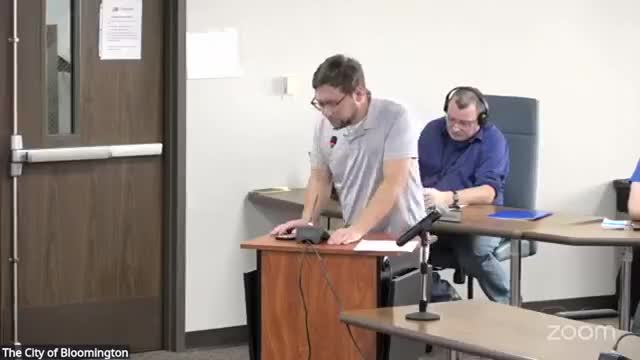
City staff presented a zoning-and-subdivision review aimed at assessing whether "missing middle" housing — duplexes, triplexes, courtyard homes and small townhouses — could be enabled more readily in parts of Bloomington. The Committee of the Whole heard roughly a dozen public commenters, followed by a staff presentation and prolonged council discussion; no ordinance or zoning text amendment was adopted.
The presentation, led by City Manager Jeff Jurgens and Development Services Director Kelly Pfeiffer, said the work is a preliminary code-analysis designed "to identify those barriers in our code that would be preventing MMH in our current zoning if we wanted to do that," and emphasized the study "is really just the start of the process," Jurgens said.
Why it matters: Staff said missing middle housing could add choices for downsizers, young professionals and workforce households by using land more efficiently, but they repeatedly urged that it would not be appropriate in every neighborhood. Dozens of nearby homeowners countered that allowing multifamily forms by right in single-family areas would damage property values, parking and neighborhood character.
The staff presentation traced the work to a July 2024 city resolution that set housing priorities and asked for a zoning/subdivision review. Director Kelly Pfeiffer told the council the Opticos (Opticos Design) analysis focused on several zoning districts (R2, R3A, RD, D2) and that staff intended to remove R1C and B1 from active study for now. "We already are going to recommend a couple of those districts be pulled out," Pfeiffer said during the presentation.
Public commenters included homeowners from Harvest Point and other subdivisions, the Bloomington Normal Community Land Trust and members of neighborhood homeowners associations. Speakers asked for greater transparency about where changes might apply and for protections against short-notice zoning changes that could alter long‑established single‑family areas. Harvest Point residents and HOA officers said they did not receive direct notice about the study and urged that areas such as Towanda Barnes/GE Road not be designated as a walkable center.
Council questions focused on definitions, scope and process. Several council members asked staff to be explicit about where missing middle might be allowed and to return with specific recommendations rather than a wholesale code rewrite. City Manager Jeff Jurgens said staff would continue to evaluate where the forms might fit and would return with proposals and public hearings if directed: "If you are interested in getting some of that type of missing middle housing, staff will go back and take a look at what might fit better for our community and come back with some specific recommendations," he said.
Discussion vs. decision: The meeting was a subject‑matter hearing; council members did not adopt any zoning changes or binding direction to map specific areas. Several members asked staff to continue analysis and to prepare clearer public outreach and implementation steps. Member comments included requests that staff quantify how proposed changes would affect affordability and that staff consider safeguards to prevent large investment firms from capturing new housing intended for owner-occupants.
Background and next steps: Staff said they will pursue two immediate items: (1) improve the "buildability" of housing forms that already can be built but are difficult to plat or finance, and (2) continue the Opticos-guided missing‑middle review focusing on a narrower set of districts. Any code changes would proceed through formal public hearings and Planning Commission review. The council did not set a vote date; staff and the mayor indicated the matter will return when staff and legal have refined recommendations and a public process is scheduled.
Ending: For now, the committee left the substantive policy question open: staff will continue analysis and public engagement, and council members asked for more precise recommendations and transparent outreach before any zoning amendments are placed on a legislative agenda.
The presentation, led by City Manager Jeff Jurgens and Development Services Director Kelly Pfeiffer, said the work is a preliminary code-analysis designed "to identify those barriers in our code that would be preventing MMH in our current zoning if we wanted to do that," and emphasized the study "is really just the start of the process," Jurgens said.
Why it matters: Staff said missing middle housing could add choices for downsizers, young professionals and workforce households by using land more efficiently, but they repeatedly urged that it would not be appropriate in every neighborhood. Dozens of nearby homeowners countered that allowing multifamily forms by right in single-family areas would damage property values, parking and neighborhood character.
The staff presentation traced the work to a July 2024 city resolution that set housing priorities and asked for a zoning/subdivision review. Director Kelly Pfeiffer told the council the Opticos (Opticos Design) analysis focused on several zoning districts (R2, R3A, RD, D2) and that staff intended to remove R1C and B1 from active study for now. "We already are going to recommend a couple of those districts be pulled out," Pfeiffer said during the presentation.
Public commenters included homeowners from Harvest Point and other subdivisions, the Bloomington Normal Community Land Trust and members of neighborhood homeowners associations. Speakers asked for greater transparency about where changes might apply and for protections against short-notice zoning changes that could alter long‑established single‑family areas. Harvest Point residents and HOA officers said they did not receive direct notice about the study and urged that areas such as Towanda Barnes/GE Road not be designated as a walkable center.
Council questions focused on definitions, scope and process. Several council members asked staff to be explicit about where missing middle might be allowed and to return with specific recommendations rather than a wholesale code rewrite. City Manager Jeff Jurgens said staff would continue to evaluate where the forms might fit and would return with proposals and public hearings if directed: "If you are interested in getting some of that type of missing middle housing, staff will go back and take a look at what might fit better for our community and come back with some specific recommendations," he said.
Discussion vs. decision: The meeting was a subject‑matter hearing; council members did not adopt any zoning changes or binding direction to map specific areas. Several members asked staff to continue analysis and to prepare clearer public outreach and implementation steps. Member comments included requests that staff quantify how proposed changes would affect affordability and that staff consider safeguards to prevent large investment firms from capturing new housing intended for owner-occupants.
Background and next steps: Staff said they will pursue two immediate items: (1) improve the "buildability" of housing forms that already can be built but are difficult to plat or finance, and (2) continue the Opticos-guided missing‑middle review focusing on a narrower set of districts. Any code changes would proceed through formal public hearings and Planning Commission review. The council did not set a vote date; staff and the mayor indicated the matter will return when staff and legal have refined recommendations and a public process is scheduled.
Ending: For now, the committee left the substantive policy question open: staff will continue analysis and public engagement, and council members asked for more precise recommendations and transparent outreach before any zoning amendments are placed on a legislative agenda.
View the Full Meeting & All Its Details
This article offers just a summary. Unlock complete video, transcripts, and insights as a Founder Member.
✓
Watch full, unedited meeting videos
✓
Search every word spoken in unlimited transcripts
✓
AI summaries & real-time alerts (all government levels)
✓
Permanent access to expanding government content
30-day money-back guarantee
