ResilientBroward website unveiled; plan estimates $9 billion in adaptation needs, 83% damage reduction with full investment
August 28, 2025 | Broward County, Florida
This article was created by AI summarizing key points discussed. AI makes mistakes, so for full details and context, please refer to the video of the full meeting. Please report any errors so we can fix them. Report an error »
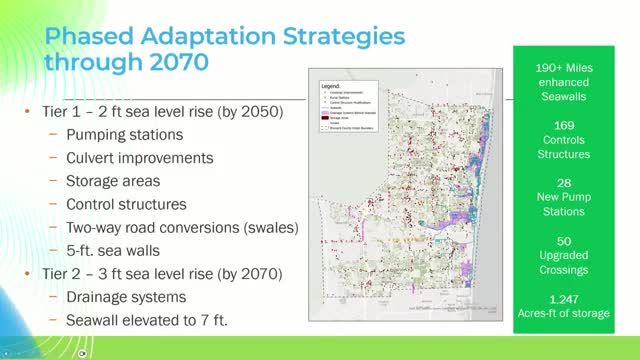
Dr. Jennifer Harada, the presenter for the Resilient Broward plan, introduced the new ResilientBroward.com site at the Aug. 28 meeting of the Broward County Planning Council in Fort Lauderdale. The web tool and supporting plan present scenario visualizations, economic modeling and a project tracker to document adaptation projects across the county.
The site compiles the plan's two-tier adaptation strategy and the scenario viewer that lets users compare no-adaptation, tier 1 and tier 2 outcomes for sea level rise, rainfall and storm surge. "This plan in the end demonstrated with tier 2 investments is estimated to reduce damages in our community by 83% relative to no adaptation," Dr. Harada said during her presentation. She said tier 2 scenarios include a modeled 3-foot sea level rise and the additional seawall height and pumping that would be required under those conditions.
The plan estimates roughly $9,000,000,000 in combined public infrastructure investments and private property improvements countywide, the presenter said. The website displays those cost rollups by municipality, governance entity and infrastructure type and provides economic metrics such as avoided damage, insurance impacts and protected gross value added by industry.
"You will see, most significantly'on the left hand side upper banner, you could access the plan," Harada demonstrated, describing an executive summary, a full plan with appendices and a scenario viewer that can zoom to specific addresses and produce 3-D visualizations. The site also provides a project tracker that the county will use to register adaptation projects and communicate measured flood reduction benefits to FEMA and other regional partners, Harada said.
School board member Alan Zeman welcomed the site and tied it to the county's economic exposure. "The gross domestic product of Broward County is $163,000,000,000. All of which is at risk," Zeman said, urging outreach to local institutions including the school district. Mayor Josh Levy described a recent local seawall project that received state funding as an example of how local and state money can align with plan goals, noting $20,000,000 in state funding for a seawall phase in Hollywood and a total phase cost north of $40,000,000.
Several council members praised the site's visuals and tools as useful for municipal planning and public outreach. Mayor Angelo Castillo called the presentation "astounding and impressive," and Dr. Maridi Fernandez compared the plan's scale and approach to major global flood-control programs.
Harada said the site uses modeling consistent with the South Florida Water Management District and other federal models and is publicly accessible to local governments, consultants and residents. She encouraged council members and municipal staff to use the scenario viewer and the project tracker as jurisdictions advance adaptation projects.
The council opened a short Q&A after the presentation. Harada said the team has presented to the Army Corps project team and that additional outreach to congressional delegations would be useful, though she did not claim current, broad familiarity among federal representatives.
The presentation slides and the ResilientBroward website will be circulated to council members and posted for public access. The planning council did not take formal action on the presentation; it served as an informational briefing to support Broward Next and related planning efforts.
The site compiles the plan's two-tier adaptation strategy and the scenario viewer that lets users compare no-adaptation, tier 1 and tier 2 outcomes for sea level rise, rainfall and storm surge. "This plan in the end demonstrated with tier 2 investments is estimated to reduce damages in our community by 83% relative to no adaptation," Dr. Harada said during her presentation. She said tier 2 scenarios include a modeled 3-foot sea level rise and the additional seawall height and pumping that would be required under those conditions.
The plan estimates roughly $9,000,000,000 in combined public infrastructure investments and private property improvements countywide, the presenter said. The website displays those cost rollups by municipality, governance entity and infrastructure type and provides economic metrics such as avoided damage, insurance impacts and protected gross value added by industry.
"You will see, most significantly'on the left hand side upper banner, you could access the plan," Harada demonstrated, describing an executive summary, a full plan with appendices and a scenario viewer that can zoom to specific addresses and produce 3-D visualizations. The site also provides a project tracker that the county will use to register adaptation projects and communicate measured flood reduction benefits to FEMA and other regional partners, Harada said.
School board member Alan Zeman welcomed the site and tied it to the county's economic exposure. "The gross domestic product of Broward County is $163,000,000,000. All of which is at risk," Zeman said, urging outreach to local institutions including the school district. Mayor Josh Levy described a recent local seawall project that received state funding as an example of how local and state money can align with plan goals, noting $20,000,000 in state funding for a seawall phase in Hollywood and a total phase cost north of $40,000,000.
Several council members praised the site's visuals and tools as useful for municipal planning and public outreach. Mayor Angelo Castillo called the presentation "astounding and impressive," and Dr. Maridi Fernandez compared the plan's scale and approach to major global flood-control programs.
Harada said the site uses modeling consistent with the South Florida Water Management District and other federal models and is publicly accessible to local governments, consultants and residents. She encouraged council members and municipal staff to use the scenario viewer and the project tracker as jurisdictions advance adaptation projects.
The council opened a short Q&A after the presentation. Harada said the team has presented to the Army Corps project team and that additional outreach to congressional delegations would be useful, though she did not claim current, broad familiarity among federal representatives.
The presentation slides and the ResilientBroward website will be circulated to council members and posted for public access. The planning council did not take formal action on the presentation; it served as an informational briefing to support Broward Next and related planning efforts.
View the Full Meeting & All Its Details
This article offers just a summary. Unlock complete video, transcripts, and insights as a Founder Member.
✓
Watch full, unedited meeting videos
✓
Search every word spoken in unlimited transcripts
✓
AI summaries & real-time alerts (all government levels)
✓
Permanent access to expanding government content
30-day money-back guarantee
