Snohomish County Council adopts updated critical-area rules after hours of public testimony
May 14, 2025 | Snohomish County, Washington
This article was created by AI summarizing key points discussed. AI makes mistakes, so for full details and context, please refer to the video of the full meeting. Please report any errors so we can fix them. Report an error »
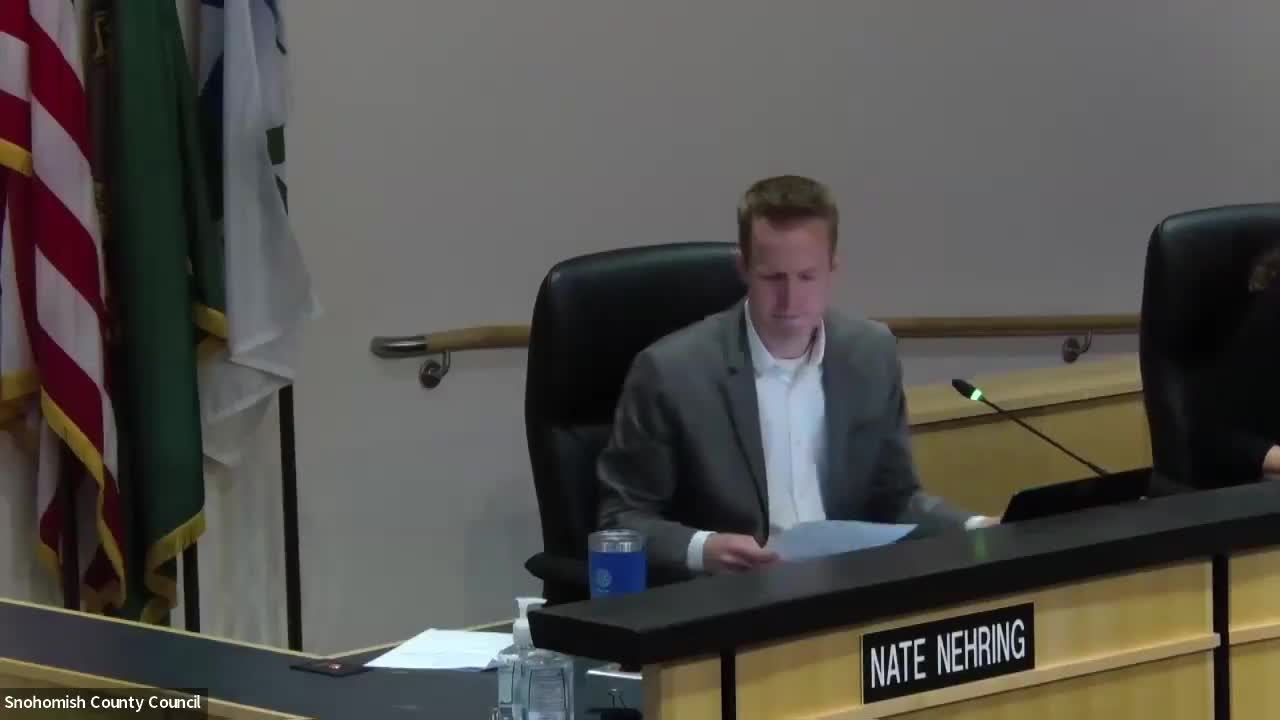
The Snohomish County Council voted 3-2 on May 14 to adopt Ordinance 24-097, an update to the county's critical-area regulations under the Growth Management Act that changes rules for wetlands, streams, geologically hazardous areas, critical aquifer recharge areas and related definitions and fees.
The adopted package included Amendment 2A, a Planning and Development Services (PDS) housekeeping package that passed unanimously 5-0, and Amendment 3, a sponsor's compromise that passed 3-2. The hearing and vote followed hours of public testimony from residents, tribes, state agencies, conservation groups and builders.
The ordinance revises several Snohomish County Code chapters (including chapters 30.62A, 30.62B, 30.62C, 30.43C, 30.86 and 30.91) to increase protections for critical areas overall compared with existing county code, according to Planning and Development Services staff. The changes tighten standards for buffers and the circumstances in which developers may reduce or average buffer widths, while also clarifying exemptions and mitigation processes.
Ryan (Planning and Development Services staff) summarized differences between current code, the Executive's proposed ordinance and Amendment 3. He said the package before the council would strengthen protections "in every category that's listed there," and described Amendment 2A as non-substantive housekeeping corrections.
State and tribal resource agencies urged the council to adopt the original, more-protective ordinance without Amendment 3. Marcus Reeves, representing the Washington Department of Fish and Wildlife (WDFW), said a new WDFW analysis found "36% of the area necessary to provide full riparian function would remain unprotected under the county's proposed code," and warned that roughly 15,000 acres of riparian forest could be at risk under current standards. Emily Atkins of the Washington Department of Ecology said Amendment 3 "is a high risk for loss of wetland functions and values in Snohomish County" and asked the council to adopt the wetland provisions of the original ordinance.
Tribal representatives and local conservation groups made similar appeals. Todd Gray of the Tulalip Tribes said scientific reports indicate current policies are not sufficient and urged the council to "be on the side of environmental protection." Tom Murdoch, director of the Adopt a Stream Foundation, warned that approving a weaker amendment "would be the degradation of Snohomish County salmon runs."
Builders and some local developers opposed removing incentives that have been used to preserve critical areas while allowing development. Dagny Cook of Pacific Ridge Homes and Brian Holtzclaw of the Master Builders Association said the county's existing toolkit uffer reductions, averaging and enhancement incentives an enable developments that retain and enhance natural areas while delivering housing. Holtzclaw urged the council to retain the ability to consider "innovative development design" and suggested technical language changes so tools remain usable.
Amendment 3, sponsored by a council member, keeps incentives for placing critical areas in separate tracts or installing protective fencing but reduces the size of those incentives compared with current code. For example, the existing code allowed up to a 15% buffer reduction for separate tracts and for protective fencing and a combined reduction of up to 25% when both measures were used; Amendment 3 reduces those incentives (separate tracts and fencing to 10% and a combined reduction to 20%). Amendment 3 also changes how buffer averaging and enhancement incentives may be applied and adjusts thresholds for when small wetlands may be allowed to be filled with mitigation. Planning staff described Amendment 3 as landing between the original ordinance and current code for small-wetland exemptions.
Council members discussed the record and cited state agency guidance. Several councilors and staff said the underlying ordinance and Amendment 3 would both increase protections compared with today's code, though Department of Ecology and WDFW recommended the more-protective original ordinance. Council debate also touched on housing capacity: staff said the county's recent land-capacity analysis used for the 2024 comprehensive-plan update assumed a range of future zoning and density changes and did not model the ordinance's potential effect on housing capacity.
After public testimony and deliberation, the council approved Amendment 2A 5-0, then approved Amendment 3 3-2, and finally adopted Ordinance 24-097 as amended 3-2. The ordinance updates the county's critical-area regulations; the council did not take additional immediate direction to staff beyond PDS's request to include Amendment 2A's housekeeping corrections if the ordinance passed.
Supporters of the ordinance as introduced, including Ecology and WDFW, had urged adoption without Amendment 3, saying their review of the science and state guidance supports the original, more-protective text. Opponents of the original ordinance who supported Amendment 3 argued the sponsor's changes preserve some development flexibility while increasing protections compared with current code in several respects.
The council opened the written record during the hearing; staff noted that an earlier public hearing on this update had occurred Jan. 15 and that the executive branch initially briefed the council in December. The county will publish the ordinance as adopted and any implementing guidance and will monitor compliance and effectiveness under the Growth Management Act framework.
The adopted package included Amendment 2A, a Planning and Development Services (PDS) housekeeping package that passed unanimously 5-0, and Amendment 3, a sponsor's compromise that passed 3-2. The hearing and vote followed hours of public testimony from residents, tribes, state agencies, conservation groups and builders.
The ordinance revises several Snohomish County Code chapters (including chapters 30.62A, 30.62B, 30.62C, 30.43C, 30.86 and 30.91) to increase protections for critical areas overall compared with existing county code, according to Planning and Development Services staff. The changes tighten standards for buffers and the circumstances in which developers may reduce or average buffer widths, while also clarifying exemptions and mitigation processes.
Ryan (Planning and Development Services staff) summarized differences between current code, the Executive's proposed ordinance and Amendment 3. He said the package before the council would strengthen protections "in every category that's listed there," and described Amendment 2A as non-substantive housekeeping corrections.
State and tribal resource agencies urged the council to adopt the original, more-protective ordinance without Amendment 3. Marcus Reeves, representing the Washington Department of Fish and Wildlife (WDFW), said a new WDFW analysis found "36% of the area necessary to provide full riparian function would remain unprotected under the county's proposed code," and warned that roughly 15,000 acres of riparian forest could be at risk under current standards. Emily Atkins of the Washington Department of Ecology said Amendment 3 "is a high risk for loss of wetland functions and values in Snohomish County" and asked the council to adopt the wetland provisions of the original ordinance.
Tribal representatives and local conservation groups made similar appeals. Todd Gray of the Tulalip Tribes said scientific reports indicate current policies are not sufficient and urged the council to "be on the side of environmental protection." Tom Murdoch, director of the Adopt a Stream Foundation, warned that approving a weaker amendment "would be the degradation of Snohomish County salmon runs."
Builders and some local developers opposed removing incentives that have been used to preserve critical areas while allowing development. Dagny Cook of Pacific Ridge Homes and Brian Holtzclaw of the Master Builders Association said the county's existing toolkit uffer reductions, averaging and enhancement incentives an enable developments that retain and enhance natural areas while delivering housing. Holtzclaw urged the council to retain the ability to consider "innovative development design" and suggested technical language changes so tools remain usable.
Amendment 3, sponsored by a council member, keeps incentives for placing critical areas in separate tracts or installing protective fencing but reduces the size of those incentives compared with current code. For example, the existing code allowed up to a 15% buffer reduction for separate tracts and for protective fencing and a combined reduction of up to 25% when both measures were used; Amendment 3 reduces those incentives (separate tracts and fencing to 10% and a combined reduction to 20%). Amendment 3 also changes how buffer averaging and enhancement incentives may be applied and adjusts thresholds for when small wetlands may be allowed to be filled with mitigation. Planning staff described Amendment 3 as landing between the original ordinance and current code for small-wetland exemptions.
Council members discussed the record and cited state agency guidance. Several councilors and staff said the underlying ordinance and Amendment 3 would both increase protections compared with today's code, though Department of Ecology and WDFW recommended the more-protective original ordinance. Council debate also touched on housing capacity: staff said the county's recent land-capacity analysis used for the 2024 comprehensive-plan update assumed a range of future zoning and density changes and did not model the ordinance's potential effect on housing capacity.
After public testimony and deliberation, the council approved Amendment 2A 5-0, then approved Amendment 3 3-2, and finally adopted Ordinance 24-097 as amended 3-2. The ordinance updates the county's critical-area regulations; the council did not take additional immediate direction to staff beyond PDS's request to include Amendment 2A's housekeeping corrections if the ordinance passed.
Supporters of the ordinance as introduced, including Ecology and WDFW, had urged adoption without Amendment 3, saying their review of the science and state guidance supports the original, more-protective text. Opponents of the original ordinance who supported Amendment 3 argued the sponsor's changes preserve some development flexibility while increasing protections compared with current code in several respects.
The council opened the written record during the hearing; staff noted that an earlier public hearing on this update had occurred Jan. 15 and that the executive branch initially briefed the council in December. The county will publish the ordinance as adopted and any implementing guidance and will monitor compliance and effectiveness under the Growth Management Act framework.
Don't Miss a Word: See the Full Meeting!
Go beyond summaries. Unlock every video, transcript, and key insight with a Founder Membership.
✓
Get instant access to full meeting videos
✓
Search and clip any phrase from complete transcripts
✓
Receive AI-powered summaries & custom alerts
✓
Enjoy lifetime, unrestricted access to government data
30-day money-back guarantee
