Orting council declines immediate stair redesign amendment, pauses on larger bridge engineering amendment amid liability and cost concerns
May 14, 2025 | Orting City, Pierce County, Washington
This article was created by AI summarizing key points discussed. AI makes mistakes, so for full details and context, please refer to the video of the full meeting. Please report any errors so we can fix them. Report an error »
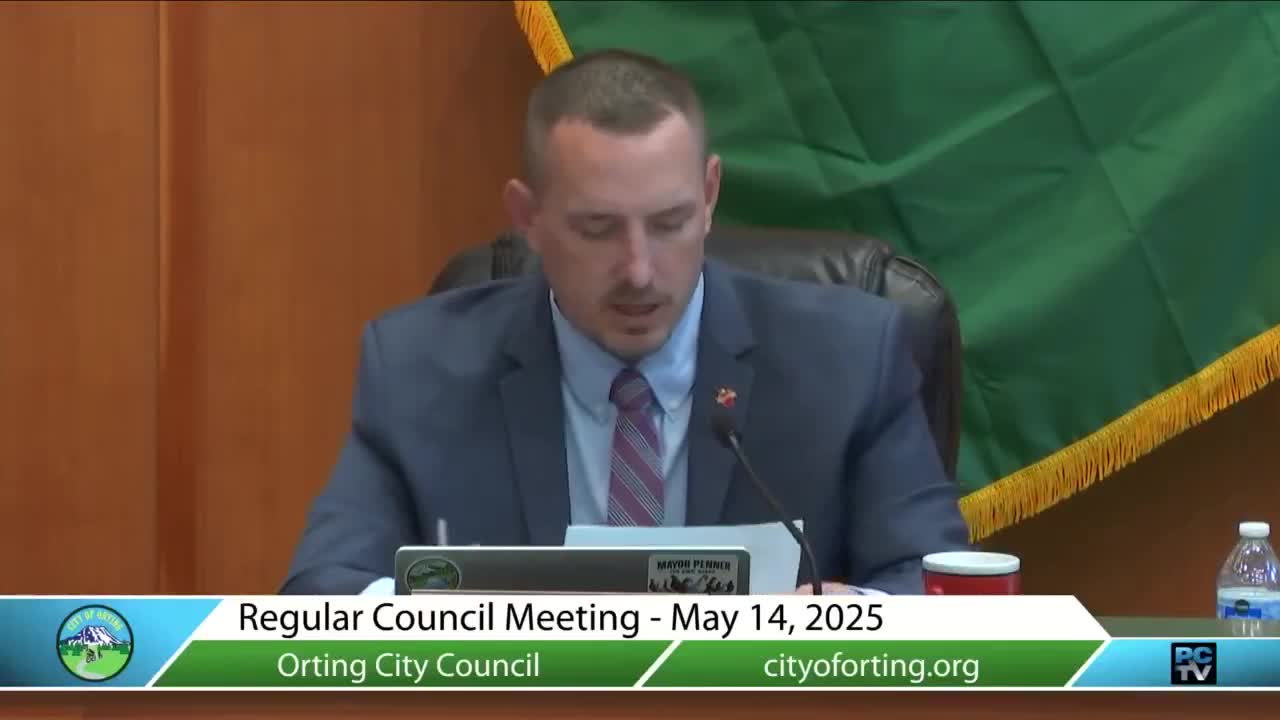
Orting City Council members voted down a motion to approve a $61,570 amendment to the construction management contract intended to redesign the variable-height top stair and revise a pedestrian pathway on the Emergency Evacuation Bridge project, and later saw a separate $249,596 amendment related to drilled-shaft anomalies fail for lack of a second.
The dispute centers on a variable-height top step on the bridge that parametric design documents allow within building-code ranges but which the prime contractor flagged as a trip-and-fall risk. Councilmember Moore presented the amendment as a way to avoid schedule delays and additional change-order costs; he said staff and the city attorney had been consulted and recommended the redesign. “Every day that we delay this project, the city is going to incur costs,” Moore said.
Why it matters: the bridge is a high-visibility public-safety and transportation project. The council must weigh the financial cost of a design change against potential liability from reported atypical stair geometry and against schedule impacts if construction stops. Councilmembers repeatedly raised questions about project oversight after hearing that the design firm also performs construction management and inspection work for the city, a setup some members said weakens checks and balances.
Most substantive facts and votes
• Agenda bill 5A requested an amendment to the construction management contract with Parametrix (referred to in materials as Parametrics) for $61,570 to produce revised drawings for a variable-height stair and a new pedestrian pathway. The proposed amendment would have increased the Parametrix contract to $1,136,780.54. The motion to authorize the mayor or designee to execute the Amendment 1 was made by Councilmember Hogan and seconded by Deputy Mayor Koenig.
• After public discussion and a roll-call vote, the motion failed. The council recorded a tally of 1 yes and 6 no (motion did not pass). The transcript shows multiple council members saying “no” during the roll call and the chair acknowledging the tally; individual roll-call attributions in the record were not all clearly transcribed.
• Agenda bill 5B sought a separate Amendment 2 to Parametrix’s contract for $249,596.23 to fund investigation and response to anomalies in five drilled shafts that support the bridge. Councilmember Hogan moved to authorize the mayor or designee to execute that amendment; the motion failed for lack of a second.
Details discussed by council and staff
Staff and the city’s construction manager explained that the contractor raised concerns about the top stair’s differing riser heights during construction. Staff said the original design “technically falls within the building code” but that the contractor, Quigg Brothers, warned of perceived risk because a person stepping across a stair with different riser heights could trip. Staff reported consulting the city attorney and cited case-law concerns about trip-and-fall claims as a reason to propose a redesign.
The city’s project engineer (identified in the meeting as “JC”) told the council that an online search and inquiry had found “I cannot find one example of a variable-height stair on a bridge anywhere,” and staff later explained the redesign work would affect structural slab thickness, drainage and how top landings tie into ramps, requiring about 24 sheets of design detail.
Several council members questioned the timing and procurement structure. Councilmember Moore and others said the design firm also performs construction observation and some inspection services under contract to the city, reducing independent oversight. “We have a single party that's responsible for all of this,” Moore said, adding that when outside consultants miss items the taxpayers currently absorb the cost through change orders.
Councilmember Sprow emphasized that the $61,570 figure covers design drafting only and that there was no cost-impact analysis attached estimating the downstream contractor or construction costs that redesign could trigger. “That’s only for drafting. So we have no idea what the cost of what these draft changes are going to do to the overall cost of the bridge, do we?” Sprow asked; Councilmember Moore replied, “We have no projected cost impact analysis of any kind that I'm aware of.”
On the drilled-shaft anomalies, staff briefed the council that five shafts (identified in the project materials and testimony as WR‑1, WR‑2, ER‑2, Pier‑1A and Pier‑1B) produced CSL (crosshole sonic logging) results that suggest possible anomalies in the cast-in-place concrete. The contractor submitted differing site condition documentation under WSDOT standard processes; staff said additional engineering analysis and possibly repairs or redesign will be needed. Because legal responsibility and potential remediation approaches were discussed in executive session, the public briefing stayed at a descriptive level: testing identified anomalies and further evaluation was required.
What the council decided and next steps
• The $61,570 amendment for the stair redesign and pedestrian-pathway design was not approved after a roll-call vote that resulted in a majority voting no.
• The $249,596 amendment related to drilled-shaft anomalies failed for lack of a second and therefore did not pass the council.
• Councilmembers asked staff to obtain a cost estimate and a clearer engineering scope if the issue is to be revisited; one councilmember asked staff to return to study session with an engineer’s cost estimate and the council discussed the option of delaying a final decision for two weeks to obtain more information.
Quotes (as spoken in the meeting)
• Councilmember Hogan: “Sixty thousand is cheaper than a trip and a fall.”
• JC (city engineer / project staff): “I cannot find one example of a variable-height stair on a bridge anywhere.”
• Councilmember Sprow: “That’s only for drafting. So we have no idea what the cost of what these draft changes are going to do to the overall cost of the bridge, do we?”
Context and unresolved items
Councilmembers repeatedly raised concerns about the project’s oversight model (the same consultant providing design, management and inspection) and about the accuracy of earlier community budget communications: staff noted the original published project budget and later revised totals differ, and members said they are increasingly concerned about recurring change orders. Staff said subconsultants perform special inspections (concrete testing, geotech) and that CSL tests and third‑party lab strength tests inform potential remedies for the shaft anomalies.
Because the council discussed potential litigation and responsibility for the anomalies in executive session, the public record is limited to the factual elements presented in open session: test results indicated possible anomalies, staff recommended further engineering analysis, and the council did not approve the requested contract amendments.
The dispute centers on a variable-height top step on the bridge that parametric design documents allow within building-code ranges but which the prime contractor flagged as a trip-and-fall risk. Councilmember Moore presented the amendment as a way to avoid schedule delays and additional change-order costs; he said staff and the city attorney had been consulted and recommended the redesign. “Every day that we delay this project, the city is going to incur costs,” Moore said.
Why it matters: the bridge is a high-visibility public-safety and transportation project. The council must weigh the financial cost of a design change against potential liability from reported atypical stair geometry and against schedule impacts if construction stops. Councilmembers repeatedly raised questions about project oversight after hearing that the design firm also performs construction management and inspection work for the city, a setup some members said weakens checks and balances.
Most substantive facts and votes
• Agenda bill 5A requested an amendment to the construction management contract with Parametrix (referred to in materials as Parametrics) for $61,570 to produce revised drawings for a variable-height stair and a new pedestrian pathway. The proposed amendment would have increased the Parametrix contract to $1,136,780.54. The motion to authorize the mayor or designee to execute the Amendment 1 was made by Councilmember Hogan and seconded by Deputy Mayor Koenig.
• After public discussion and a roll-call vote, the motion failed. The council recorded a tally of 1 yes and 6 no (motion did not pass). The transcript shows multiple council members saying “no” during the roll call and the chair acknowledging the tally; individual roll-call attributions in the record were not all clearly transcribed.
• Agenda bill 5B sought a separate Amendment 2 to Parametrix’s contract for $249,596.23 to fund investigation and response to anomalies in five drilled shafts that support the bridge. Councilmember Hogan moved to authorize the mayor or designee to execute that amendment; the motion failed for lack of a second.
Details discussed by council and staff
Staff and the city’s construction manager explained that the contractor raised concerns about the top stair’s differing riser heights during construction. Staff said the original design “technically falls within the building code” but that the contractor, Quigg Brothers, warned of perceived risk because a person stepping across a stair with different riser heights could trip. Staff reported consulting the city attorney and cited case-law concerns about trip-and-fall claims as a reason to propose a redesign.
The city’s project engineer (identified in the meeting as “JC”) told the council that an online search and inquiry had found “I cannot find one example of a variable-height stair on a bridge anywhere,” and staff later explained the redesign work would affect structural slab thickness, drainage and how top landings tie into ramps, requiring about 24 sheets of design detail.
Several council members questioned the timing and procurement structure. Councilmember Moore and others said the design firm also performs construction observation and some inspection services under contract to the city, reducing independent oversight. “We have a single party that's responsible for all of this,” Moore said, adding that when outside consultants miss items the taxpayers currently absorb the cost through change orders.
Councilmember Sprow emphasized that the $61,570 figure covers design drafting only and that there was no cost-impact analysis attached estimating the downstream contractor or construction costs that redesign could trigger. “That’s only for drafting. So we have no idea what the cost of what these draft changes are going to do to the overall cost of the bridge, do we?” Sprow asked; Councilmember Moore replied, “We have no projected cost impact analysis of any kind that I'm aware of.”
On the drilled-shaft anomalies, staff briefed the council that five shafts (identified in the project materials and testimony as WR‑1, WR‑2, ER‑2, Pier‑1A and Pier‑1B) produced CSL (crosshole sonic logging) results that suggest possible anomalies in the cast-in-place concrete. The contractor submitted differing site condition documentation under WSDOT standard processes; staff said additional engineering analysis and possibly repairs or redesign will be needed. Because legal responsibility and potential remediation approaches were discussed in executive session, the public briefing stayed at a descriptive level: testing identified anomalies and further evaluation was required.
What the council decided and next steps
• The $61,570 amendment for the stair redesign and pedestrian-pathway design was not approved after a roll-call vote that resulted in a majority voting no.
• The $249,596 amendment related to drilled-shaft anomalies failed for lack of a second and therefore did not pass the council.
• Councilmembers asked staff to obtain a cost estimate and a clearer engineering scope if the issue is to be revisited; one councilmember asked staff to return to study session with an engineer’s cost estimate and the council discussed the option of delaying a final decision for two weeks to obtain more information.
Quotes (as spoken in the meeting)
• Councilmember Hogan: “Sixty thousand is cheaper than a trip and a fall.”
• JC (city engineer / project staff): “I cannot find one example of a variable-height stair on a bridge anywhere.”
• Councilmember Sprow: “That’s only for drafting. So we have no idea what the cost of what these draft changes are going to do to the overall cost of the bridge, do we?”
Context and unresolved items
Councilmembers repeatedly raised concerns about the project’s oversight model (the same consultant providing design, management and inspection) and about the accuracy of earlier community budget communications: staff noted the original published project budget and later revised totals differ, and members said they are increasingly concerned about recurring change orders. Staff said subconsultants perform special inspections (concrete testing, geotech) and that CSL tests and third‑party lab strength tests inform potential remedies for the shaft anomalies.
Because the council discussed potential litigation and responsibility for the anomalies in executive session, the public record is limited to the factual elements presented in open session: test results indicated possible anomalies, staff recommended further engineering analysis, and the council did not approve the requested contract amendments.
View the Full Meeting & All Its Details
This article offers just a summary. Unlock complete video, transcripts, and insights as a Founder Member.
✓
Watch full, unedited meeting videos
✓
Search every word spoken in unlimited transcripts
✓
AI summaries & real-time alerts (all government levels)
✓
Permanent access to expanding government content
30-day money-back guarantee
