Lake Wales staff update commission on proposed changes to fire protection assessment
May 14, 2025 | City of Lake Wales, Polk County, Florida
This article was created by AI summarizing key points discussed. AI makes mistakes, so for full details and context, please refer to the video of the full meeting. Please report any errors so we can fix them. Report an error »
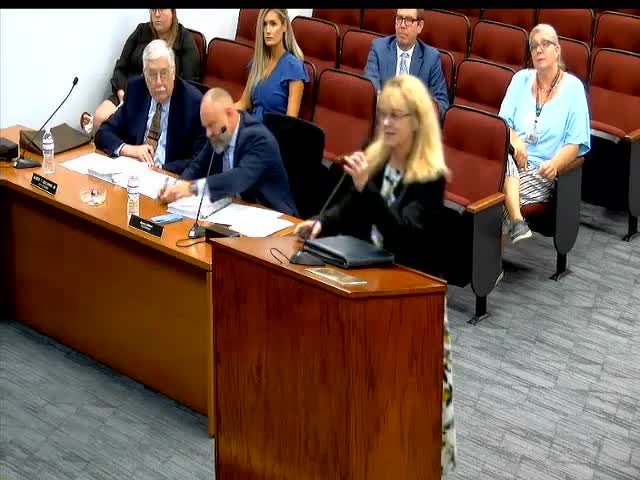
Sandy Newbarth, a consultant with Accenture, told the City of Lake Wales City Commission that an updated fire protection assessment changes how the city splits fire and emergency medical service costs and increases the square-foot cap used to calculate nonresidential charges.
The presentation, given at a work session, explained the legal and technical basis for the fee and walked commissioners through multiple rate scenarios and a timeline for adopting preliminary and final rates. “A fire assessment is a charge imposed against property to pay for fire protection services. It's a Home Rule revenue source,” Newbarth said. She added, “The courts have said fire protection services up to the level of first responder do provide a benefit to property, but EMS does not.”
The update uses a five‑year average assessable budget and a court‑tested “historical demand” methodology that allocates cost by past calls and time spent on incidents. Newbarth said the study separated EMS costs from fire protection and determined about 66.53% of the fire department budget could be funded by assessment revenue, with roughly 33.28% attributable to EMS and therefore funded from the general fund. The five‑year assessable budget used for the scenarios was $5,159,823.
Newbarth identified two main technical changes that affect large properties: the city’s standard for fire flow (7,900 gallons per minute per NFPA guidance) supports a square‑foot cap of about 191,400 square feet, up from the current 125,500 square‑foot cap. Under the older cap the consultant identified six buildings that exceeded it (Dillard’s, Lowe’s, Walmart, two School Board buildings and a property listed as Stockbridge Madison); the new cap reduces that list to two properties (the Walmart at about 195,000 square feet and the Stockbridge Madison property at about 397,000 square feet), with billing capped at 191,400 square feet for those outliers.
Newbarth summarized call‑volume and time‑on‑scene data used to apportion costs: city fire units ran 8,071 calls in the two‑year sample, of which 6,078 were EMS calls and were removed from assessment apportionment. Of the remaining calls used for fire apportionment, she reported single‑family households demanded 34.84% of fire services, multifamily 14.98%, mobile homes 1.27%, commercial 31.24%, industrial/warehouse 1.98% and institutional 15.68%.
The consultant presented two rate sets: the theoretical maximum rates tied to the full assessable budget and a staff‑recommended “45% funding” scenario. Under the maximum scenario, Newbarth said, single‑family residential would be $387 per dwelling unit; multifamily $318; mobile homes $139; commercial 40¢ per square foot; industrial 6¢ per square foot; institutional 31¢ per square foot. Staff’s recommended 45% scenario would set single‑family at $174 (an increase of $28 from the current rate), multifamily at $143 (increase of about $71), mobile homes $63, commercial 18¢/sq ft, industrial 3¢/sq ft and institutional 14¢/sq ft. Newbarth described those numbers as staff recommendations, not final decisions.
The presentation also highlighted a recurring policy choice: whether to continue the city’s historic exemptions for government and institutional tax‑exempt properties (churches, nonprofits, schools). Newbarth said exempt properties create a “buy‑down” the general fund must cover; at the $146 current rate she said the buy‑down is about $225,000 and in the draft scenarios she estimated exempt property impact at roughly $919,000 (about $600,000 attributable to government and $320,000 to institutional tax‑exempt properties). She explained that government properties, if exempted, cannot be placed on the tax roll and would require separate billing that is difficult to enforce.
Commissioners and staff asked for more detail. Deputy Mayor Gibson and Commissioner Williams sought a clearer breakdown of the buy‑down by exempt category and whether partial exemptions (for example, charging a fraction of the rate to institutional users) were legally or practically possible; Newbarth said partial buy‑downs are a policy decision and told the commission they could adopt a percentage reduction (for example, a 50% exemption) across exempt categories if they wished, but they must treat like properties equally. Newbarth also noted the administrative schedule: the initial (preliminary) rate resolution is scheduled for June 3, a final public hearing is planned for Sept. 9 and the tax roll must be certified to the tax collector by the statutory deadline of Sept. 15 for inclusion on the tax bill.
No formal motion or vote was taken at the work session. Staff indicated they will bring a preliminary rate resolution to the commission on June 3 and provide a breakdown of the exemption buy‑down (government vs. institutional/churches/nonprofits) in advance. Commissioners signaled differing views about the timing and size of any increase; one asked for an extended outreach and 12‑month conversation with institutional stakeholders before changing exemption policy, while others said the commission needs to act as part of the broader budget process.
The next formal procedural steps listed by staff are: adoption of a preliminary rate resolution on June 3 (signaling the maximum rates that can be considered), publication and inclusion on the Property Appraiser TRIM notice, a final public hearing on Sept. 9 and certification of the adopted rates to the tax collector by close of business on Sept. 15. Staff also told the commission they are available to meet with exempt institutions and government property owners to discuss budgets and collection options.
Commissioners asked staff to return with a detailed exempt‑property breakdown, clarifying how much of the buy‑down is government versus institutional/churches and what partial exemption options would mean for rates and revenue realization.
The presentation, given at a work session, explained the legal and technical basis for the fee and walked commissioners through multiple rate scenarios and a timeline for adopting preliminary and final rates. “A fire assessment is a charge imposed against property to pay for fire protection services. It's a Home Rule revenue source,” Newbarth said. She added, “The courts have said fire protection services up to the level of first responder do provide a benefit to property, but EMS does not.”
The update uses a five‑year average assessable budget and a court‑tested “historical demand” methodology that allocates cost by past calls and time spent on incidents. Newbarth said the study separated EMS costs from fire protection and determined about 66.53% of the fire department budget could be funded by assessment revenue, with roughly 33.28% attributable to EMS and therefore funded from the general fund. The five‑year assessable budget used for the scenarios was $5,159,823.
Newbarth identified two main technical changes that affect large properties: the city’s standard for fire flow (7,900 gallons per minute per NFPA guidance) supports a square‑foot cap of about 191,400 square feet, up from the current 125,500 square‑foot cap. Under the older cap the consultant identified six buildings that exceeded it (Dillard’s, Lowe’s, Walmart, two School Board buildings and a property listed as Stockbridge Madison); the new cap reduces that list to two properties (the Walmart at about 195,000 square feet and the Stockbridge Madison property at about 397,000 square feet), with billing capped at 191,400 square feet for those outliers.
Newbarth summarized call‑volume and time‑on‑scene data used to apportion costs: city fire units ran 8,071 calls in the two‑year sample, of which 6,078 were EMS calls and were removed from assessment apportionment. Of the remaining calls used for fire apportionment, she reported single‑family households demanded 34.84% of fire services, multifamily 14.98%, mobile homes 1.27%, commercial 31.24%, industrial/warehouse 1.98% and institutional 15.68%.
The consultant presented two rate sets: the theoretical maximum rates tied to the full assessable budget and a staff‑recommended “45% funding” scenario. Under the maximum scenario, Newbarth said, single‑family residential would be $387 per dwelling unit; multifamily $318; mobile homes $139; commercial 40¢ per square foot; industrial 6¢ per square foot; institutional 31¢ per square foot. Staff’s recommended 45% scenario would set single‑family at $174 (an increase of $28 from the current rate), multifamily at $143 (increase of about $71), mobile homes $63, commercial 18¢/sq ft, industrial 3¢/sq ft and institutional 14¢/sq ft. Newbarth described those numbers as staff recommendations, not final decisions.
The presentation also highlighted a recurring policy choice: whether to continue the city’s historic exemptions for government and institutional tax‑exempt properties (churches, nonprofits, schools). Newbarth said exempt properties create a “buy‑down” the general fund must cover; at the $146 current rate she said the buy‑down is about $225,000 and in the draft scenarios she estimated exempt property impact at roughly $919,000 (about $600,000 attributable to government and $320,000 to institutional tax‑exempt properties). She explained that government properties, if exempted, cannot be placed on the tax roll and would require separate billing that is difficult to enforce.
Commissioners and staff asked for more detail. Deputy Mayor Gibson and Commissioner Williams sought a clearer breakdown of the buy‑down by exempt category and whether partial exemptions (for example, charging a fraction of the rate to institutional users) were legally or practically possible; Newbarth said partial buy‑downs are a policy decision and told the commission they could adopt a percentage reduction (for example, a 50% exemption) across exempt categories if they wished, but they must treat like properties equally. Newbarth also noted the administrative schedule: the initial (preliminary) rate resolution is scheduled for June 3, a final public hearing is planned for Sept. 9 and the tax roll must be certified to the tax collector by the statutory deadline of Sept. 15 for inclusion on the tax bill.
No formal motion or vote was taken at the work session. Staff indicated they will bring a preliminary rate resolution to the commission on June 3 and provide a breakdown of the exemption buy‑down (government vs. institutional/churches/nonprofits) in advance. Commissioners signaled differing views about the timing and size of any increase; one asked for an extended outreach and 12‑month conversation with institutional stakeholders before changing exemption policy, while others said the commission needs to act as part of the broader budget process.
The next formal procedural steps listed by staff are: adoption of a preliminary rate resolution on June 3 (signaling the maximum rates that can be considered), publication and inclusion on the Property Appraiser TRIM notice, a final public hearing on Sept. 9 and certification of the adopted rates to the tax collector by close of business on Sept. 15. Staff also told the commission they are available to meet with exempt institutions and government property owners to discuss budgets and collection options.
Commissioners asked staff to return with a detailed exempt‑property breakdown, clarifying how much of the buy‑down is government versus institutional/churches and what partial exemption options would mean for rates and revenue realization.
View the Full Meeting & All Its Details
This article offers just a summary. Unlock complete video, transcripts, and insights as a Founder Member.
✓
Watch full, unedited meeting videos
✓
Search every word spoken in unlimited transcripts
✓
AI summaries & real-time alerts (all government levels)
✓
Permanent access to expanding government content
30-day money-back guarantee
