Board grants density but denies height for proposed North Walnut mixed-use building
May 08, 2025 | Milford, Sussex County, Delaware
This article was created by AI summarizing key points discussed. AI makes mistakes, so for full details and context, please refer to the video of the full meeting. Please report any errors so we can fix them. Report an error »
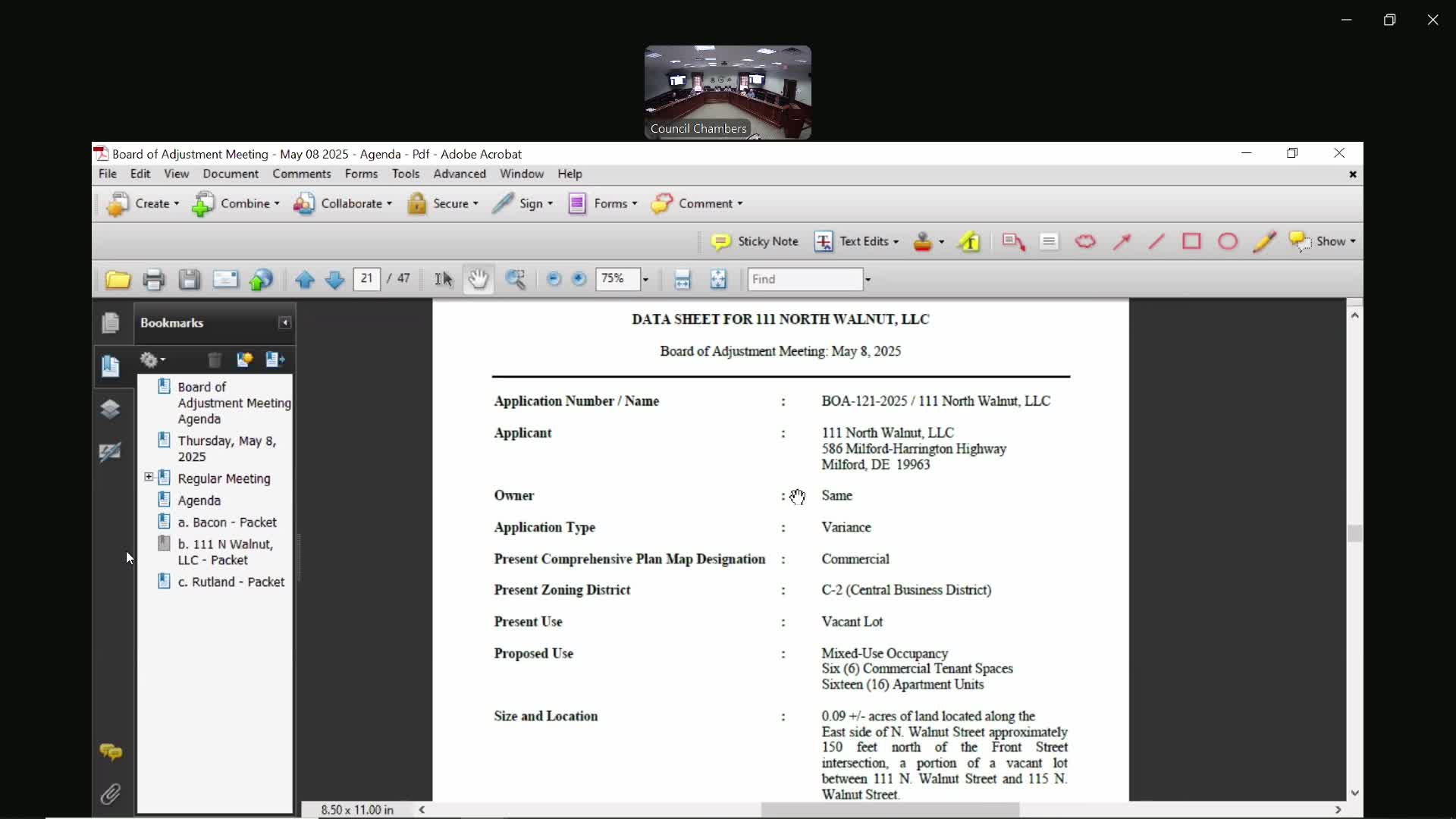
The Milford Board of Adjustment on May 8 approved a variance to increase allowable residential density for a proposed mixed-use building at a parcel on North Walnut Street but denied the applicant’s request to raise the building height to 52 feet.
Applicant 111 North Walnut LLC (represented by Zach King) proposed a four-story, mixed-use building with up to 16 apartment units and six commercial tenant spaces on a narrow downtown lot. King told the board, “The main goal for our project is affordable housing,” and said the project’s height and density needs were driven by an effort to keep per-unit construction costs low so rents could be affordable.
City staff told the board the applicant seeks three variances from the C-2 Central Business District rules: (1) increase density from 16 units per acre to 178 units per acre; (2) raise the 35-foot building height limit to 52 feet; and (3) reduce minimum lot width from 50 feet to about 48.2 feet to allow subdivision. Staff also noted there is no off-street parking requirement in the C-2 district and that conditional-use review by the Planning Commission (May 20) and City Council (May 27) will follow the Board of Adjustment decision.
Supporters spoke in favor of the project’s economic and housing benefits. Terry Rogers, president of Downtown Milford Incorporated and a local editor, said the Kings’ prior downtown renovations “do it with style and grace” and that he did not see a parking shortage downtown. Opponents called for a historic-preservation review. Daniel Bond, who has worked on historic-tax-credit projects, urged the city to request the State Historic Preservation Office’s input before approving a taller infill building: “I think it would be good to have a request from the City of Milford to the State Historic Preservation Office … to work with the city in determining what type of building would be appropriate here.”
After deliberation the board voted to grant the density variance, deny the variance to increase building height, and grant the small lot-width variance. Board members who voted to deny the height increase cited incompatibility with the immediate historic streetscape and privacy impacts on neighboring properties. The lot-width variance was approved on the grounds that the existing parcel width was close to the measured minimum and that the requested change matched the physical conditions of the property.
Because the height variance was denied, the applicant may proceed with the conditional-use review only for a structure that does not exceed the 35-foot height limit; further design or conditional-use negotiations will take place at Planning Commission and City Council hearings.
Applicant 111 North Walnut LLC (represented by Zach King) proposed a four-story, mixed-use building with up to 16 apartment units and six commercial tenant spaces on a narrow downtown lot. King told the board, “The main goal for our project is affordable housing,” and said the project’s height and density needs were driven by an effort to keep per-unit construction costs low so rents could be affordable.
City staff told the board the applicant seeks three variances from the C-2 Central Business District rules: (1) increase density from 16 units per acre to 178 units per acre; (2) raise the 35-foot building height limit to 52 feet; and (3) reduce minimum lot width from 50 feet to about 48.2 feet to allow subdivision. Staff also noted there is no off-street parking requirement in the C-2 district and that conditional-use review by the Planning Commission (May 20) and City Council (May 27) will follow the Board of Adjustment decision.
Supporters spoke in favor of the project’s economic and housing benefits. Terry Rogers, president of Downtown Milford Incorporated and a local editor, said the Kings’ prior downtown renovations “do it with style and grace” and that he did not see a parking shortage downtown. Opponents called for a historic-preservation review. Daniel Bond, who has worked on historic-tax-credit projects, urged the city to request the State Historic Preservation Office’s input before approving a taller infill building: “I think it would be good to have a request from the City of Milford to the State Historic Preservation Office … to work with the city in determining what type of building would be appropriate here.”
After deliberation the board voted to grant the density variance, deny the variance to increase building height, and grant the small lot-width variance. Board members who voted to deny the height increase cited incompatibility with the immediate historic streetscape and privacy impacts on neighboring properties. The lot-width variance was approved on the grounds that the existing parcel width was close to the measured minimum and that the requested change matched the physical conditions of the property.
Because the height variance was denied, the applicant may proceed with the conditional-use review only for a structure that does not exceed the 35-foot height limit; further design or conditional-use negotiations will take place at Planning Commission and City Council hearings.
View the Full Meeting & All Its Details
This article offers just a summary. Unlock complete video, transcripts, and insights as a Founder Member.
✓
Watch full, unedited meeting videos
✓
Search every word spoken in unlimited transcripts
✓
AI summaries & real-time alerts (all government levels)
✓
Permanent access to expanding government content
30-day money-back guarantee
