Mineola board presents $112 million budget, proposes 2.08% tax levy and $1.6 million transfer to capital
May 08, 2025 | MINEOLA UNION FREE SCHOOL DISTRICT, School Districts, New York
This article was created by AI summarizing key points discussed. AI makes mistakes, so for full details and context, please refer to the video of the full meeting. Please report any errors so we can fix them. Report an error »
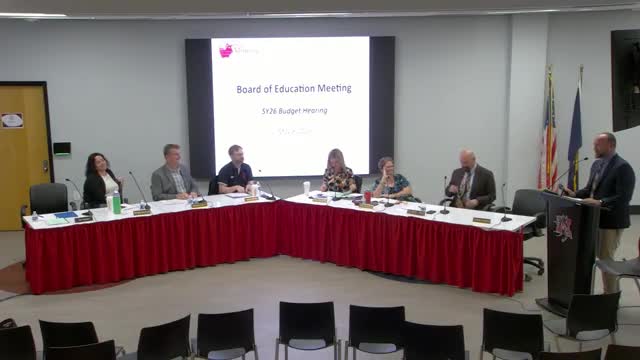
Mineola Union Free School District officials presented a proposed $112 million operating budget for the 2025–26 school year and urged residents to vote on the plan at the district's May 20 budget vote.
"We are proposing, similar to last year, to come in right at the tax cap. So for this year, that is 2.08%," Will Herman, assistant superintendent for business and operations, told the board during the district's formal budget hearing.
The proposed budget would hold the district’s tax levy increase to the state tax‑cap limit of 2.08% while maintaining planned spending across salaries, benefits and operating costs. The plan also includes a $1,600,000 transfer from the general fund to capital to start converting the current middle‑school gym into a new kitchen and cafeteria, and it would add nine replacement vehicles under a five‑year lease‑purchase arrangement.
Why it matters: The budget hearing was the final scheduled public presentation before the district's May 20 vote, and the proposed package ties operating priorities (instruction, bus replacement, building upkeep) to two ballot questions: the main operating budget and a proposition to use capital reserve funds for three campus projects.
Herman told trustees the district’s overall proposed spending would increase modestly year over year and that recent state budget activity produced a small upward revision in state aid. "Our state aid is projected to be about $4,100 more than what we heard in January," he said, noting that the change reduced the district’s intended use of fund balance by roughly the same amount but did not change the total proposed budget.
Key numbers and items discussed
- Proposed overall budget: about $112,000,000 (presented as the bottom‑row total on the district slides).
- Proposed tax‑levy increase: 2.08% (the state tax cap for this district).
- Appropriated fund balance: reduced to about $795,828 after a small upward revision in projected state aid.
- Transfer to capital: $1,600,000 to begin the conversion of the middle‑school gym into a new kitchen and cafeteria.
- Bus replacement: nine vehicles planned next year (two large buses; six vans with 20–30 passenger capacities; one wheelchair‑capable small bus) via a five‑year lease purchase.
- Notable cost pressures cited: an ERS pension increase of roughly $300,000 (about a 16% jump for that line), insurance up about 20%, security‑guard costs up roughly 44%, and charter‑school tuition up in dollar terms by about $105,000 (a near‑90% year‑over‑year percentage increase noted by staff, driven primarily by more students attending charter schools).
Herman walked the board through the district's three‑part budget breakdown (program, capital and administrative) and noted the district spends about three‑quarters of its money on instruction. He also described the district's contingency‑budget rules and the implications of a failed budget vote: a contingency budget would require a zero tax‑levy increase relative to the current year and would eliminate noncontingent items such as the proposed transfer to capital, many equipment purchases and some administrative costs. "A contingency budget would decrease our maximum operating budget to that $109,000,000 figure," Herman said, summarizing the potential $3 million gap and the choices that would follow (eliminating positions/programming or increasing fund‑balance use).
Board context and next steps
Trustee Patrick Talty highlighted the unique role of voters in school finance: "This is the only budget at any level that you actually get to vote on," he said as he urged turnout for the May 20 vote, which Herman said would run from 6 a.m. to 9 p.m. in the district meeting space where the hearing was held.
The presentation included photographs and details for capital reserve projects that would be covered by proposition two on the ballot: extending the turf at the baseball field to match adjacent work, replacing a leaking auditorium roof at the middle school (including a nonfunctioning fire dampener and other roof penetrations), and replacing failing entryway ramps and concrete on the east side of the middle school with stairs, improved drainage and new concrete.
Herman said the district had paused vehicle purchases during an earlier period of uncertainty about a statewide electric‑vehicle transition and now plans a larger replacement year to "make up for some lost time." He also advised that while some items are rising sharply in percentage terms, the absolute dollar increases remain manageable now but would be watched closely in future years.
What voters will see on May 20
- Proposition 1: the operating budget (the $112 million proposal) and the related tax‑levy request set at the 2.08% cap.
- Proposition 2: use of capital reserve funds for the three projects described above (baseball/turf work, auditorium roof replacement, east‑side entryway repairs).
The district posted a line‑by‑line version of the proposed budget on its website (titled "Educational Plan and Budget"/the green book), and Herman encouraged community members to review that document before voting.
Sources and attribution
All direct quotations and figures in this article are drawn from the Mineola Union Free School District budget presentation and the district board meeting record. The presentation and vote schedule were given by Will Herman, assistant superintendent for business and operations; trustee Patrick Talty offered remarks urging voter participation.
Ending note: The board's formal budget hearing concluded with a question‑and‑answer period; the district's proposed budget will be decided by voters on May 20, when polls open from 6 a.m. to 9 p.m. in the district meeting space.
"We are proposing, similar to last year, to come in right at the tax cap. So for this year, that is 2.08%," Will Herman, assistant superintendent for business and operations, told the board during the district's formal budget hearing.
The proposed budget would hold the district’s tax levy increase to the state tax‑cap limit of 2.08% while maintaining planned spending across salaries, benefits and operating costs. The plan also includes a $1,600,000 transfer from the general fund to capital to start converting the current middle‑school gym into a new kitchen and cafeteria, and it would add nine replacement vehicles under a five‑year lease‑purchase arrangement.
Why it matters: The budget hearing was the final scheduled public presentation before the district's May 20 vote, and the proposed package ties operating priorities (instruction, bus replacement, building upkeep) to two ballot questions: the main operating budget and a proposition to use capital reserve funds for three campus projects.
Herman told trustees the district’s overall proposed spending would increase modestly year over year and that recent state budget activity produced a small upward revision in state aid. "Our state aid is projected to be about $4,100 more than what we heard in January," he said, noting that the change reduced the district’s intended use of fund balance by roughly the same amount but did not change the total proposed budget.
Key numbers and items discussed
- Proposed overall budget: about $112,000,000 (presented as the bottom‑row total on the district slides).
- Proposed tax‑levy increase: 2.08% (the state tax cap for this district).
- Appropriated fund balance: reduced to about $795,828 after a small upward revision in projected state aid.
- Transfer to capital: $1,600,000 to begin the conversion of the middle‑school gym into a new kitchen and cafeteria.
- Bus replacement: nine vehicles planned next year (two large buses; six vans with 20–30 passenger capacities; one wheelchair‑capable small bus) via a five‑year lease purchase.
- Notable cost pressures cited: an ERS pension increase of roughly $300,000 (about a 16% jump for that line), insurance up about 20%, security‑guard costs up roughly 44%, and charter‑school tuition up in dollar terms by about $105,000 (a near‑90% year‑over‑year percentage increase noted by staff, driven primarily by more students attending charter schools).
Herman walked the board through the district's three‑part budget breakdown (program, capital and administrative) and noted the district spends about three‑quarters of its money on instruction. He also described the district's contingency‑budget rules and the implications of a failed budget vote: a contingency budget would require a zero tax‑levy increase relative to the current year and would eliminate noncontingent items such as the proposed transfer to capital, many equipment purchases and some administrative costs. "A contingency budget would decrease our maximum operating budget to that $109,000,000 figure," Herman said, summarizing the potential $3 million gap and the choices that would follow (eliminating positions/programming or increasing fund‑balance use).
Board context and next steps
Trustee Patrick Talty highlighted the unique role of voters in school finance: "This is the only budget at any level that you actually get to vote on," he said as he urged turnout for the May 20 vote, which Herman said would run from 6 a.m. to 9 p.m. in the district meeting space where the hearing was held.
The presentation included photographs and details for capital reserve projects that would be covered by proposition two on the ballot: extending the turf at the baseball field to match adjacent work, replacing a leaking auditorium roof at the middle school (including a nonfunctioning fire dampener and other roof penetrations), and replacing failing entryway ramps and concrete on the east side of the middle school with stairs, improved drainage and new concrete.
Herman said the district had paused vehicle purchases during an earlier period of uncertainty about a statewide electric‑vehicle transition and now plans a larger replacement year to "make up for some lost time." He also advised that while some items are rising sharply in percentage terms, the absolute dollar increases remain manageable now but would be watched closely in future years.
What voters will see on May 20
- Proposition 1: the operating budget (the $112 million proposal) and the related tax‑levy request set at the 2.08% cap.
- Proposition 2: use of capital reserve funds for the three projects described above (baseball/turf work, auditorium roof replacement, east‑side entryway repairs).
The district posted a line‑by‑line version of the proposed budget on its website (titled "Educational Plan and Budget"/the green book), and Herman encouraged community members to review that document before voting.
Sources and attribution
All direct quotations and figures in this article are drawn from the Mineola Union Free School District budget presentation and the district board meeting record. The presentation and vote schedule were given by Will Herman, assistant superintendent for business and operations; trustee Patrick Talty offered remarks urging voter participation.
Ending note: The board's formal budget hearing concluded with a question‑and‑answer period; the district's proposed budget will be decided by voters on May 20, when polls open from 6 a.m. to 9 p.m. in the district meeting space.
Don't Miss a Word: See the Full Meeting!
Go beyond summaries. Unlock every video, transcript, and key insight with a Founder Membership.
✓
Get instant access to full meeting videos
✓
Search and clip any phrase from complete transcripts
✓
Receive AI-powered summaries & custom alerts
✓
Enjoy lifetime, unrestricted access to government data
30-day money-back guarantee
