Council tables TIF vote on Brickyard Estates, Paddock at the Park after broad public comment
May 08, 2025 | Terre Haute City, Vigo County, Indiana
This article was created by AI summarizing key points discussed. AI makes mistakes, so for full details and context, please refer to the video of the full meeting. Please report any errors so we can fix them. Report an error »
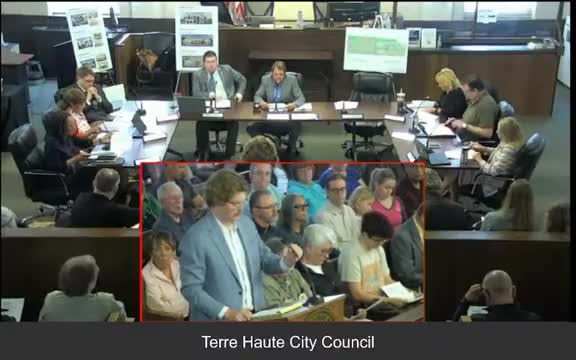
The Terre Haute City Council on Thursday delayed action on a pair of measures to create an economic development area and tax-increment financing (TIF) districts for a proposed Brickyard Estates and Paddock at the Park development until a June meeting, after extensive public comment and questions about school capacity, traffic, historic character and the financing structure.
The council voted to table Resolution 13-20-25, which would have declared the Brickyard Estates and Paddock at the Park economic development area and established the commercial TIF allocation area, until the council’s June 12 meeting. Councilman Chalos moved to table and Councilman Diggle seconded; the motion carried with a voice vote of ayes. A companion measure (Resolution 14-20-25) to establish a residential allocation area remained under discussion and had not been adopted by the time the council recessed.
The proposal before the council would attach two development components to the same economic development area: Paddock at the Park, a proposed 176-unit, class-A multifamily project on roughly 12 acres led by Crestline Communities, and Brickyard Estates, a proposed 93-lot single-family subdivision on about 23 acres developed by Jared Grable. Attorneys and project representatives told the council the overall private investment is about $70 million, the multifamily portion is “a 30-plus million dollar investment,” and the multifamily rent range was presented as roughly $1,250 to $1,872 per month. Jared Grable described single-family homes averaging about 1,600–1,700 square feet with expected price points near $350,000–$400,000 and an initial build plan of 10 homes followed by about 20–25 homes per year as sales permit.
Redevelopment director Jordan Marville and Barnes & Thornburg attorney Dustin Meeks said the two resolutions are procedural steps in a four-step process under state law and would allow the capture of incremental property tax revenue from the parcels to repay infrastructure financing. Meeks summarized the legal mechanics, saying the resolutions would “approve the creation of a new economic development area to be known as the Brickyard Estates And Paddock At The Park Economic Development area and approves, the creation of a commercial TIF area within that economic development area,” and that the residential allocation would be established by a companion amendment.
Project financing would rely primarily on a low-interest loan from the Indiana Finance Authority’s Residential Infrastructure Fund (RIF) and a developer guarantee, officials said. Meeks told the council the RIF application requires establishment of the TIF districts as a second revenue stream and that “if these TIFs are not created, the state would likely move their funding to other opportunities.” The presenters emphasized the developer guarantee and said the city would not underwrite the loan; Meeks noted the redevelopment commission would collect the increment and use it for public improvements that serve the economic development area, consistent with Indiana Code 36-7-14.
City staff said other approvals remain required. Meeks and project counsel emphasized that creation of the TIF does not change land-use or rezoning procedures; the area plan commission and the council must still consider rezoning petitions and subdivision approvals. Eddie Felling, speaking for the developers, said the rezoning petition had been filed and is expected to be before the area plan commission and the council in June.
City Engineer Marcus Meyer described an ongoing traffic study the city mobilized after the designs were submitted. Meyer said staff are collecting tube counts, peak-hour turning-movement observations and pedestrian counts at key intersections including Fruitridge & Ohio and Brown & Ohio, and that the city engaged a second firm, United Consulting, for quality assurance. Meyer said the traffic analysis and any recommended mitigation will be brought back to the area plan commission and city council.
Public commenters raised similar themes across more than two dozen speakers. Concerns included anticipated school overcrowding on the east side, the compatibility of multifamily buildings and higher-density infill with the historic Ohio Boulevard corridor and Deming Park, long-term commitments to a TIF, and the pace and transparency of the process. Vincent Little questioned whether powers available in an economic development area could “circumvent the zoning,” and multiple speakers asked about school capacity and building-condition ratings. Educators and parents urged the council to consider limits on classroom capacity; several speakers pointed to the Vigo County School Corporation’s facilities reports and said nearby schools appear near capacity.
Others urged patience and more community engagement. Eric Reyes and others asked the council to “pause” and complete the traffic study and other analyses before voting. Supporters of the concept argued the project would add housing choices that could help retain college graduates and meet market demand; James Wilson of Crestline described the multifamily product as amenity-rich, with clubhouse, pool and trails, intended to attract commuting professionals and recent hires. Jared Grable and project counsel said the developer has been working with the Indiana Finance Authority and that the proposal presented to the IFA is what the city will see if the financing proceeds.
What the council voted on and what remains: Resolution 13-20-25 (creation of the economic development area and commercial allocation area) was tabled to the council’s June 12 meeting after a motion by Councilman Chalos and a second by Councilman Diggle. The separate ordinance to rezone property (Special Ordinance 11-20-25) was previously tabled to a June meeting. The residential allocation (Resolution 14-20-25) and rezoning petitions were discussed and will return for future hearings; no final council action on those items was recorded before the council recessed.
The next formal opportunities for public input are the area plan commission hearings and successive council meetings in June; petitioners and city staff told attendees they expect three additional public meetings on the project before any final council votes.
The council voted to table Resolution 13-20-25, which would have declared the Brickyard Estates and Paddock at the Park economic development area and established the commercial TIF allocation area, until the council’s June 12 meeting. Councilman Chalos moved to table and Councilman Diggle seconded; the motion carried with a voice vote of ayes. A companion measure (Resolution 14-20-25) to establish a residential allocation area remained under discussion and had not been adopted by the time the council recessed.
The proposal before the council would attach two development components to the same economic development area: Paddock at the Park, a proposed 176-unit, class-A multifamily project on roughly 12 acres led by Crestline Communities, and Brickyard Estates, a proposed 93-lot single-family subdivision on about 23 acres developed by Jared Grable. Attorneys and project representatives told the council the overall private investment is about $70 million, the multifamily portion is “a 30-plus million dollar investment,” and the multifamily rent range was presented as roughly $1,250 to $1,872 per month. Jared Grable described single-family homes averaging about 1,600–1,700 square feet with expected price points near $350,000–$400,000 and an initial build plan of 10 homes followed by about 20–25 homes per year as sales permit.
Redevelopment director Jordan Marville and Barnes & Thornburg attorney Dustin Meeks said the two resolutions are procedural steps in a four-step process under state law and would allow the capture of incremental property tax revenue from the parcels to repay infrastructure financing. Meeks summarized the legal mechanics, saying the resolutions would “approve the creation of a new economic development area to be known as the Brickyard Estates And Paddock At The Park Economic Development area and approves, the creation of a commercial TIF area within that economic development area,” and that the residential allocation would be established by a companion amendment.
Project financing would rely primarily on a low-interest loan from the Indiana Finance Authority’s Residential Infrastructure Fund (RIF) and a developer guarantee, officials said. Meeks told the council the RIF application requires establishment of the TIF districts as a second revenue stream and that “if these TIFs are not created, the state would likely move their funding to other opportunities.” The presenters emphasized the developer guarantee and said the city would not underwrite the loan; Meeks noted the redevelopment commission would collect the increment and use it for public improvements that serve the economic development area, consistent with Indiana Code 36-7-14.
City staff said other approvals remain required. Meeks and project counsel emphasized that creation of the TIF does not change land-use or rezoning procedures; the area plan commission and the council must still consider rezoning petitions and subdivision approvals. Eddie Felling, speaking for the developers, said the rezoning petition had been filed and is expected to be before the area plan commission and the council in June.
City Engineer Marcus Meyer described an ongoing traffic study the city mobilized after the designs were submitted. Meyer said staff are collecting tube counts, peak-hour turning-movement observations and pedestrian counts at key intersections including Fruitridge & Ohio and Brown & Ohio, and that the city engaged a second firm, United Consulting, for quality assurance. Meyer said the traffic analysis and any recommended mitigation will be brought back to the area plan commission and city council.
Public commenters raised similar themes across more than two dozen speakers. Concerns included anticipated school overcrowding on the east side, the compatibility of multifamily buildings and higher-density infill with the historic Ohio Boulevard corridor and Deming Park, long-term commitments to a TIF, and the pace and transparency of the process. Vincent Little questioned whether powers available in an economic development area could “circumvent the zoning,” and multiple speakers asked about school capacity and building-condition ratings. Educators and parents urged the council to consider limits on classroom capacity; several speakers pointed to the Vigo County School Corporation’s facilities reports and said nearby schools appear near capacity.
Others urged patience and more community engagement. Eric Reyes and others asked the council to “pause” and complete the traffic study and other analyses before voting. Supporters of the concept argued the project would add housing choices that could help retain college graduates and meet market demand; James Wilson of Crestline described the multifamily product as amenity-rich, with clubhouse, pool and trails, intended to attract commuting professionals and recent hires. Jared Grable and project counsel said the developer has been working with the Indiana Finance Authority and that the proposal presented to the IFA is what the city will see if the financing proceeds.
What the council voted on and what remains: Resolution 13-20-25 (creation of the economic development area and commercial allocation area) was tabled to the council’s June 12 meeting after a motion by Councilman Chalos and a second by Councilman Diggle. The separate ordinance to rezone property (Special Ordinance 11-20-25) was previously tabled to a June meeting. The residential allocation (Resolution 14-20-25) and rezoning petitions were discussed and will return for future hearings; no final council action on those items was recorded before the council recessed.
The next formal opportunities for public input are the area plan commission hearings and successive council meetings in June; petitioners and city staff told attendees they expect three additional public meetings on the project before any final council votes.
View the Full Meeting & All Its Details
This article offers just a summary. Unlock complete video, transcripts, and insights as a Founder Member.
✓
Watch full, unedited meeting videos
✓
Search every word spoken in unlimited transcripts
✓
AI summaries & real-time alerts (all government levels)
✓
Permanent access to expanding government content
30-day money-back guarantee
