David Douglas high school outlines 'freshman houses' and expanded pathways to boost on‑track rates
May 08, 2025 | David Douglas SD 40, School Districts, Oregon
This article was created by AI summarizing key points discussed. AI makes mistakes, so for full details and context, please refer to the video of the full meeting. Please report any errors so we can fix them. Report an error »
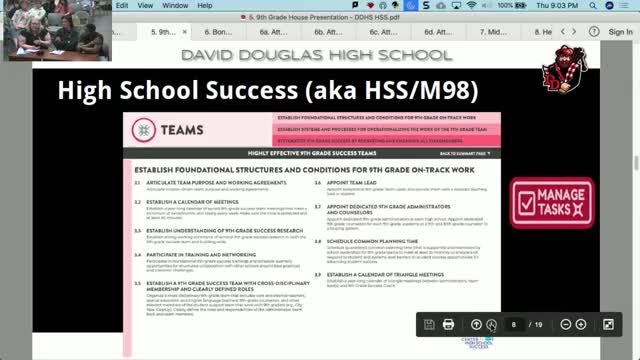
David Douglas High School leaders presented a new ninth‑grade "house" model May 8, describing how cohorted teacher teams, semester‑long strategies classes and expanded dual‑credit and Advanced Placement opportunities are intended to increase students’ on‑track status and graduation rates.
Principal Jen Buscher and assistant principals outlined goals tied to state High School Success funding and local graduation targets, saying the district aims to raise its graduation rate from 69% to 72% and increase the percentage of ninth graders on track. "We are putting wraparound services around our incoming ninth graders," Buscher said, describing coordinated teacher planning time and a set of freshman strategies classes.
Under the proposal, all incoming ninth graders would be assigned to one of four houses — Summit, Cascade, Ocean and Timber — each staffed by a team of teachers who share prep time twice weekly to coordinate supports and interventions. Students would take one semester of a freshman strategies class; students with specific needs would instead be placed in curriculum support or literacy classes such as Read 180.
Administrators emphasized the plan is designed to increase equitable access to advanced coursework: ninth‑grade core classes will integrate pre‑AP strategies so students can develop the confidence and skills to pursue honors, AP and dual‑credit options in later grades. "We want all of our students to be able to access these courses," said a district presenter, noting the district currently offers dozens of dual‑credit courses in partnership with Mount Hood Community College, Eastern Oregon University, Clackamas Community College and Central Oregon Community College.
Board members asked about transcript labeling and college admissions, and administrators said honors and AP designation remains available on student transcripts beyond the freshman year and that freshmen would have opt‑in advanced unit opportunities. Administrators also said Level Up — a prior year‑long course — will be replaced with semester‑long strategy classes while SB‑related personal finance and higher‑education credits will be offered in the schedule.
The presentation included discussion of implementation issues, including where multilingual newcomer students would be assigned and how cohorting would account for behavioral or scheduling conflicts. Administrators said they will work with middle schools to balance cohorts and allow flexibility to reassign students where needed.
The plan was a presentation item; the board did not vote on policy changes at the May 8 meeting. Administrators asked for continued engagement with teachers and principals as the plan proceeds toward implementation in the next school year.
Principal Jen Buscher and assistant principals outlined goals tied to state High School Success funding and local graduation targets, saying the district aims to raise its graduation rate from 69% to 72% and increase the percentage of ninth graders on track. "We are putting wraparound services around our incoming ninth graders," Buscher said, describing coordinated teacher planning time and a set of freshman strategies classes.
Under the proposal, all incoming ninth graders would be assigned to one of four houses — Summit, Cascade, Ocean and Timber — each staffed by a team of teachers who share prep time twice weekly to coordinate supports and interventions. Students would take one semester of a freshman strategies class; students with specific needs would instead be placed in curriculum support or literacy classes such as Read 180.
Administrators emphasized the plan is designed to increase equitable access to advanced coursework: ninth‑grade core classes will integrate pre‑AP strategies so students can develop the confidence and skills to pursue honors, AP and dual‑credit options in later grades. "We want all of our students to be able to access these courses," said a district presenter, noting the district currently offers dozens of dual‑credit courses in partnership with Mount Hood Community College, Eastern Oregon University, Clackamas Community College and Central Oregon Community College.
Board members asked about transcript labeling and college admissions, and administrators said honors and AP designation remains available on student transcripts beyond the freshman year and that freshmen would have opt‑in advanced unit opportunities. Administrators also said Level Up — a prior year‑long course — will be replaced with semester‑long strategy classes while SB‑related personal finance and higher‑education credits will be offered in the schedule.
The presentation included discussion of implementation issues, including where multilingual newcomer students would be assigned and how cohorting would account for behavioral or scheduling conflicts. Administrators said they will work with middle schools to balance cohorts and allow flexibility to reassign students where needed.
The plan was a presentation item; the board did not vote on policy changes at the May 8 meeting. Administrators asked for continued engagement with teachers and principals as the plan proceeds toward implementation in the next school year.
Don't Miss a Word: See the Full Meeting!
Go beyond summaries. Unlock every video, transcript, and key insight with a Founder Membership.
✓
Get instant access to full meeting videos
✓
Search and clip any phrase from complete transcripts
✓
Receive AI-powered summaries & custom alerts
✓
Enjoy lifetime, unrestricted access to government data
30-day money-back guarantee
