Housing New Mexico outlines pipeline, affordability gaps and programs for Santa Fe
September 04, 2025 | Santa Fe, Santa Fe County, New Mexico
This article was created by AI summarizing key points discussed. AI makes mistakes, so for full details and context, please refer to the video of the full meeting. Please report any errors so we can fix them. Report an error »
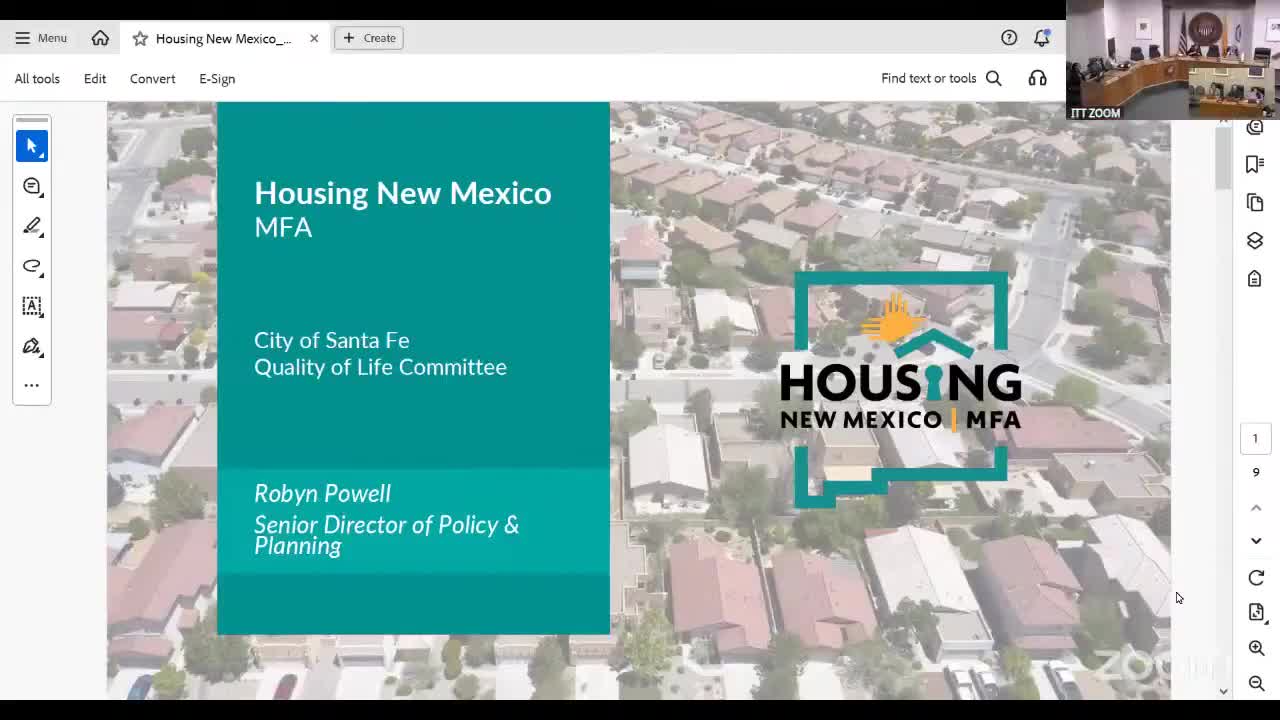
Housing New Mexico presented data and program options to the City of Santa Fe Quality of Life Committee about local housing need and programmatic tools on file with the city. Robin Powell, senior director of policy and planning at Housing New Mexico, told the committee that Santa Fe’s population grew faster than the state between 2017 and 2022 and that the city faces a “very difficult” affordability picture. Powell said roughly 40% of housing vacancy in Santa Fe is attributable to seasonal or occasional use, higher than the statewide average she cited, and that nearly 60% of renters earning under $50,000 are cost‑burdened, meaning they pay more than 30% of income for housing.
Powell said only about 8.6% of renters in Santa Fe can afford to buy the median‑priced home in the city, which she described as “nearly $600,000.” She contrasted that with a lower statewide median home price. Powell also described a rental development pipeline she said includes more than 1,100 affordable units under development in Santa Fe, representing about $424 million of investment; the presentation listed dates when projects are expected to be “placed in service.”
The presentation summarized Housing New Mexico programs that apply across the housing continuum. Powell described first‑mortgage products paired with down‑payment assistance that the agency offers, including First Home, HomeNow and HomeForward, and said the agency’s mortgage rates are commonly about 1 percentage point below market. She described preservation programs—weatherization, homeowner rehabilitation and a program to acquire, rehabilitate and resell single‑family properties—and emergency assistance, shelter operations support, state and federal voucher funding (including Section 8) and a pilot landlord incentive program.
On landlord incentives, Powell said the statewide landlord incentive requires landlords to rent to voucher holders and that the program is state‑funded and currently a pilot. Powell said the program can be used to help landlords bring units up to standard so they can accept vouchers. Director Hammond Paul (city staff) and council members pressed for more timeline detail on two local projects named in the presentation: Bella Luce and the Lamplighter/Lamblighter project. Powell said the projects remain viable; Hammond Paul said some projects that include tax credit subsidies have strict deadlines and thresholds and that, from the city’s perspective, public funds tied to Lamplighter were expected to be expended by June 2026.
Committee members asked for clarifications Housing New Mexico agreed to supply in writing, including project‑level timelines and a breakdown of the pipeline between rental and for‑sale units. Powell said single‑family definitions for some MFA programs extend to 1–4 units, and separate rental development and preservation funding typically covers larger multifamily projects.
The committee discussion included repeated requests for greater clarity about which projects in the pipeline are inside city limits versus county projects and for more detail about workforce housing eligibility. Powell said federal funding typically limits assistance to households up to 80% of area median income (AMI), while state programs and certain tax‑exempt bond programs can reach roughly 115–120% of AMI; the agency said it aims to serve working families within those limits.
The committee did not take a formal vote on policy changes. Members requested follow‑up materials from Housing New Mexico and city staff, including a written update on the Lamplighter timeline and a city‑specific breakdown of units under construction versus in the broader pipeline.
Ending: Housing New Mexico offered to provide written clarifications and to follow up with the committee; city staff said they would compile city‑specific counts for construction and pipeline projects and bring further detail back to the committee.
Powell said only about 8.6% of renters in Santa Fe can afford to buy the median‑priced home in the city, which she described as “nearly $600,000.” She contrasted that with a lower statewide median home price. Powell also described a rental development pipeline she said includes more than 1,100 affordable units under development in Santa Fe, representing about $424 million of investment; the presentation listed dates when projects are expected to be “placed in service.”
The presentation summarized Housing New Mexico programs that apply across the housing continuum. Powell described first‑mortgage products paired with down‑payment assistance that the agency offers, including First Home, HomeNow and HomeForward, and said the agency’s mortgage rates are commonly about 1 percentage point below market. She described preservation programs—weatherization, homeowner rehabilitation and a program to acquire, rehabilitate and resell single‑family properties—and emergency assistance, shelter operations support, state and federal voucher funding (including Section 8) and a pilot landlord incentive program.
On landlord incentives, Powell said the statewide landlord incentive requires landlords to rent to voucher holders and that the program is state‑funded and currently a pilot. Powell said the program can be used to help landlords bring units up to standard so they can accept vouchers. Director Hammond Paul (city staff) and council members pressed for more timeline detail on two local projects named in the presentation: Bella Luce and the Lamplighter/Lamblighter project. Powell said the projects remain viable; Hammond Paul said some projects that include tax credit subsidies have strict deadlines and thresholds and that, from the city’s perspective, public funds tied to Lamplighter were expected to be expended by June 2026.
Committee members asked for clarifications Housing New Mexico agreed to supply in writing, including project‑level timelines and a breakdown of the pipeline between rental and for‑sale units. Powell said single‑family definitions for some MFA programs extend to 1–4 units, and separate rental development and preservation funding typically covers larger multifamily projects.
The committee discussion included repeated requests for greater clarity about which projects in the pipeline are inside city limits versus county projects and for more detail about workforce housing eligibility. Powell said federal funding typically limits assistance to households up to 80% of area median income (AMI), while state programs and certain tax‑exempt bond programs can reach roughly 115–120% of AMI; the agency said it aims to serve working families within those limits.
The committee did not take a formal vote on policy changes. Members requested follow‑up materials from Housing New Mexico and city staff, including a written update on the Lamplighter timeline and a city‑specific breakdown of units under construction versus in the broader pipeline.
Ending: Housing New Mexico offered to provide written clarifications and to follow up with the committee; city staff said they would compile city‑specific counts for construction and pipeline projects and bring further detail back to the committee.
Don't Miss a Word: See the Full Meeting!
Go beyond summaries. Unlock every video, transcript, and key insight with a Founder Membership.
✓
Get instant access to full meeting videos
✓
Search and clip any phrase from complete transcripts
✓
Receive AI-powered summaries & custom alerts
✓
Enjoy lifetime, unrestricted access to government data
30-day money-back guarantee
