GCCC Ice Arena shut down after system failures; city details $1.4M in repairs, procurement hurdles and Nov. window for reopening
August 21, 2025 | Santa Fe, Santa Fe County, New Mexico
This article was created by AI summarizing key points discussed. AI makes mistakes, so for full details and context, please refer to the video of the full meeting. Please report any errors so we can fix them. Report an error »
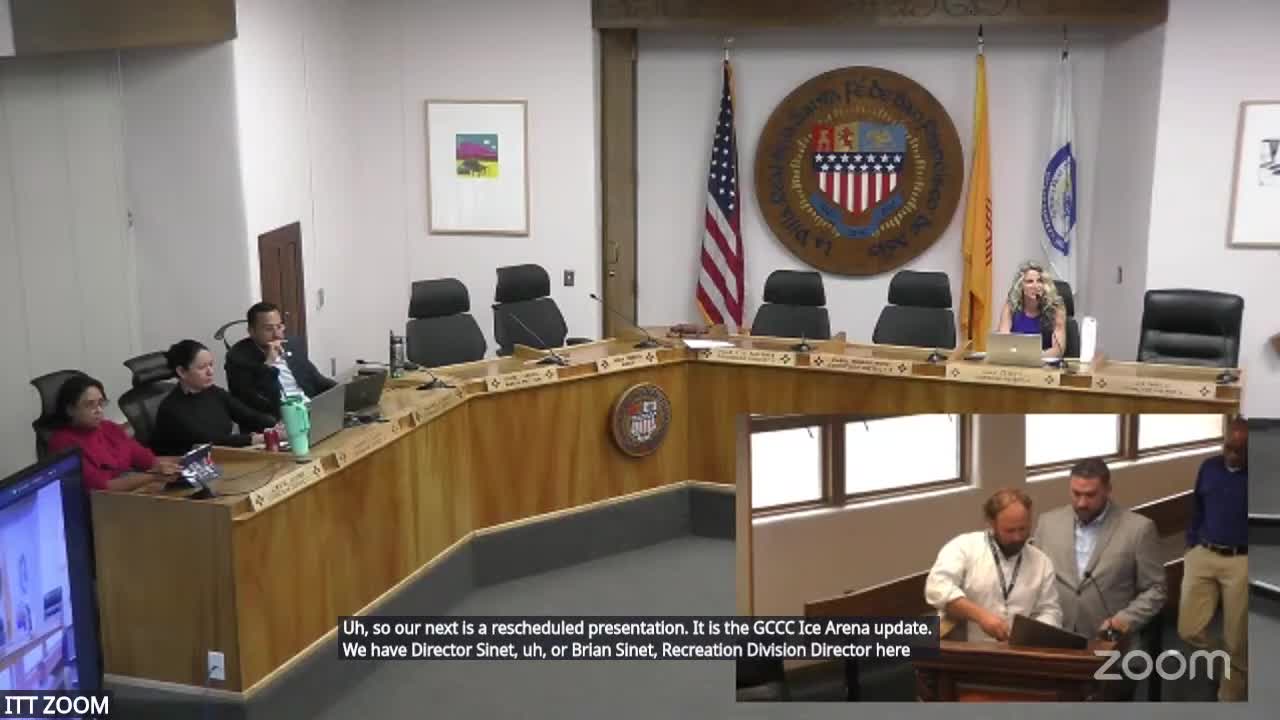
At the Quality of Life Committee meeting, Brian Sannette, Recreation Division Director, delivered a technical update on the GCCC Ice Arena (presented as "G C C C Ice Arena" in staff materials). Sannette summarized years of cumulative maintenance issues, distinct equipment failures across multiple summers, and current procurement and timeline constraints for repairs.
Sannette said the arenaclosed on June 9 after the combination of long compressor run times and cooling‑tower capacity problems triggered safety shutdowns: "The long run times, the cooling towers unable to keep up with the demand, set off our vehicle warning light, shut down or you're gonna damage the vehicle. And that's where we arrived on June 9." He explained that the arena depends on three interdependent systems (compressors/chillers, cooling towers and water treatment, and HVAC/dehumidification) and that failures in any one system can make the ice unsustainable.
Key factual points presented
- Equipment age and prior work: Several original plant components date to the 1999–2000 build. Skid 2 (a compressor package) was replaced in 2019 at roughly $500,000, and the presentation said total city investment in rink repairs and related work from 2019 through 2025 is about $1,400,000.
- Multiple, separate failure causes: Sannette outlined that each summer's shutdown had different proximate causes: 2023 (safety systems/chiller maintenance and a leaking valve), 2024 (HVAC failures and loss of primary coolant), and 2025 (cooling tower and dehumidifier failures). He said those layered problems, plus insufficient original design capacity for the high‑desert climate, contributed to the June failure.
- Recent and planned repairs: City contractors rebuilt or replaced compressors in 2024–2025; the facilities division replaced HVAC in 2024. The presentation identified remaining work on cooling towers and the dehumidifier drum, and showed procurement steps completed and pending. Sannette reported B and D Industries provided an emergency services quote and Arena Products supplied parts; the final labor/installation bid to the city was about $267,000 (the presentation noted an earlier $222,000 bid). The city has meteor appropriations of roughly $140,000 (cooling towers), $40,000 (compressor 3), and $50,000 (Munter's unit) of which $20,000 was already deployed; staff said about $170,000 remains from those appropriations for rink repairs and related needs.
- Procurement and licensing hurdles: Sannette told the committee that procurement rules (the city does not make large vendor down payments) and licensing reciprocity limited vendor options. Arena Products had relevant arena expertise but not a New Mexico mechanical license; other vendors required 50% upfront payments the city could not make under procurement rules. Staff said those constraints led to emergency and sole‑source procurements and added time to repairs.
- Timeline and reopening window: Staff provided vendor lead times: equipment deliverables about 8–10 weeks and installation 1–2 weeks (with a range depending on engineering, crane work, permitting and subcontractors). Cooling towers were said to be roughly seven weeks on order; the presentation projected a conditional November 1–17 window for having ice restored if no major subcontractor or supply delays occur.
- Maintenance and budgeting recommendations: Sannette proposed a maintenance schedule (routine cleaning/descale annually for cooling towers; rebuilds and top‑end compressor work on multi‑year cycles) and told the committee the current three‑year average budget model understates the larger fourth‑ and fifth‑year capital needs for rink systems. He and staff recommended a dedicated recreation maintenance position with certified ice arena technician expertise and a revised budgeting approach that builds multi‑year equipment replacement cycles into capital planning.
Questions and follow up: Councilors pushed for regular public updates for user groups and recommended posting a dedicated web page with status and timelines. Councilor Travis and others asked that staff be transparent about timeline shifts caused by outside subcontractor lead times. Sannette said staff already sends routine updates to user groups and agreed to include the governing body on BCCs for those updates.
Ending: The committee thanked staff for a technical briefing. Staff emphasized the November window is conditional on timely deliveries and subcontractor schedules and said funding rollovers and remaining meteor appropriations should allow the city to proceed without moving money from unrelated projects if all approvals and rollovers are completed.
Sannette said the arenaclosed on June 9 after the combination of long compressor run times and cooling‑tower capacity problems triggered safety shutdowns: "The long run times, the cooling towers unable to keep up with the demand, set off our vehicle warning light, shut down or you're gonna damage the vehicle. And that's where we arrived on June 9." He explained that the arena depends on three interdependent systems (compressors/chillers, cooling towers and water treatment, and HVAC/dehumidification) and that failures in any one system can make the ice unsustainable.
Key factual points presented
- Equipment age and prior work: Several original plant components date to the 1999–2000 build. Skid 2 (a compressor package) was replaced in 2019 at roughly $500,000, and the presentation said total city investment in rink repairs and related work from 2019 through 2025 is about $1,400,000.
- Multiple, separate failure causes: Sannette outlined that each summer's shutdown had different proximate causes: 2023 (safety systems/chiller maintenance and a leaking valve), 2024 (HVAC failures and loss of primary coolant), and 2025 (cooling tower and dehumidifier failures). He said those layered problems, plus insufficient original design capacity for the high‑desert climate, contributed to the June failure.
- Recent and planned repairs: City contractors rebuilt or replaced compressors in 2024–2025; the facilities division replaced HVAC in 2024. The presentation identified remaining work on cooling towers and the dehumidifier drum, and showed procurement steps completed and pending. Sannette reported B and D Industries provided an emergency services quote and Arena Products supplied parts; the final labor/installation bid to the city was about $267,000 (the presentation noted an earlier $222,000 bid). The city has meteor appropriations of roughly $140,000 (cooling towers), $40,000 (compressor 3), and $50,000 (Munter's unit) of which $20,000 was already deployed; staff said about $170,000 remains from those appropriations for rink repairs and related needs.
- Procurement and licensing hurdles: Sannette told the committee that procurement rules (the city does not make large vendor down payments) and licensing reciprocity limited vendor options. Arena Products had relevant arena expertise but not a New Mexico mechanical license; other vendors required 50% upfront payments the city could not make under procurement rules. Staff said those constraints led to emergency and sole‑source procurements and added time to repairs.
- Timeline and reopening window: Staff provided vendor lead times: equipment deliverables about 8–10 weeks and installation 1–2 weeks (with a range depending on engineering, crane work, permitting and subcontractors). Cooling towers were said to be roughly seven weeks on order; the presentation projected a conditional November 1–17 window for having ice restored if no major subcontractor or supply delays occur.
- Maintenance and budgeting recommendations: Sannette proposed a maintenance schedule (routine cleaning/descale annually for cooling towers; rebuilds and top‑end compressor work on multi‑year cycles) and told the committee the current three‑year average budget model understates the larger fourth‑ and fifth‑year capital needs for rink systems. He and staff recommended a dedicated recreation maintenance position with certified ice arena technician expertise and a revised budgeting approach that builds multi‑year equipment replacement cycles into capital planning.
Questions and follow up: Councilors pushed for regular public updates for user groups and recommended posting a dedicated web page with status and timelines. Councilor Travis and others asked that staff be transparent about timeline shifts caused by outside subcontractor lead times. Sannette said staff already sends routine updates to user groups and agreed to include the governing body on BCCs for those updates.
Ending: The committee thanked staff for a technical briefing. Staff emphasized the November window is conditional on timely deliveries and subcontractor schedules and said funding rollovers and remaining meteor appropriations should allow the city to proceed without moving money from unrelated projects if all approvals and rollovers are completed.
Don't Miss a Word: See the Full Meeting!
Go beyond summaries. Unlock every video, transcript, and key insight with a Founder Membership.
✓
Get instant access to full meeting videos
✓
Search and clip any phrase from complete transcripts
✓
Receive AI-powered summaries & custom alerts
✓
Enjoy lifetime, unrestricted access to government data
30-day money-back guarantee
