Santa Fe discussion centers on proposed living-wage increase to $17.50 with one-year delay
August 21, 2025 | Santa Fe, Santa Fe County, New Mexico
This article was created by AI summarizing key points discussed. AI makes mistakes, so for full details and context, please refer to the video of the full meeting. Please report any errors so we can fix them. Report an error »
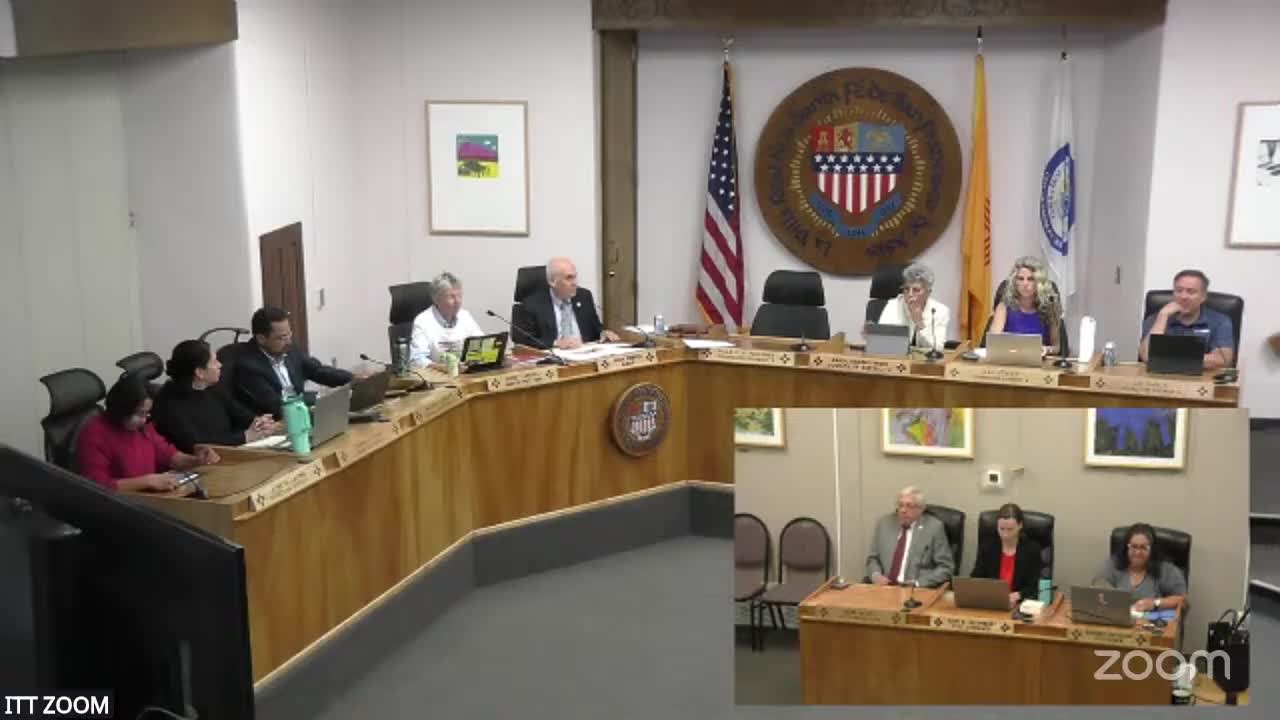
The Santa Fe governing body discussed a proposal to raise the city's living wage from $15 to $17.50 an hour and to delay implementation for one year so employers and the local economy can adjust.
The proposal, presented at a special study session by Rod Gould, senior adviser for public engagement, would also change the annual escalator for the living wage so future increases are based 50% on the Western regional consumer price index and 50% on HUD's fair market rent for a two-bedroom unit in Santa Fe, with a 5% annual cap and a 0% floor.
Why it matters: City staff and councilors said housing costs are a principal factor in who can live and work in Santa Fe; the proposal ties wage growth explicitly to a housing measure in an effort to keep long-term residents from being displaced.
Details of the proposal and background
Rod Gould said the draft would raise the living wage to $17.50 an hour and then hold that increase in abeyance for one year while the city assesses national and local economic conditions. Gould described the escalator change as a direct link between wages and rents: "by linking any increase to the fair market rent for a 2 bedroom rental, we are acknowledging the significance of rents in achieving our policy goal." He told the council the draft would retain existing carve-outs, such as current handling of tipped wages and exemptions for nonprofits highly dependent on Medicaid reimbursement.
The presentation included housing data from the Santa Fe Forward assessment: the city will need more than 3,000 new units by 2050 (not including current unmet demand), staff said there are roughly 2,000 units under construction and about 4,000 more in the pipeline, and that rents rose by about 0.5% from 2024 to 2025. Gould also described modeling by economist Riley White showing three scenarios; White's mid-range projection produced an average annual wage increase of about 2.6% that would push the $17.50 level into the low $20s over several years.
What would change under the proposal
- Immediate new nominal level: $17.50 per hour (up from $15).
- One-year implementation delay (abeyance) to give employers time to prepare and to monitor macroeconomic uncertainty.
- Annual increases: 50% Western regional CPI + 50% HUD two-bedroom fair market rent for Santa Fe; capped at 5% and floored at 0%.
- Tipped employees: the ordinance would keep existing treatment; tips would continue to count toward the living wage and the base tipped rate would be preserved.
- Exemptions: nonprofits heavily reliant on Medicaid reimbursement would remain exempt per the draft.
- Enforcement: the current complaint-based enforcement model would continue, administered by the city manager or designee; staff noted few complaints historically but acknowledged enforcement capacity could become more salient if the wage is raised.
Councilor and stakeholder perspectives
Councilor Lindell praised the vetting and stakeholder outreach and said she especially "like[d] that it's been vetted through Chamber of Commerce, hospitality, hospital, nonprofits, unions." Lindell and other councilors asked for more empirical data on how many private-sector positions are at or near the current $15 level and how many would be affected.
Councilor Cassett said community input is essential and asked for demographic and workforce breakdowns, including what percentage of workers would see direct increases and how benefits are counted. Gould confirmed the current ordinance permits employers to count employer-provided health care and child care toward the living-wage calculation.
Councilor John (first name not specified in the transcript) and others urged robust town-hall engagement before a final decision; several councilors expressed support for a roundtable format with translation and childcare to increase participation.
Councilor Michael Garcia, speaking as a business-owner, said he supports raising wages for city employees immediately and asked the council to consider starting with municipal payroll: "Let's begin to pay every single city worker a minimum of $17.50 right now." City staff responded that of the city's roughly 1,350 employees, about 18 earn between $17 and $17.50 in straight wages (the lowest reported at $17), and those employees also receive the city's benefits package.
Councilor Lee Garcia and Councilor Romero Worth voiced concern about potential impacts on small businesses, youth employment, tipped and commission-based work, payroll taxes and how employers might respond by raising prices or reducing hours. Romero Worth said employers asked for "some advanced warning" so they could plan for a substantial increase.
Enforcement and worker protections
Councilors and staff discussed the ordinance's current complaint-driven enforcement model. Staff and the city attorney said complaints have historically been uncommon and have been resolved through the city attorney's office and community organizations. Councilors urged clearer intake processes and increased outreach; one councilor described a recent case in which a constituent had difficulty finding the city's complaint form and asked staff to improve the process.
Next steps
No vote or ordinance was adopted at the study session. Staff said they will schedule community engagement (town halls and roundtables) including the public event currently planned for Sept. 9 (city staff indicated scheduling flexibility if that date conflicts with other community events), gather additional data requested by the council, share materials from economist Riley White, and return to the governing body in further work sessions.
Votes at a glance
No formal motions or votes were taken at the study session; councilors directed staff to pursue community engagement and additional analysis prior to any formal ordinance or vote.
Ending
Councilors and staff concluded the study session with agreement to pursue broader public engagement and additional analysis; staff said they had "4 or 5 pages of notes" and would continue the work publicly. The governing body did not take formal action on the proposal.
The proposal, presented at a special study session by Rod Gould, senior adviser for public engagement, would also change the annual escalator for the living wage so future increases are based 50% on the Western regional consumer price index and 50% on HUD's fair market rent for a two-bedroom unit in Santa Fe, with a 5% annual cap and a 0% floor.
Why it matters: City staff and councilors said housing costs are a principal factor in who can live and work in Santa Fe; the proposal ties wage growth explicitly to a housing measure in an effort to keep long-term residents from being displaced.
Details of the proposal and background
Rod Gould said the draft would raise the living wage to $17.50 an hour and then hold that increase in abeyance for one year while the city assesses national and local economic conditions. Gould described the escalator change as a direct link between wages and rents: "by linking any increase to the fair market rent for a 2 bedroom rental, we are acknowledging the significance of rents in achieving our policy goal." He told the council the draft would retain existing carve-outs, such as current handling of tipped wages and exemptions for nonprofits highly dependent on Medicaid reimbursement.
The presentation included housing data from the Santa Fe Forward assessment: the city will need more than 3,000 new units by 2050 (not including current unmet demand), staff said there are roughly 2,000 units under construction and about 4,000 more in the pipeline, and that rents rose by about 0.5% from 2024 to 2025. Gould also described modeling by economist Riley White showing three scenarios; White's mid-range projection produced an average annual wage increase of about 2.6% that would push the $17.50 level into the low $20s over several years.
What would change under the proposal
- Immediate new nominal level: $17.50 per hour (up from $15).
- One-year implementation delay (abeyance) to give employers time to prepare and to monitor macroeconomic uncertainty.
- Annual increases: 50% Western regional CPI + 50% HUD two-bedroom fair market rent for Santa Fe; capped at 5% and floored at 0%.
- Tipped employees: the ordinance would keep existing treatment; tips would continue to count toward the living wage and the base tipped rate would be preserved.
- Exemptions: nonprofits heavily reliant on Medicaid reimbursement would remain exempt per the draft.
- Enforcement: the current complaint-based enforcement model would continue, administered by the city manager or designee; staff noted few complaints historically but acknowledged enforcement capacity could become more salient if the wage is raised.
Councilor and stakeholder perspectives
Councilor Lindell praised the vetting and stakeholder outreach and said she especially "like[d] that it's been vetted through Chamber of Commerce, hospitality, hospital, nonprofits, unions." Lindell and other councilors asked for more empirical data on how many private-sector positions are at or near the current $15 level and how many would be affected.
Councilor Cassett said community input is essential and asked for demographic and workforce breakdowns, including what percentage of workers would see direct increases and how benefits are counted. Gould confirmed the current ordinance permits employers to count employer-provided health care and child care toward the living-wage calculation.
Councilor John (first name not specified in the transcript) and others urged robust town-hall engagement before a final decision; several councilors expressed support for a roundtable format with translation and childcare to increase participation.
Councilor Michael Garcia, speaking as a business-owner, said he supports raising wages for city employees immediately and asked the council to consider starting with municipal payroll: "Let's begin to pay every single city worker a minimum of $17.50 right now." City staff responded that of the city's roughly 1,350 employees, about 18 earn between $17 and $17.50 in straight wages (the lowest reported at $17), and those employees also receive the city's benefits package.
Councilor Lee Garcia and Councilor Romero Worth voiced concern about potential impacts on small businesses, youth employment, tipped and commission-based work, payroll taxes and how employers might respond by raising prices or reducing hours. Romero Worth said employers asked for "some advanced warning" so they could plan for a substantial increase.
Enforcement and worker protections
Councilors and staff discussed the ordinance's current complaint-driven enforcement model. Staff and the city attorney said complaints have historically been uncommon and have been resolved through the city attorney's office and community organizations. Councilors urged clearer intake processes and increased outreach; one councilor described a recent case in which a constituent had difficulty finding the city's complaint form and asked staff to improve the process.
Next steps
No vote or ordinance was adopted at the study session. Staff said they will schedule community engagement (town halls and roundtables) including the public event currently planned for Sept. 9 (city staff indicated scheduling flexibility if that date conflicts with other community events), gather additional data requested by the council, share materials from economist Riley White, and return to the governing body in further work sessions.
Votes at a glance
No formal motions or votes were taken at the study session; councilors directed staff to pursue community engagement and additional analysis prior to any formal ordinance or vote.
Ending
Councilors and staff concluded the study session with agreement to pursue broader public engagement and additional analysis; staff said they had "4 or 5 pages of notes" and would continue the work publicly. The governing body did not take formal action on the proposal.
Don't Miss a Word: See the Full Meeting!
Go beyond summaries. Unlock every video, transcript, and key insight with a Founder Membership.
✓
Get instant access to full meeting videos
✓
Search and clip any phrase from complete transcripts
✓
Receive AI-powered summaries & custom alerts
✓
Enjoy lifetime, unrestricted access to government data
30-day money-back guarantee
