Council advances Downtown Honolulu Business Improvement District after wide public support and Chinatown inclusion debate
September 04, 2025 | Honolulu City, Honolulu County, Hawaii
This article was created by AI summarizing key points discussed. AI makes mistakes, so for full details and context, please refer to the video of the full meeting. Please report any errors so we can fix them. Report an error »
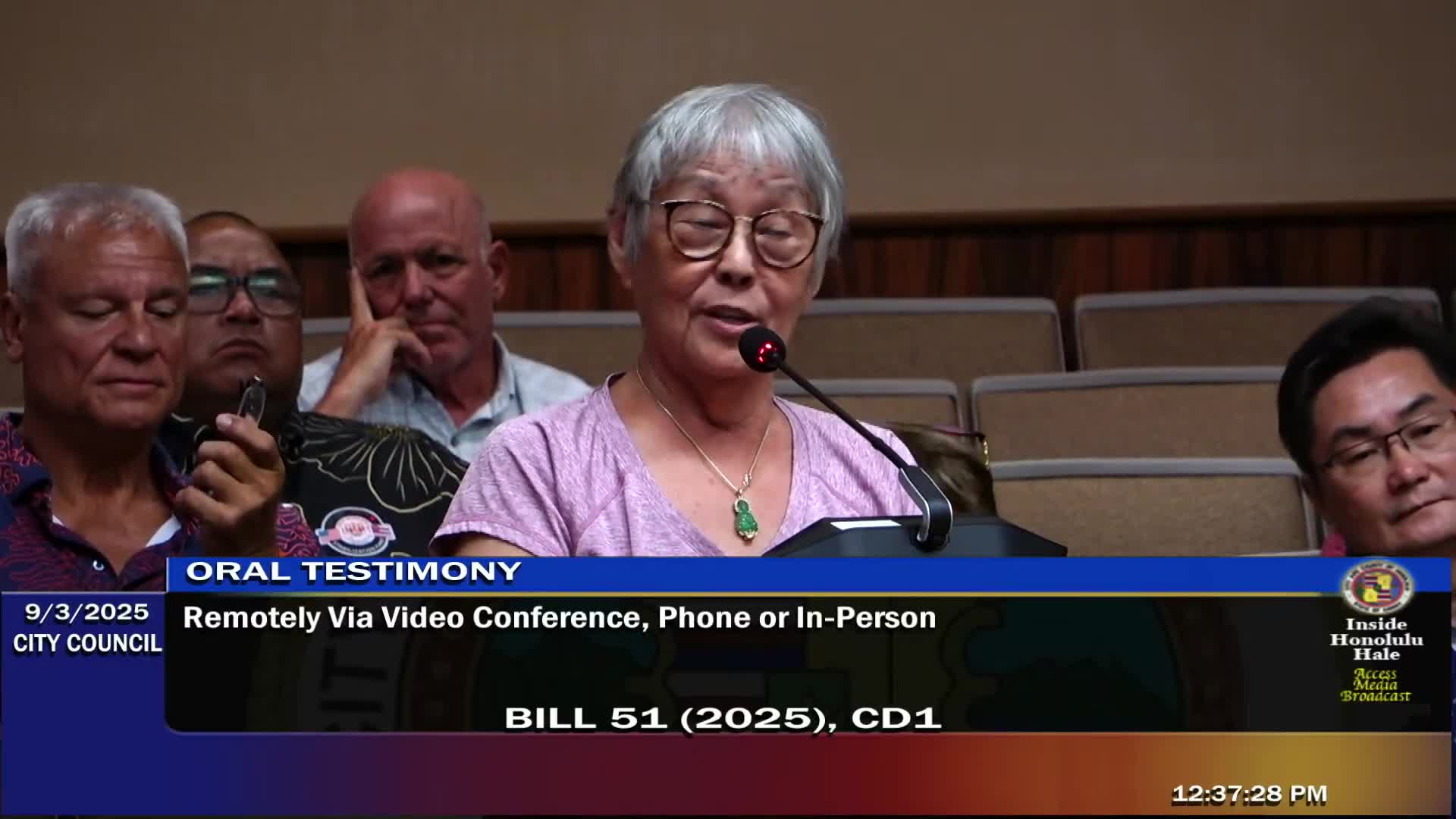
The Honolulu City Council voted to advance Bill 51, a proposal to create a Downtown Business Improvement District (BID), after a long public hearing that included business owners, property managers and community leaders from both downtown and neighboring Chinatown.
Supporters told the council a BID would fund supplemental cleaning, power washing, graffiti removal and private security that local stakeholders say the city currently cannot provide at the needed scale. “This bill will allow us to capitalize on the momentum that’s happening downtown,” said Andrew Pereira of Pacific Resource Partnership, who testified in support. Several business owners and tenants — including a downtown bubble-tea shop owner and representatives of hotels and developers — described foot-traffic gains and said they wanted consistent cleanliness and security to sustain investment.
Opponents and cautious stakeholders raised two recurring themes: first, some property owners asked for more evidence the BID model (as currently structured) will deliver measurable reductions in homelessness and crime; second, Chinatown leaders urged either immediate inclusion of Chinatown parcels or a committed, short timeline to add the historic district in a second phase. “When downtown thrives, Chinatown breathes easier,” said a Chinatown property owner who urged inclusion in a near-term expansion. Several Chinatown speakers said they had insufficient public notice to organize and recommended the council adopt a phased approach — enact the BID now, but add Chinatown in phase two with a clear schedule and commitment of some initial district funds for Chinatown cleanup and security.
Council conversation reflected those split concerns. Council Member Kia Aina, who chairs Zoning and Planning, said the measure was not being rushed: the procedure would allow additional hearings and a return to committee for further refinements. After the hearing, the council adopted the committee report and passed Bill 51 to second reading by roll call, with nine ayes recorded.
Discussion vs. decision: The council advanced the bill past second reading, meaning it will return for further committee review and a subsequent vote. Several council members and speakers asked for follow-up items and committee briefings on BID governance, potential effects on Chinatown, and the proposed assessment formula for property owners.
Ending: Supporters described the BID as a pragmatic tool to fund day-to-day street services and community advocacy; Chinatown stakeholders urged that the measure include or quickly expand to include their district so improvements affect both neighborhoods simultaneously. The Council agreed to move the measure forward to allow additional committee-level discussion and to develop implementation details.
Supporters told the council a BID would fund supplemental cleaning, power washing, graffiti removal and private security that local stakeholders say the city currently cannot provide at the needed scale. “This bill will allow us to capitalize on the momentum that’s happening downtown,” said Andrew Pereira of Pacific Resource Partnership, who testified in support. Several business owners and tenants — including a downtown bubble-tea shop owner and representatives of hotels and developers — described foot-traffic gains and said they wanted consistent cleanliness and security to sustain investment.
Opponents and cautious stakeholders raised two recurring themes: first, some property owners asked for more evidence the BID model (as currently structured) will deliver measurable reductions in homelessness and crime; second, Chinatown leaders urged either immediate inclusion of Chinatown parcels or a committed, short timeline to add the historic district in a second phase. “When downtown thrives, Chinatown breathes easier,” said a Chinatown property owner who urged inclusion in a near-term expansion. Several Chinatown speakers said they had insufficient public notice to organize and recommended the council adopt a phased approach — enact the BID now, but add Chinatown in phase two with a clear schedule and commitment of some initial district funds for Chinatown cleanup and security.
Council conversation reflected those split concerns. Council Member Kia Aina, who chairs Zoning and Planning, said the measure was not being rushed: the procedure would allow additional hearings and a return to committee for further refinements. After the hearing, the council adopted the committee report and passed Bill 51 to second reading by roll call, with nine ayes recorded.
Discussion vs. decision: The council advanced the bill past second reading, meaning it will return for further committee review and a subsequent vote. Several council members and speakers asked for follow-up items and committee briefings on BID governance, potential effects on Chinatown, and the proposed assessment formula for property owners.
Ending: Supporters described the BID as a pragmatic tool to fund day-to-day street services and community advocacy; Chinatown stakeholders urged that the measure include or quickly expand to include their district so improvements affect both neighborhoods simultaneously. The Council agreed to move the measure forward to allow additional committee-level discussion and to develop implementation details.
View the Full Meeting & All Its Details
This article offers just a summary. Unlock complete video, transcripts, and insights as a Founder Member.
✓
Watch full, unedited meeting videos
✓
Search every word spoken in unlimited transcripts
✓
AI summaries & real-time alerts (all government levels)
✓
Permanent access to expanding government content
30-day money-back guarantee
