Officials brief council committee on rulemaking under HRS Chapter 91; urge targeted reviews and cleanups
August 22, 2025 | Honolulu City, Honolulu County, Hawaii
This article was created by AI summarizing key points discussed. AI makes mistakes, so for full details and context, please refer to the video of the full meeting. Please report any errors so we can fix them. Report an error »
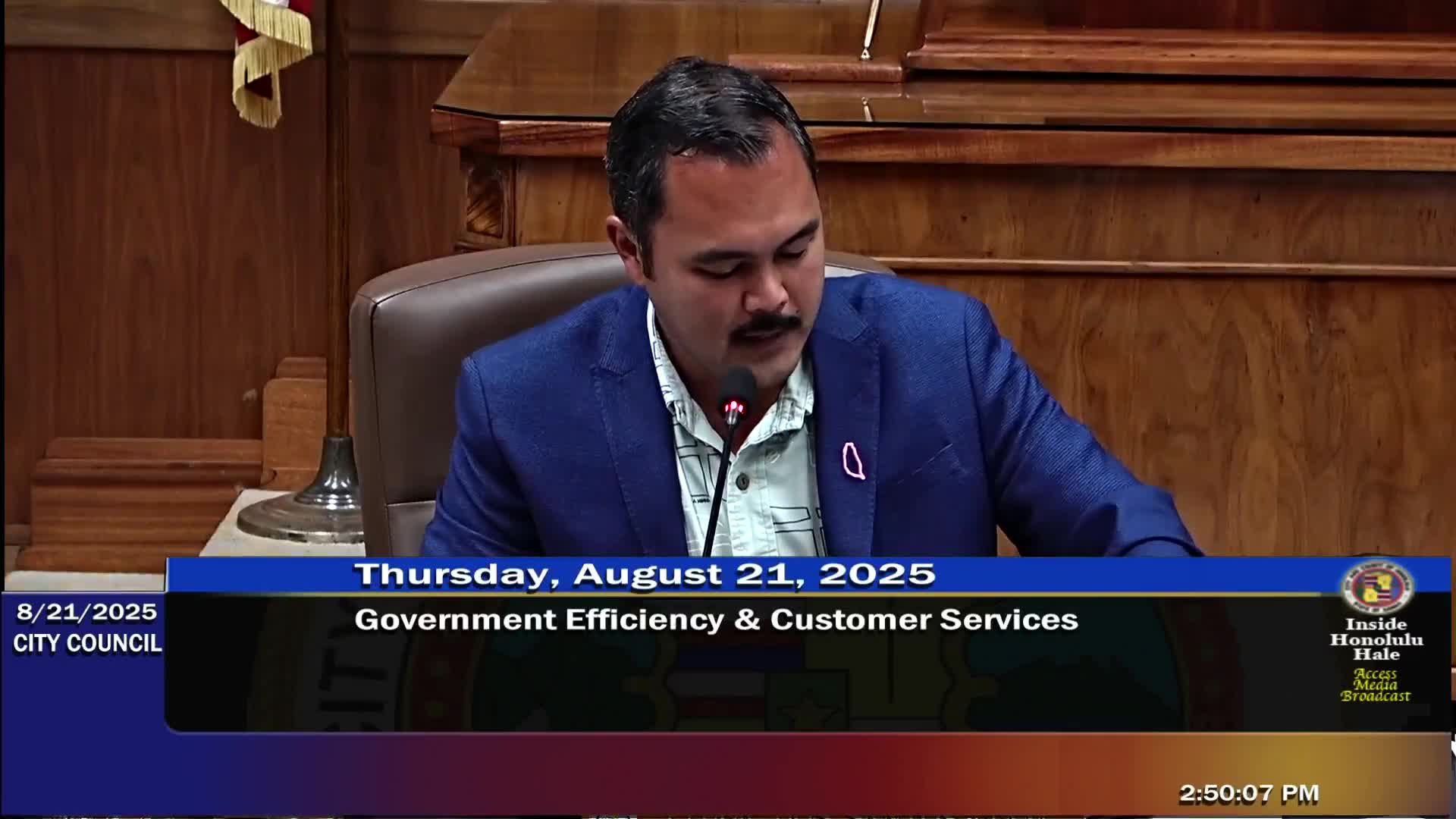
City officials briefed the Honolulu City Council Committee on Government Efficiency and Customer Services on Aug. 21 on how rulemaking is governed under Hawaii’s Administrative Procedure Act (HRS Chapter 91) and on when departments must adopt administrative rules.
Managing Director Mike Formby summarized the legal framework, saying the process is governed by HRS Chapter 91 and that a definition of “rule” excludes internal management matters and rules that do not affect private rights. He told the committee rules are required when the affected public needs to know procedures that are not plainly evident in statutes or ordinances and that, “If the ordinance contains sufficient specificity to inform the public, even if the ordinance states that the agency shall adopt rules, rules would not be mandated by” the Administrative Procedure Act.
Dana Viola, corporation counsel, told the committee that whether language in ordinance uses “shall” or “may” can be a cleanup item but that state law governs whether rules are legally required. She said changing “shall” to “may” in ordinances could reduce public confusion but is not legally necessary because the state statute that governs rulemaking takes precedence. Viola advised the committee that recommendations to the departments for rulemaking are appropriate and that counsel will work with departments where rules were expected but not drafted.
Officials said rule adoption and rule amendments follow the same timeline and procedures—notice, public hearing, consideration of public testimony—and that amendments to rules use the same process as initial adoption. Formby and Viola offered the community workforce agreement as an example: the administration is drafting rules so that enforcement and procedures are clear to the public.
Committee members asked operational questions. Council Member Weier asked whether it is preferable to put more specificity in ordinances rather than in rules; Viola and Formby said it depends on subject matter and that highly technical or frequently changing implementation details are often better handled in rules so they can be updated more quickly than ordinances. The committee also raised the need to review old rules tied to legacy paper-based processes after software modernization; Formby said departments such as the Department of Planning and Permitting should “go back and look at rules” now that they have new online systems, and he named DPP Director Takauchi Opuna and Deputy Brian Gallagher as staff who have put out FAQs and should review rules.
Chair Del Santos Tam said his office counted multiple instances where council-created rulemaking authority had not been followed by departments and that the committee will continue cleanup work to determine when ordinance language should be clarified or left to departmental rulemaking. There was no public testimony and no formal committee action on the informational briefing.
Managing Director Mike Formby summarized the legal framework, saying the process is governed by HRS Chapter 91 and that a definition of “rule” excludes internal management matters and rules that do not affect private rights. He told the committee rules are required when the affected public needs to know procedures that are not plainly evident in statutes or ordinances and that, “If the ordinance contains sufficient specificity to inform the public, even if the ordinance states that the agency shall adopt rules, rules would not be mandated by” the Administrative Procedure Act.
Dana Viola, corporation counsel, told the committee that whether language in ordinance uses “shall” or “may” can be a cleanup item but that state law governs whether rules are legally required. She said changing “shall” to “may” in ordinances could reduce public confusion but is not legally necessary because the state statute that governs rulemaking takes precedence. Viola advised the committee that recommendations to the departments for rulemaking are appropriate and that counsel will work with departments where rules were expected but not drafted.
Officials said rule adoption and rule amendments follow the same timeline and procedures—notice, public hearing, consideration of public testimony—and that amendments to rules use the same process as initial adoption. Formby and Viola offered the community workforce agreement as an example: the administration is drafting rules so that enforcement and procedures are clear to the public.
Committee members asked operational questions. Council Member Weier asked whether it is preferable to put more specificity in ordinances rather than in rules; Viola and Formby said it depends on subject matter and that highly technical or frequently changing implementation details are often better handled in rules so they can be updated more quickly than ordinances. The committee also raised the need to review old rules tied to legacy paper-based processes after software modernization; Formby said departments such as the Department of Planning and Permitting should “go back and look at rules” now that they have new online systems, and he named DPP Director Takauchi Opuna and Deputy Brian Gallagher as staff who have put out FAQs and should review rules.
Chair Del Santos Tam said his office counted multiple instances where council-created rulemaking authority had not been followed by departments and that the committee will continue cleanup work to determine when ordinance language should be clarified or left to departmental rulemaking. There was no public testimony and no formal committee action on the informational briefing.
Don't Miss a Word: See the Full Meeting!
Go beyond summaries. Unlock every video, transcript, and key insight with a Founder Membership.
✓
Get instant access to full meeting videos
✓
Search and clip any phrase from complete transcripts
✓
Receive AI-powered summaries & custom alerts
✓
Enjoy lifetime, unrestricted access to government data
30-day money-back guarantee
