Council adopts consolidated property‑maintenance chapter but removes rental inspection and vacant‑registry sections after public outcry
June 24, 2025 | Mexico City, Audrain County, Missouri
This article was created by AI summarizing key points discussed. AI makes mistakes, so for full details and context, please refer to the video of the full meeting. Please report any errors so we can fix them. Report an error »
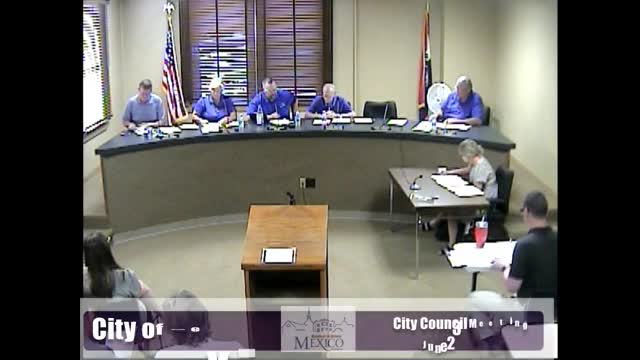
The Mexico City Council on June 23 voted to create a consolidated code‑enforcement chapter (chapter 43) but removed two contested sections — proposed residential rental inspections (Article 2) and the vacant building registry (Article 3) — for further discussion after a wave of public comment from landlords and residents.
City staff described the package as an effort to bring clarity to code enforcement by consolidating scattered provisions into one chapter and by adopting the International Property Maintenance Code (IPMC) with Mexico‑specific edits. "Article 1 is just adopting the International Property Maintenance Code," staff said during the presentation, summarizing the intent to standardize citations and processes for property maintenance violations.
Nathan Lombardo, identified in the record as deputy city manager and community development director, walked the council through the four related ordinances that together move building‑code language into appropriate chapters, create a new chapter for code enforcement and clarify when the building code applies citywide. Staff said the changes also remove duplicative enforcement language and shift code enforcement citation rules into a single place for greater consistency.
The council debated and then approved ordinance bill 20‑25‑42, titled "an ordinance creating chapter 43, property maintenance, residential rental property regulations and vacant building registry," as amended. A motion to remove Article 2 (residential rental regulations) and Article 3 (vacant building registry) for further discussion carried; the amended ordinance creating chapter 43 (with those articles removed) was then passed by the council.
Public comment that followed focused heavily on the proposed residential rental inspections and the vacant building registry. Dozens of residents — many identifying themselves as landlords — told the council the proposed rules as drafted would impose new costs, regulatory burdens and operational challenges on small property owners.
"Why are we making a problem where we don't have one?" asked Mark Rogers, a long‑time landlord, summarizing a common theme among speakers who said the city already enforces visible nuisance issues and that mandatory rental licensing or inspections would increase housing costs.
Several speakers urged the council to allow inspections only at change of occupancy or at the tenant’s request rather than implementing mandatory periodic inspections for all rental properties. Rick Pratt suggested letting tenants request inspections and pay the fee, saying the tenant should be able to decide whether to request an inspection.
Other commenters raised practical concerns about enforcement capacity and technical expectations. Contractors and landlords asked who would perform interior and subfloor inspections, whether the city would hire additional inspectors, how the city would treat older homes that do not meet modern electrical or plumbing standards, and whether banks or buyers would be affected when properties must be brought to current code.
City staff told the council the residential inspection element the ordinance proposed would focus on minimum life‑safety standards similar to those used by the state of Missouri and HUD programs and that change‑of‑occupancy inspections were the intended enforcement trigger in many cases. Staff also described an annual vacant‑property registration that would require owners to update local contact information once per year, with carve‑outs for between‑tenant repair periods and active construction.
Council action separated the technical, citywide building code and property‑maintenance consolidation from the more politically sensitive rental‑inspection and vacant‑registry proposals. By removing Articles 2 and 3, the council kept in place the structural code clarifications and adoption of a single property‑maintenance code while deferring the creation of a broad rental‑inspection regime and the vacant‑property registry for additional study and public input.
Ending
The council advanced a reorganization of the municipal code into a single chapter for property maintenance while pausing debate on mandatory rental inspections and a vacant‑property registry in response to public concerns. Staff said the new chapter will standardize enforcement processes, adopt the International Property Maintenance Code with local modifications, and allow the council to revisit residential rental and vacant‑property rules after further review and public engagement.
(Readers should note: the meeting record shows extensive public comment opposed to mandatory inspections and licensing; Council removed those items from the ordinance for further discussion.)
City staff described the package as an effort to bring clarity to code enforcement by consolidating scattered provisions into one chapter and by adopting the International Property Maintenance Code (IPMC) with Mexico‑specific edits. "Article 1 is just adopting the International Property Maintenance Code," staff said during the presentation, summarizing the intent to standardize citations and processes for property maintenance violations.
Nathan Lombardo, identified in the record as deputy city manager and community development director, walked the council through the four related ordinances that together move building‑code language into appropriate chapters, create a new chapter for code enforcement and clarify when the building code applies citywide. Staff said the changes also remove duplicative enforcement language and shift code enforcement citation rules into a single place for greater consistency.
The council debated and then approved ordinance bill 20‑25‑42, titled "an ordinance creating chapter 43, property maintenance, residential rental property regulations and vacant building registry," as amended. A motion to remove Article 2 (residential rental regulations) and Article 3 (vacant building registry) for further discussion carried; the amended ordinance creating chapter 43 (with those articles removed) was then passed by the council.
Public comment that followed focused heavily on the proposed residential rental inspections and the vacant building registry. Dozens of residents — many identifying themselves as landlords — told the council the proposed rules as drafted would impose new costs, regulatory burdens and operational challenges on small property owners.
"Why are we making a problem where we don't have one?" asked Mark Rogers, a long‑time landlord, summarizing a common theme among speakers who said the city already enforces visible nuisance issues and that mandatory rental licensing or inspections would increase housing costs.
Several speakers urged the council to allow inspections only at change of occupancy or at the tenant’s request rather than implementing mandatory periodic inspections for all rental properties. Rick Pratt suggested letting tenants request inspections and pay the fee, saying the tenant should be able to decide whether to request an inspection.
Other commenters raised practical concerns about enforcement capacity and technical expectations. Contractors and landlords asked who would perform interior and subfloor inspections, whether the city would hire additional inspectors, how the city would treat older homes that do not meet modern electrical or plumbing standards, and whether banks or buyers would be affected when properties must be brought to current code.
City staff told the council the residential inspection element the ordinance proposed would focus on minimum life‑safety standards similar to those used by the state of Missouri and HUD programs and that change‑of‑occupancy inspections were the intended enforcement trigger in many cases. Staff also described an annual vacant‑property registration that would require owners to update local contact information once per year, with carve‑outs for between‑tenant repair periods and active construction.
Council action separated the technical, citywide building code and property‑maintenance consolidation from the more politically sensitive rental‑inspection and vacant‑registry proposals. By removing Articles 2 and 3, the council kept in place the structural code clarifications and adoption of a single property‑maintenance code while deferring the creation of a broad rental‑inspection regime and the vacant‑property registry for additional study and public input.
Ending
The council advanced a reorganization of the municipal code into a single chapter for property maintenance while pausing debate on mandatory rental inspections and a vacant‑property registry in response to public concerns. Staff said the new chapter will standardize enforcement processes, adopt the International Property Maintenance Code with local modifications, and allow the council to revisit residential rental and vacant‑property rules after further review and public engagement.
(Readers should note: the meeting record shows extensive public comment opposed to mandatory inspections and licensing; Council removed those items from the ordinance for further discussion.)
View the Full Meeting & All Its Details
This article offers just a summary. Unlock complete video, transcripts, and insights as a Founder Member.
✓
Watch full, unedited meeting videos
✓
Search every word spoken in unlimited transcripts
✓
AI summaries & real-time alerts (all government levels)
✓
Permanent access to expanding government content
30-day money-back guarantee
