Port of Alaska warns of structural problems at Petroleum Terminal 2, plans condition assessment
August 22, 2025 | Anchorage Municipality, Alaska
This article was created by AI summarizing key points discussed. AI makes mistakes, so for full details and context, please refer to the video of the full meeting. Please report any errors so we can fix them. Report an error »
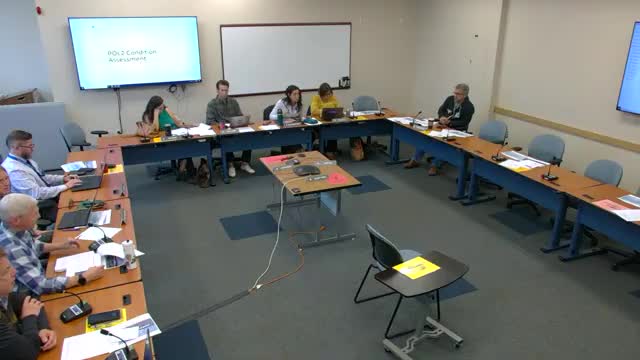
Port of Alaska staff told the Assembly Infrastructure, Enterprise and Utility Oversight Committee on Aug. 1 that substantial corrosion and other structural problems at Petroleum Terminal 2 (POL 2) require an immediate condition assessment and a load-rating analysis.
The assessment will inventory defects — including a leaking 30-year-old hydraulic crane, missing rubber fender elements, buckled fender piles, corrosion holes in pile seams, and a spalled precast pile cap exposing reinforcing and pretensioned strands — and provide cost and scope recommendations before the end of the year, officials said.
The condition assessment and the load-rating study are intended to determine whether heavy equipment can safely operate on the trestle and to estimate repairs needed to keep POL 2 functional until it is scheduled to be replaced in roughly 10 years.
"We need to keep POL 2 in operation for about 10 more years before it's scheduled to be replaced," said John Daly, Port of Alaska engineering, describing the goal of avoiding an emergency failure. "If it were to fail, it would leave the port in a very precarious position and it would then become kind of an emergency repair."
Bill Carlson, port engineer, described specific failures observed in spring cathodic-protection surveys, including spalled concrete on a pile cap that exposed rebar and possibly pretensioned strands. "We're worried about the load capacity of it," Carlson said, noting the team is limiting access until the load rating is completed.
Assemblymember Christopher Constant pressed staff on operational impacts if POL 2 were taken out of service during construction of other facilities. Daly replied that the port currently operates three petroleum-capable docks (POL 1, POL 2 and the PCT), that POL 1 will be removed during Terminal 1 construction, and that losing POL 2 would likely leave only PCT available, which would "be challenging and difficult to operate with 1 terminal."
Staff described contingency planning options including scheduling adjustments at the remaining terminal, potential temporary fueling points, raising efficiency at PCT and the possible design of a limited-capacity emergency fuel point. "This is not a decided upon scenario, and there are multiple different outcomes that could come here," said a member of the port team.
The port said the assessment work — condition report, cost estimates and a pile-cap load rating — aims to be complete by the end of the year; no contract award or appropriation for the assessment was finalized during the committee meeting.
The committee was also told the port will continue a five-year fender repair program, planned at about $2 million per year, to maintain docks while replacements proceed.
If the condition assessment shows the structure is unsafe for required operations such as crane work, port staff indicated they would have to consider accelerating repairs or adjusting PAMP sequencing to avoid prolonged single-terminal operation.
The assessment will inventory defects — including a leaking 30-year-old hydraulic crane, missing rubber fender elements, buckled fender piles, corrosion holes in pile seams, and a spalled precast pile cap exposing reinforcing and pretensioned strands — and provide cost and scope recommendations before the end of the year, officials said.
The condition assessment and the load-rating study are intended to determine whether heavy equipment can safely operate on the trestle and to estimate repairs needed to keep POL 2 functional until it is scheduled to be replaced in roughly 10 years.
"We need to keep POL 2 in operation for about 10 more years before it's scheduled to be replaced," said John Daly, Port of Alaska engineering, describing the goal of avoiding an emergency failure. "If it were to fail, it would leave the port in a very precarious position and it would then become kind of an emergency repair."
Bill Carlson, port engineer, described specific failures observed in spring cathodic-protection surveys, including spalled concrete on a pile cap that exposed rebar and possibly pretensioned strands. "We're worried about the load capacity of it," Carlson said, noting the team is limiting access until the load rating is completed.
Assemblymember Christopher Constant pressed staff on operational impacts if POL 2 were taken out of service during construction of other facilities. Daly replied that the port currently operates three petroleum-capable docks (POL 1, POL 2 and the PCT), that POL 1 will be removed during Terminal 1 construction, and that losing POL 2 would likely leave only PCT available, which would "be challenging and difficult to operate with 1 terminal."
Staff described contingency planning options including scheduling adjustments at the remaining terminal, potential temporary fueling points, raising efficiency at PCT and the possible design of a limited-capacity emergency fuel point. "This is not a decided upon scenario, and there are multiple different outcomes that could come here," said a member of the port team.
The port said the assessment work — condition report, cost estimates and a pile-cap load rating — aims to be complete by the end of the year; no contract award or appropriation for the assessment was finalized during the committee meeting.
The committee was also told the port will continue a five-year fender repair program, planned at about $2 million per year, to maintain docks while replacements proceed.
If the condition assessment shows the structure is unsafe for required operations such as crane work, port staff indicated they would have to consider accelerating repairs or adjusting PAMP sequencing to avoid prolonged single-terminal operation.
View the Full Meeting & All Its Details
This article offers just a summary. Unlock complete video, transcripts, and insights as a Founder Member.
✓
Watch full, unedited meeting videos
✓
Search every word spoken in unlimited transcripts
✓
AI summaries & real-time alerts (all government levels)
✓
Permanent access to expanding government content
30-day money-back guarantee
