ACE Fund board reports first year distributions: subsidies, operational grants and pilots underway
September 04, 2025 | Anchorage Municipality, Alaska
This article was created by AI summarizing key points discussed. AI makes mistakes, so for full details and context, please refer to the video of the full meeting. Please report any errors so we can fix them. Report an error »
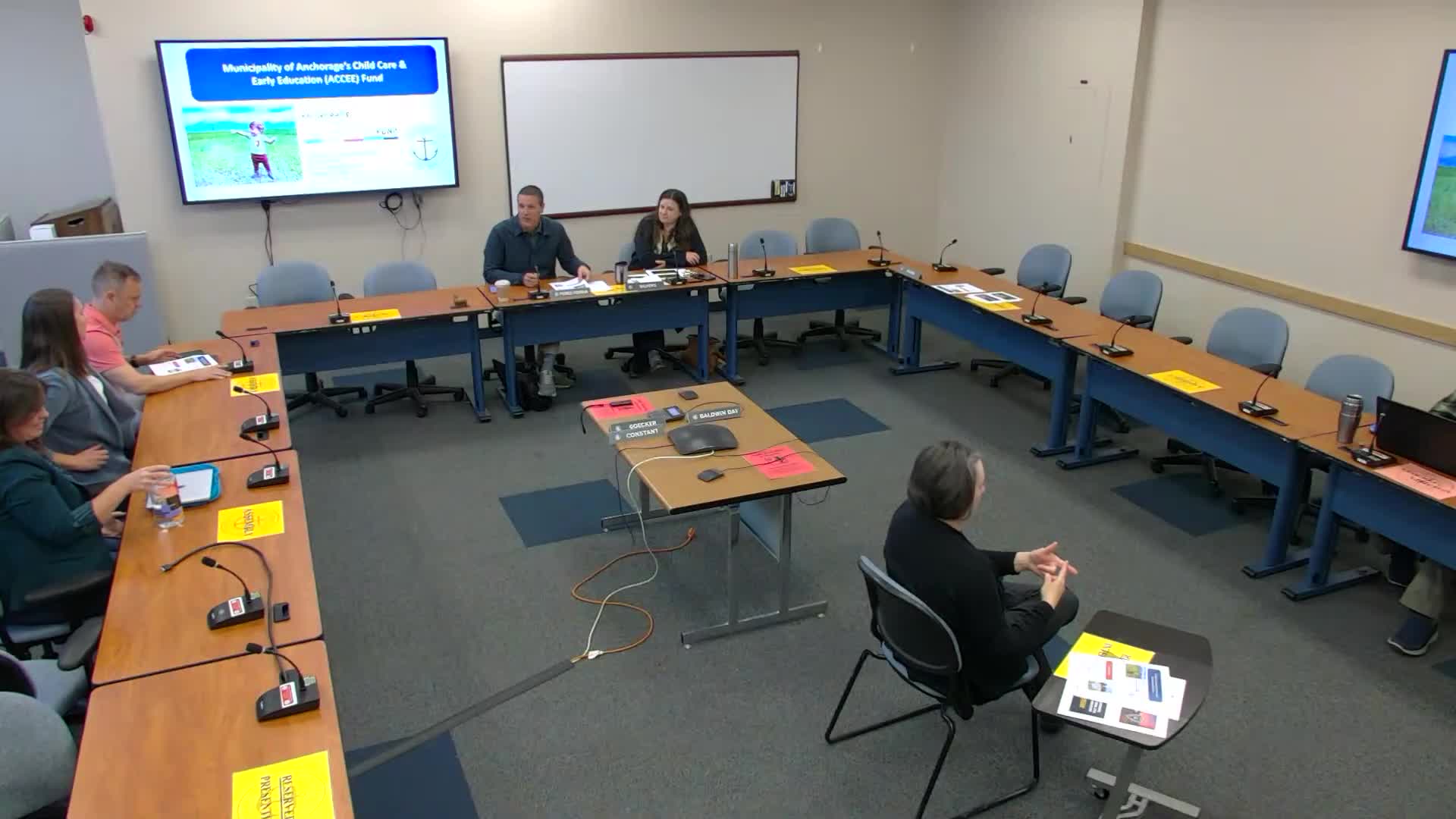
The Anchorage Child Care and Early Education Fund board reported progress Sept. 3 on its first‑year implementation: initial payments have gone out for an early‑educator subsidy, a $2.4 million operational assistance pool has begun distribution through Thread Alaska, and the board recommended funding for capital and pilot projects after a competitive round.
Board chair Trevor Storrs said the early‑educator subsidy — administered by Alaska Family Services because of that agency’s role managing the state child‑care assistance program locally — has enrolled 76 workers so far and is paying care for 119 children. The board designed the subsidy to retain child‑care workers who also have children in care and to expand available slots by enabling workers to stay employed. Payments are monthly and recipients must participate in data collection for an evaluation the board plans to report on in the fall.
Operational assistance and pilots: Storrs said Thread Alaska is distributing a $2.4 million one‑time operational assistance pool in the same manner it administered COVID‑era relief, and that checks began mailing roughly two weeks before the meeting and should be complete by mid‑September. The board issued an RFGP (request for grant proposals) that drew 48 proposals totaling just over $5 million; an evaluation committee recommended funding 13 capital projects and 7 pilot projects. The board said eligibility included licensed centers, family home providers and license‑exempt nonrelative providers; it also allowed camps to apply.
Board members and health‑department staff acknowledged administrative challenges: several applicants lacked insurance coverage required by municipal contracting, which delayed some agreements, and the BidExpress application platform posed accessibility issues for smaller or non‑English‑speaking providers. The municipality and the Anchorage Health Department plan to hire a grants‑and‑contracts administrator funded within the ACE budget to streamline future rounds.
Next steps: the board is undertaking a strategic‑planning process this month to guide investment priorities, is preparing its first municipal budget submission for 2026, and has opened a search for a permanent executive director to replace the interim director, Austin Quinn Davidson. The board emphasized the program will continue to collect outcome data and refine program design.
Board chair Trevor Storrs said the early‑educator subsidy — administered by Alaska Family Services because of that agency’s role managing the state child‑care assistance program locally — has enrolled 76 workers so far and is paying care for 119 children. The board designed the subsidy to retain child‑care workers who also have children in care and to expand available slots by enabling workers to stay employed. Payments are monthly and recipients must participate in data collection for an evaluation the board plans to report on in the fall.
Operational assistance and pilots: Storrs said Thread Alaska is distributing a $2.4 million one‑time operational assistance pool in the same manner it administered COVID‑era relief, and that checks began mailing roughly two weeks before the meeting and should be complete by mid‑September. The board issued an RFGP (request for grant proposals) that drew 48 proposals totaling just over $5 million; an evaluation committee recommended funding 13 capital projects and 7 pilot projects. The board said eligibility included licensed centers, family home providers and license‑exempt nonrelative providers; it also allowed camps to apply.
Board members and health‑department staff acknowledged administrative challenges: several applicants lacked insurance coverage required by municipal contracting, which delayed some agreements, and the BidExpress application platform posed accessibility issues for smaller or non‑English‑speaking providers. The municipality and the Anchorage Health Department plan to hire a grants‑and‑contracts administrator funded within the ACE budget to streamline future rounds.
Next steps: the board is undertaking a strategic‑planning process this month to guide investment priorities, is preparing its first municipal budget submission for 2026, and has opened a search for a permanent executive director to replace the interim director, Austin Quinn Davidson. The board emphasized the program will continue to collect outcome data and refine program design.
Don't Miss a Word: See the Full Meeting!
Go beyond summaries. Unlock every video, transcript, and key insight with a Founder Membership.
✓
Get instant access to full meeting videos
✓
Search and clip any phrase from complete transcripts
✓
Receive AI-powered summaries & custom alerts
✓
Enjoy lifetime, unrestricted access to government data
30-day money-back guarantee
