Council overturns planning commission, approves MF‑12 rezoning for Levine Avenue parcel with 50‑foot buffers
August 28, 2025 | Springdale City, Washington County, Arkansas
This article was created by AI summarizing key points discussed. AI makes mistakes, so for full details and context, please refer to the video of the full meeting. Please report any errors so we can fix them. Report an error »
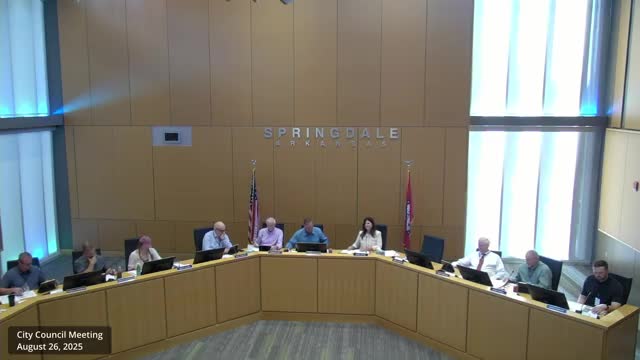
On Aug. 26, 2025, the Springdale City Council voted 5‑2 to overturn a Planning Commission denial of rezoning petition R25‑39 and instructed staff to prepare an ordinance to rezone a parcel at 4617 Levine Avenue to MF‑12 while adding 50‑foot MF‑4 buffer strips on the eastern edge and the south end. The motion carried after discussion and public comment and the ordinance will return to council Sept. 9.
Sharon Tromberg, director of Planning and Community Development, told the council the request matches the city's comprehensive land‑use plan calling for medium‑density residential along the collector and that MF‑12 is intended to sit between single‑family neighborhoods and higher‑density districts. Tromberg said the petition was brought by the property owners and that no development plan has been submitted for the site: "This request is still at the rezoning stage only," she said.
Neighbors who live directly behind the parcel urged protections. Victoria Gammell of 2116 Cobblestone said, "Anything that happens on this property is gonna affect my home, my way of life, my property value, etcetera." Rhonda Coates, whose yard floods after heavy rain, cited runoff concerns and quoted runoff rates for different surfaces, saying the change worried her family. Resident Jeff Onstead said he and his wife have lived adjacent to the parcel for decades and called the proposed buffer "a little bit more" protection than the minimum setback.
City staff and the applicant emphasized that a development plan, if submitted, would be vetted by engineering, fire and building departments. Brandon Resch, with Engineering Services and the authorized representative for the petitioner, described the MF‑12 designation as the "highest and best use" according to the comprehensive plan and said the developer proposes to provide required landscaping, parking and buffers when a plan is filed. Tromberg and staff noted that MF‑12 is 8 units per acre by right, with incentives (open‑space and design features) that can allow higher density up to 12 units per acre.
Council and staff discussed how the proposed MF‑4 50‑foot strip would function. Tromberg said the narrow MF‑4 band is intended as a buffer that would prevent certain multifamily building types from encroaching; in practice it would be difficult but not impossible to construct in that strip because of setback requirements and typical lot dimensions. Council asked whether a duplex or small single‑family structure could be placed there; staff said such lower‑intensity uses could be possible but multifamily apartments would not be permitted in the MF‑4 strip.
On maintenance and ownership, the council and staff said the different zoned strips would remain a single tract and be maintained by the property owner, or by an HOA or property management entity if the development is sold or managed as a common interest community. Tromberg reminded residents that adjacent property owners will be notified again by certified mail when a large‑scale development plan is submitted, at which time stormwater, lighting, access and other site‑specific concerns will be documented and reviewed.
The formal action recorded at the meeting overturns the Planning Commission's 4‑3 denial and directs staff to draft an ordinance reflecting MF‑12 for the main tract with MF‑4 buffer strips (50 feet) including the amendment to add the same 50‑foot buffer along the south boundary; the council's vote was recorded as 5 in favor, 2 opposed. The council did not take a final development approval; the zoning change and any site design details will be resolved through the ordinance and the later large‑scale development review process.
Why it matters: The decision changes the legal zoning for a parcel currently surrounded by long‑standing single‑family neighborhoods and signals the council's willingness to prioritize the city's comprehensive land‑use guidance for collectors, while adding a negotiated buffer to address immediate neighborhood concerns. Nearby residents will have another formal opportunity to review a development plan when it is filed.
Questions that remain: No development plan with site, parking, stormwater and lighting designs has been submitted. The council made clear those technical items will be handled during the large‑scale review and that adjacent owners will receive certified‑mail notice when that application is filed.
Ending note: The council directed staff to prepare an ordinance to appear at the Sept. 9 council meeting; until then the new zoning is not final and no construction approvals have been issued.
Sharon Tromberg, director of Planning and Community Development, told the council the request matches the city's comprehensive land‑use plan calling for medium‑density residential along the collector and that MF‑12 is intended to sit between single‑family neighborhoods and higher‑density districts. Tromberg said the petition was brought by the property owners and that no development plan has been submitted for the site: "This request is still at the rezoning stage only," she said.
Neighbors who live directly behind the parcel urged protections. Victoria Gammell of 2116 Cobblestone said, "Anything that happens on this property is gonna affect my home, my way of life, my property value, etcetera." Rhonda Coates, whose yard floods after heavy rain, cited runoff concerns and quoted runoff rates for different surfaces, saying the change worried her family. Resident Jeff Onstead said he and his wife have lived adjacent to the parcel for decades and called the proposed buffer "a little bit more" protection than the minimum setback.
City staff and the applicant emphasized that a development plan, if submitted, would be vetted by engineering, fire and building departments. Brandon Resch, with Engineering Services and the authorized representative for the petitioner, described the MF‑12 designation as the "highest and best use" according to the comprehensive plan and said the developer proposes to provide required landscaping, parking and buffers when a plan is filed. Tromberg and staff noted that MF‑12 is 8 units per acre by right, with incentives (open‑space and design features) that can allow higher density up to 12 units per acre.
Council and staff discussed how the proposed MF‑4 50‑foot strip would function. Tromberg said the narrow MF‑4 band is intended as a buffer that would prevent certain multifamily building types from encroaching; in practice it would be difficult but not impossible to construct in that strip because of setback requirements and typical lot dimensions. Council asked whether a duplex or small single‑family structure could be placed there; staff said such lower‑intensity uses could be possible but multifamily apartments would not be permitted in the MF‑4 strip.
On maintenance and ownership, the council and staff said the different zoned strips would remain a single tract and be maintained by the property owner, or by an HOA or property management entity if the development is sold or managed as a common interest community. Tromberg reminded residents that adjacent property owners will be notified again by certified mail when a large‑scale development plan is submitted, at which time stormwater, lighting, access and other site‑specific concerns will be documented and reviewed.
The formal action recorded at the meeting overturns the Planning Commission's 4‑3 denial and directs staff to draft an ordinance reflecting MF‑12 for the main tract with MF‑4 buffer strips (50 feet) including the amendment to add the same 50‑foot buffer along the south boundary; the council's vote was recorded as 5 in favor, 2 opposed. The council did not take a final development approval; the zoning change and any site design details will be resolved through the ordinance and the later large‑scale development review process.
Why it matters: The decision changes the legal zoning for a parcel currently surrounded by long‑standing single‑family neighborhoods and signals the council's willingness to prioritize the city's comprehensive land‑use guidance for collectors, while adding a negotiated buffer to address immediate neighborhood concerns. Nearby residents will have another formal opportunity to review a development plan when it is filed.
Questions that remain: No development plan with site, parking, stormwater and lighting designs has been submitted. The council made clear those technical items will be handled during the large‑scale review and that adjacent owners will receive certified‑mail notice when that application is filed.
Ending note: The council directed staff to prepare an ordinance to appear at the Sept. 9 council meeting; until then the new zoning is not final and no construction approvals have been issued.
View the Full Meeting & All Its Details
This article offers just a summary. Unlock complete video, transcripts, and insights as a Founder Member.
✓
Watch full, unedited meeting videos
✓
Search every word spoken in unlimited transcripts
✓
AI summaries & real-time alerts (all government levels)
✓
Permanent access to expanding government content
30-day money-back guarantee
