Mass. committee hears bill to require recovery housing and naloxone on public college campuses
September 11, 2025 | 2025 Legislature MA, Massachusetts
This article was created by AI summarizing key points discussed. AI makes mistakes, so for full details and context, please refer to the video of the full meeting. Please report any errors so we can fix them. Report an error »
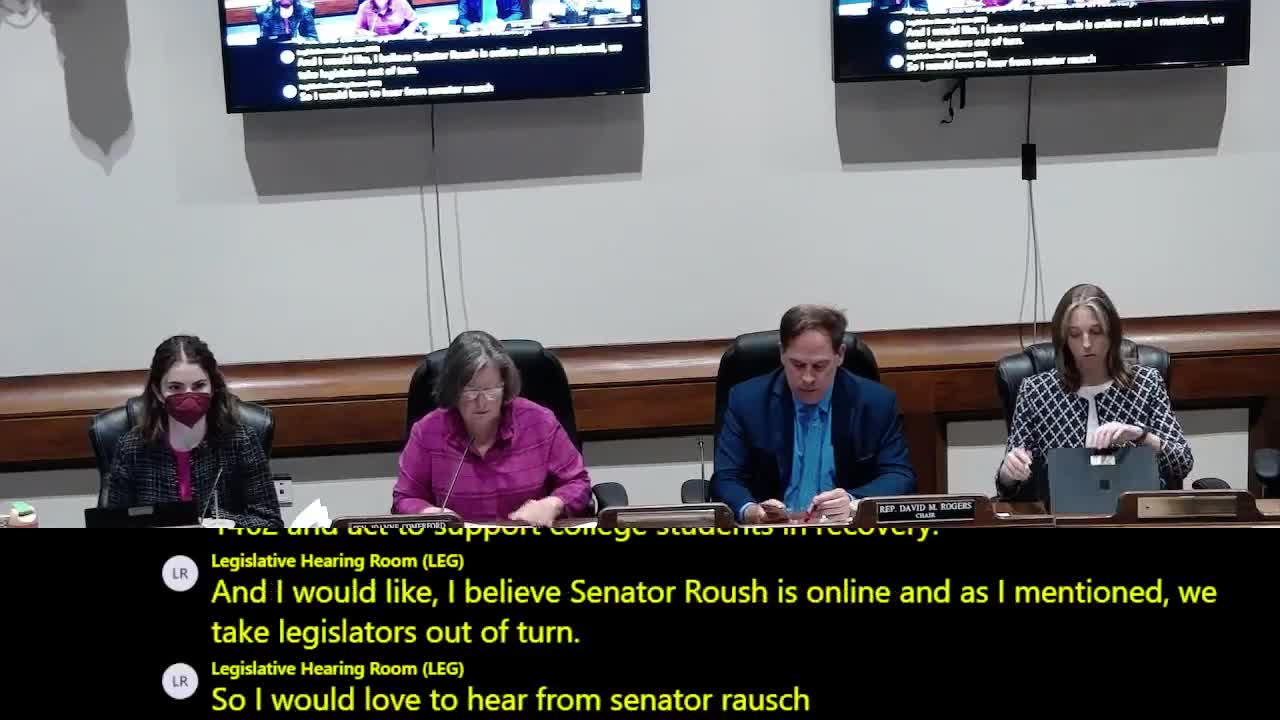
Senator Rausch urged the Joint Committee on Higher Education to report favorably on S.951 and H.1462, bills “to support college students in recovery,” saying the legislation would require recovery-focused housing on Massachusetts public college campuses and expand naloxone access and training.
The bills would require public universities, state colleges and community colleges to provide recovery housing — designated, alcohol- and drug-free living environments paired with trauma-informed counseling, peer mentoring and supportive services — and to make naloxone available on campus alongside training for students and staff.
Why it matters: Testimony emphasized that the current drug supply is increasingly contaminated with synthetic opioids such as fentanyl and that young people can be at risk even with limited experimentation. “Youth do not need a substance use disorder to die of an overdose,” said Dr. Britney Carney, a nurse practitioner at Boston Medical Center, who told the committee that having naloxone on campus is “just like having a fire extinguisher in the kitchen.”
Evidence and precedents: Senator Rausch and other witnesses pointed to New Jersey and Rutgers University’s program as a model. Rausch said Rutgers established the nation’s first campus recovery housing with a reported 95 percent recovery rate and an average student GPA of 3.2. Academic and public-health researchers on the panel said surveys show many students are willing to intervene in an overdose but lack training: a Boston University study cited by Yukino Nakamura found only about 14 percent of surveyed 18-to-25-year-olds knew how to administer naloxone.
Panel remarks and technical details: Jamie Sanislo, who founded a campus naloxone outreach program, described training’s effect on willingness to act, saying trainings “give people the confidence and willingness to actually intervene.” Noel Vest, an assistant professor at Boston University School of Public Health, cited research showing students in collegiate recovery often face co-occurring mental-health needs and that programs with diversified, sustainable funding serve more students and offer more services, including recovery housing.
Budget and implementation notes: Senator Rausch told the committee that last session a $50,000 pilot program was included in the state budget to support creation of recovery housing at public institutions; she said she would follow up with the Department of Higher Education on how that pilot is being dispersed. Dr. Christina Freibaugh noted that Massachusetts colleges may already participate in the Department of Public Health’s naloxone community program and, through the State Office of Pharmacy Services, can obtain naloxone at partial or full subsidy.
What the bill would and would not do: Supporters framed S.951/H.1462 as setting minimum expectations — making recovery housing available where campuses choose to implement it and requiring naloxone availability and training — while leaving operational details to campuses and state agencies. Witnesses urged the committee to add sustainable funding pathways to ensure programs can operate long term.
No committee vote or formal action was taken at the hearing. The sponsors and multiple witnesses asked the committee to report the bills favorably so agencies and campuses can develop and scale programs.
Outlook: Committee members asked for follow-up information on the budget pilot and how New Jersey structured eligibility and implementation. Supporters said they will provide additional documentation to the committee and Department of Higher Education staff.
The bills would require public universities, state colleges and community colleges to provide recovery housing — designated, alcohol- and drug-free living environments paired with trauma-informed counseling, peer mentoring and supportive services — and to make naloxone available on campus alongside training for students and staff.
Why it matters: Testimony emphasized that the current drug supply is increasingly contaminated with synthetic opioids such as fentanyl and that young people can be at risk even with limited experimentation. “Youth do not need a substance use disorder to die of an overdose,” said Dr. Britney Carney, a nurse practitioner at Boston Medical Center, who told the committee that having naloxone on campus is “just like having a fire extinguisher in the kitchen.”
Evidence and precedents: Senator Rausch and other witnesses pointed to New Jersey and Rutgers University’s program as a model. Rausch said Rutgers established the nation’s first campus recovery housing with a reported 95 percent recovery rate and an average student GPA of 3.2. Academic and public-health researchers on the panel said surveys show many students are willing to intervene in an overdose but lack training: a Boston University study cited by Yukino Nakamura found only about 14 percent of surveyed 18-to-25-year-olds knew how to administer naloxone.
Panel remarks and technical details: Jamie Sanislo, who founded a campus naloxone outreach program, described training’s effect on willingness to act, saying trainings “give people the confidence and willingness to actually intervene.” Noel Vest, an assistant professor at Boston University School of Public Health, cited research showing students in collegiate recovery often face co-occurring mental-health needs and that programs with diversified, sustainable funding serve more students and offer more services, including recovery housing.
Budget and implementation notes: Senator Rausch told the committee that last session a $50,000 pilot program was included in the state budget to support creation of recovery housing at public institutions; she said she would follow up with the Department of Higher Education on how that pilot is being dispersed. Dr. Christina Freibaugh noted that Massachusetts colleges may already participate in the Department of Public Health’s naloxone community program and, through the State Office of Pharmacy Services, can obtain naloxone at partial or full subsidy.
What the bill would and would not do: Supporters framed S.951/H.1462 as setting minimum expectations — making recovery housing available where campuses choose to implement it and requiring naloxone availability and training — while leaving operational details to campuses and state agencies. Witnesses urged the committee to add sustainable funding pathways to ensure programs can operate long term.
No committee vote or formal action was taken at the hearing. The sponsors and multiple witnesses asked the committee to report the bills favorably so agencies and campuses can develop and scale programs.
Outlook: Committee members asked for follow-up information on the budget pilot and how New Jersey structured eligibility and implementation. Supporters said they will provide additional documentation to the committee and Department of Higher Education staff.
View the Full Meeting & All Its Details
This article offers just a summary. Unlock complete video, transcripts, and insights as a Founder Member.
✓
Watch full, unedited meeting videos
✓
Search every word spoken in unlimited transcripts
✓
AI summaries & real-time alerts (all government levels)
✓
Permanent access to expanding government content
30-day money-back guarantee
