UMass leaders say federal grant slowdowns threaten research enterprise, endorse state DRIVE proposal
September 11, 2025 | 2025 Legislature MA, Massachusetts
This article was created by AI summarizing key points discussed. AI makes mistakes, so for full details and context, please refer to the video of the full meeting. Please report any errors so we can fix them. Report an error »
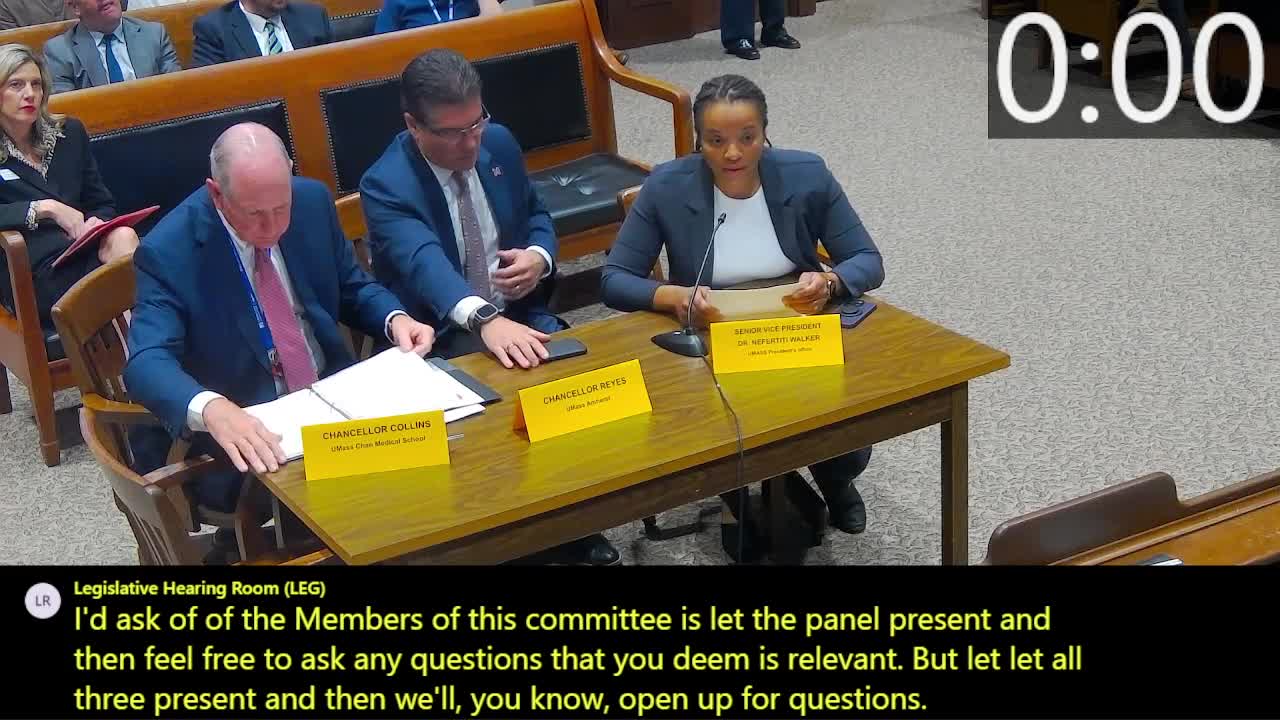
State university leaders testified Sept. 11 before the Joint Committee on Economic Development and Emerging Technologies that recent federal cancellations and slowdowns of research grants have damaged the Commonwealth’s university research enterprise and that the governor’s DRIVE initiative could help bridge the gap.
Neff Walker, senior vice president for academic affairs for the UMass president’s office, told the committee that UMass had seen “$12,600,000 in grants terminated, $3,300,000 in grants suspended for a combined loss of $16,000,000,” and described a broader slowdown in new awards. “Without action, Massachusetts risks losing some of its top talent, its competitive edge, and its leadership role in so many industries,” Walker said.
The testimony explained why university officials support Governor Healy’s DRIVE initiative, a bill that had been referred to the committee. Javier Reyes, chancellor of UMass Amherst, said the DRIVE proposal “will invest in UMass and our private counterparts in Massachusetts so we do not lose our national leadership position.” Michael Collins, chancellor of UMass Chan Medical School, said DRIVE funding would “help us to retain world‑class talent, sustain momentum, preserve and create jobs” across the state’s life‑sciences ecosystem.
UMass officials described concrete near‑term impacts: reduced research awards year‑to‑date and personnel decisions taken this spring, including furloughs and layoffs at some campuses. Collins said researchers are being actively recruited by foreign institutions that can offer more stable funding, adding that some top students and postdoctoral researchers have received offers abroad. Reyes and Collins emphasized that rebuilding research groups and faculty clusters takes years and requires planning grants, start‑up funds and graduate student support.
Committee chairs and members asked for additional, more granular data on federal awards, local economic impacts and the degree to which state bridge funding would preserve jobs and research capacity. No formal committee action was recorded at the hearing; witnesses and committee members said DRIVE had been filed and referred to the committee and that additional hearings were expected.
The discussion highlighted two distinct needs: (1) immediate bridge funding — described by witnesses as necessary to prevent an abrupt loss of researchers and graduate students — and (2) longer‑term actions to sustain Massachusetts’s research ecosystem if federal awards remain constrained. UMass officials asked the committee for timely consideration, saying delays of months would be consequential for hiring and graduate enrollment.
The committee did not take a vote at the Sept. 11 hearing; witnesses offered to provide follow‑up data and to return for further briefings as DRIVE and related proposals move through the legislative process.
Neff Walker, senior vice president for academic affairs for the UMass president’s office, told the committee that UMass had seen “$12,600,000 in grants terminated, $3,300,000 in grants suspended for a combined loss of $16,000,000,” and described a broader slowdown in new awards. “Without action, Massachusetts risks losing some of its top talent, its competitive edge, and its leadership role in so many industries,” Walker said.
The testimony explained why university officials support Governor Healy’s DRIVE initiative, a bill that had been referred to the committee. Javier Reyes, chancellor of UMass Amherst, said the DRIVE proposal “will invest in UMass and our private counterparts in Massachusetts so we do not lose our national leadership position.” Michael Collins, chancellor of UMass Chan Medical School, said DRIVE funding would “help us to retain world‑class talent, sustain momentum, preserve and create jobs” across the state’s life‑sciences ecosystem.
UMass officials described concrete near‑term impacts: reduced research awards year‑to‑date and personnel decisions taken this spring, including furloughs and layoffs at some campuses. Collins said researchers are being actively recruited by foreign institutions that can offer more stable funding, adding that some top students and postdoctoral researchers have received offers abroad. Reyes and Collins emphasized that rebuilding research groups and faculty clusters takes years and requires planning grants, start‑up funds and graduate student support.
Committee chairs and members asked for additional, more granular data on federal awards, local economic impacts and the degree to which state bridge funding would preserve jobs and research capacity. No formal committee action was recorded at the hearing; witnesses and committee members said DRIVE had been filed and referred to the committee and that additional hearings were expected.
The discussion highlighted two distinct needs: (1) immediate bridge funding — described by witnesses as necessary to prevent an abrupt loss of researchers and graduate students — and (2) longer‑term actions to sustain Massachusetts’s research ecosystem if federal awards remain constrained. UMass officials asked the committee for timely consideration, saying delays of months would be consequential for hiring and graduate enrollment.
The committee did not take a vote at the Sept. 11 hearing; witnesses offered to provide follow‑up data and to return for further briefings as DRIVE and related proposals move through the legislative process.
View the Full Meeting & All Its Details
This article offers just a summary. Unlock complete video, transcripts, and insights as a Founder Member.
✓
Watch full, unedited meeting videos
✓
Search every word spoken in unlimited transcripts
✓
AI summaries & real-time alerts (all government levels)
✓
Permanent access to expanding government content
30-day money-back guarantee
