Advocates urge state to accept IEPs, 504 plans as sufficient documentation for college accommodations
September 11, 2025 | 2025 Legislature MA, Massachusetts
This article was created by AI summarizing key points discussed. AI makes mistakes, so for full details and context, please refer to the video of the full meeting. Please report any errors so we can fix them. Report an error »
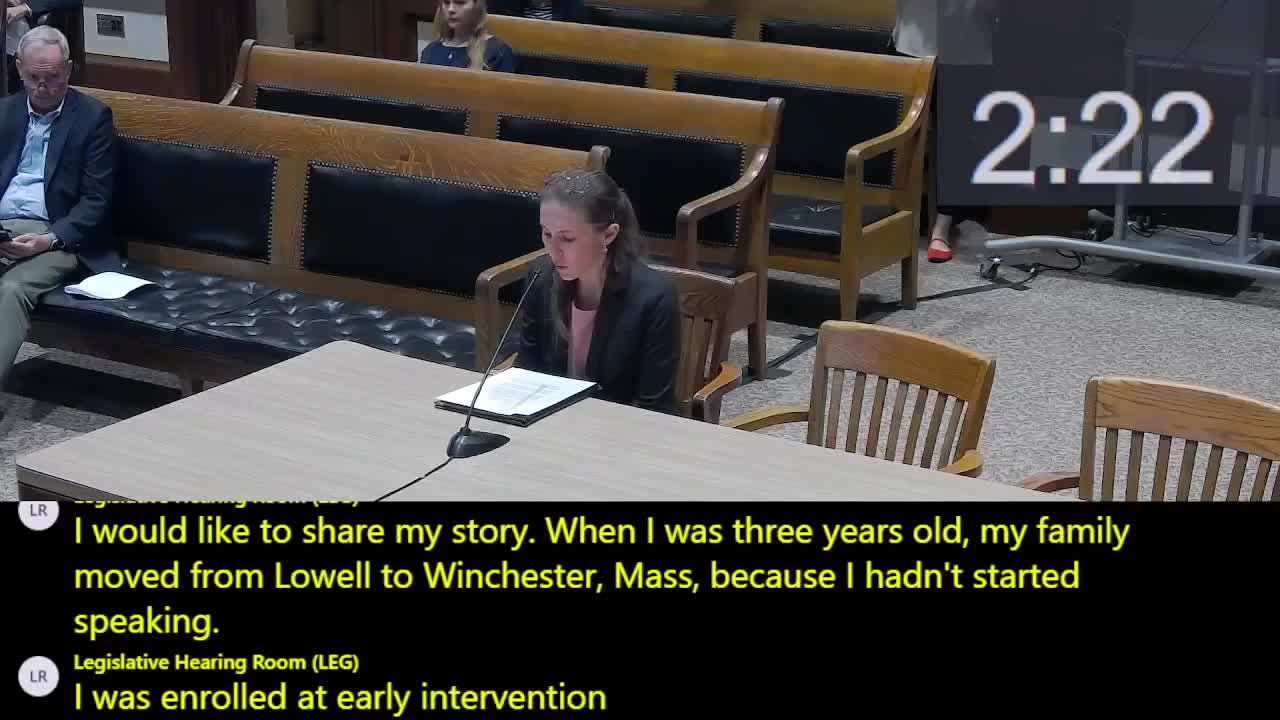
Erin Mayo, an advocate with the National Center for Learning Disabilities, and other experts told the Joint Committee on Higher Education that H.1433 would reduce financial and administrative barriers for college students seeking accommodations by allowing colleges to accept IEPs and 504 plans as sufficient documentation.
“Disabilities do not disappear once a student graduates high school,” Mayo testified, describing how many students are forced to pay for expensive neuropsychological testing — commonly quoted at $1,500 to $3,000 — to prove a lifelong disability after they matriculate.
Researchers and advocates explained the current process. Dr. Jacqueline Rodriguez, CEO of the National Center for Learning Disabilities, told the committee that colleges often require recent evaluations — typically within 18 months — before granting accommodations, and that uneven campus practices produce wide variation: the percentage of students identified with disabilities across state universities in Massachusetts ranges from about 3 percent to 22 percent, which she said “clearly indicate[s] disparities in access to information and quality of support.”
Witnesses said the bill is not meant to force institutions to provide specific services but to remove the initial barrier that keeps students from entering the campus disability‑services conversation. “All this legislation asks for is that when a student goes to the disability or accessibility office, they aren't turned away to prove the disability exists,” Dr. Todd Bridwell (testifying as Dr. Todd Bridal in the hearing) said.
Supporters also noted research showing that students with learning disabilities frequently have co‑occurring mental‑health needs and that collegiate programs with stable, multi‑source funding serve more students and offer more robust services.
No formal committee vote occurred; sponsors and advocates asked the committee to report H.1433 favorably and to consider how standardized treatment of IEPs and 504 plans could reduce inequities for low‑income and first‑generation students.
“Disabilities do not disappear once a student graduates high school,” Mayo testified, describing how many students are forced to pay for expensive neuropsychological testing — commonly quoted at $1,500 to $3,000 — to prove a lifelong disability after they matriculate.
Researchers and advocates explained the current process. Dr. Jacqueline Rodriguez, CEO of the National Center for Learning Disabilities, told the committee that colleges often require recent evaluations — typically within 18 months — before granting accommodations, and that uneven campus practices produce wide variation: the percentage of students identified with disabilities across state universities in Massachusetts ranges from about 3 percent to 22 percent, which she said “clearly indicate[s] disparities in access to information and quality of support.”
Witnesses said the bill is not meant to force institutions to provide specific services but to remove the initial barrier that keeps students from entering the campus disability‑services conversation. “All this legislation asks for is that when a student goes to the disability or accessibility office, they aren't turned away to prove the disability exists,” Dr. Todd Bridwell (testifying as Dr. Todd Bridal in the hearing) said.
Supporters also noted research showing that students with learning disabilities frequently have co‑occurring mental‑health needs and that collegiate programs with stable, multi‑source funding serve more students and offer more robust services.
No formal committee vote occurred; sponsors and advocates asked the committee to report H.1433 favorably and to consider how standardized treatment of IEPs and 504 plans could reduce inequities for low‑income and first‑generation students.
View the Full Meeting & All Its Details
This article offers just a summary. Unlock complete video, transcripts, and insights as a Founder Member.
✓
Watch full, unedited meeting videos
✓
Search every word spoken in unlimited transcripts
✓
AI summaries & real-time alerts (all government levels)
✓
Permanent access to expanding government content
30-day money-back guarantee
