Private and public colleges highlight $71 billion annual impact, workforce pipelines and apprenticeship ties to employers
September 11, 2025 | 2025 Legislature MA, Massachusetts
This article was created by AI summarizing key points discussed. AI makes mistakes, so for full details and context, please refer to the video of the full meeting. Please report any errors so we can fix them. Report an error »
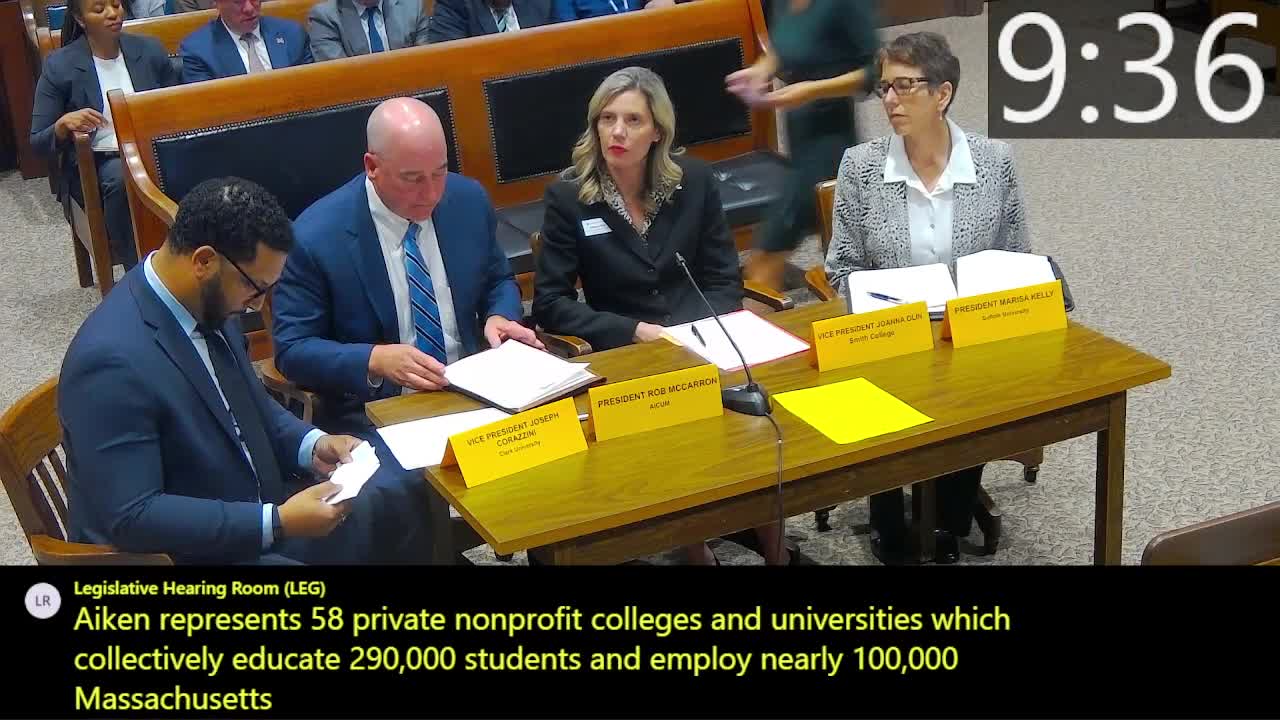
Leaders from private and public colleges and universities described Sept. 11 how campuses across Massachusetts support jobs, local economies and workforce pipelines — and urged continued state support as federal research funding and enrollment pressures mount.
Rob McCarron, president of the Association of Independent Colleges and Universities in Massachusetts (ACAM), said ACAM’s members — 58 private, nonprofit colleges and universities — have an annual economic impact of about $71.1 billion and employ nearly 100,000 residents. “These institutions are the driving force in each region's ability to contribute to the Commonwealth's overall position as leader in health care, life science, technology, arts, education, and the humanities,” McCarron told the committee.
Campus leaders gave institution‑level examples: Marissa Kelly, president of Suffolk University, described community‑facing programs such as law school clinics providing millions in pro bono legal services and dual‑enrollment and entrepreneurship programs that feed local small businesses. Joanna Olin, vice president for government relations at Smith College, highlighted Smith’s geothermal capital project and more than $600 million annual regional contribution.
Matt Vanderheiden, director of MIT’s Koch Institute, discussed company creation tied to university research, saying the institute’s laboratories have spun out 126 companies that have created an estimated 12,000 jobs and that Kendall Square draws a large share of biopharma venture investment. Jared O’Claire of Northeastern emphasized cooperative education and employer partnerships that place students in paid work: “If you want to stay in the state of Massachusetts, you earn and learn and stay,” he said, noting Northeastern’s co‑op placements and workforce programs.
Several witnesses described apprenticeship and short‑course models aligned to employer needs. Northeastern, Bridgewater State and others highlighted registered apprenticeships and industry‑aligned certificate programs in life sciences, artificial intelligence and cyber security. Bristol Community College said its MassReconnect and MassEducate participation increased enrollment sharply and expanded early‑college credits for local students.
Panelists said higher education’s economic contributions extend beyond research: campuses anchor public transit ridership, support small businesses and provide direct community services. They urged coordinated state support for workforce pathways, data on placement and wage outcomes, and inclusion of private institutions in competitive funding opportunities when appropriate.
Committee members asked for more granular, institution‑level data in advance of future hearings; witnesses offered to provide follow‑up materials.
Rob McCarron, president of the Association of Independent Colleges and Universities in Massachusetts (ACAM), said ACAM’s members — 58 private, nonprofit colleges and universities — have an annual economic impact of about $71.1 billion and employ nearly 100,000 residents. “These institutions are the driving force in each region's ability to contribute to the Commonwealth's overall position as leader in health care, life science, technology, arts, education, and the humanities,” McCarron told the committee.
Campus leaders gave institution‑level examples: Marissa Kelly, president of Suffolk University, described community‑facing programs such as law school clinics providing millions in pro bono legal services and dual‑enrollment and entrepreneurship programs that feed local small businesses. Joanna Olin, vice president for government relations at Smith College, highlighted Smith’s geothermal capital project and more than $600 million annual regional contribution.
Matt Vanderheiden, director of MIT’s Koch Institute, discussed company creation tied to university research, saying the institute’s laboratories have spun out 126 companies that have created an estimated 12,000 jobs and that Kendall Square draws a large share of biopharma venture investment. Jared O’Claire of Northeastern emphasized cooperative education and employer partnerships that place students in paid work: “If you want to stay in the state of Massachusetts, you earn and learn and stay,” he said, noting Northeastern’s co‑op placements and workforce programs.
Several witnesses described apprenticeship and short‑course models aligned to employer needs. Northeastern, Bridgewater State and others highlighted registered apprenticeships and industry‑aligned certificate programs in life sciences, artificial intelligence and cyber security. Bristol Community College said its MassReconnect and MassEducate participation increased enrollment sharply and expanded early‑college credits for local students.
Panelists said higher education’s economic contributions extend beyond research: campuses anchor public transit ridership, support small businesses and provide direct community services. They urged coordinated state support for workforce pathways, data on placement and wage outcomes, and inclusion of private institutions in competitive funding opportunities when appropriate.
Committee members asked for more granular, institution‑level data in advance of future hearings; witnesses offered to provide follow‑up materials.
View the Full Meeting & All Its Details
This article offers just a summary. Unlock complete video, transcripts, and insights as a Founder Member.
✓
Watch full, unedited meeting videos
✓
Search every word spoken in unlimited transcripts
✓
AI summaries & real-time alerts (all government levels)
✓
Permanent access to expanding government content
30-day money-back guarantee
