Actuarial audit finds SERS valuations reasonable; recommends clearer disclosures
August 14, 2025 | Retirement Study Council , Joint, Committees, Legislative, Ohio
This article was created by AI summarizing key points discussed. AI makes mistakes, so for full details and context, please refer to the video of the full meeting. Please report any errors so we can fix them. Report an error »
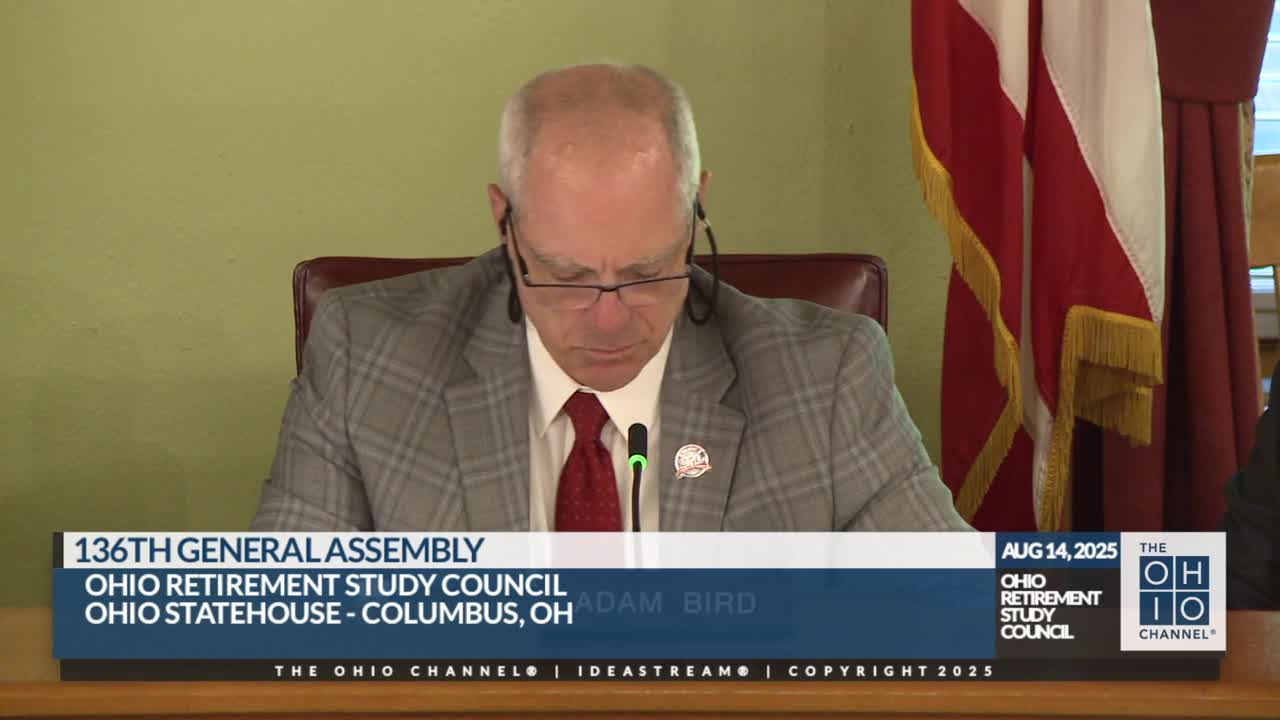
Linda Bornable, the actuarial auditor from KMS Bolton, told the Retirement Study Council on Aug. 2025 that an independent audit of the School Employees Retirement System found the system actuary’s calculations to be accurate and the assumptions reasonable. "No news was good news," Bornable said, adding her firm replicated the system actuary’s results within about 1 percent.
The audit, which replicated the system actuary’s June 30, 2024 valuation for both pensions and retiree health benefits, validated methods and assumptions used to calculate liabilities and noted only minor recommendations to improve report disclosures so another actuary could more readily reproduce the work. Bornable said the firm reviewed the experience study the system’s actuary prepared and found the changes and rationale there to be consistent with what the audit team expects.
The audit matters because the actuarial assumptions—especially the assumed investment return—drive reported liabilities and funding timelines. Bornable said the investment return assumption reviewed in the audit was 7 percent and that the firm judged it reasonable in the context of peer systems. She also reported that KMS Bolton’s replication matched pension valuation results with a 0.22 percent deviation on present value of benefits and matched overall results within about 1 percent.
Council members pressed the auditor on several specifics. Senator Grama Chuck asked whether the auditor had discussed its disclosure recommendations with the system; Bornable said the auditor had not yet done so but that in other states such recommendations sometimes are incorporated after follow-up conversations. Representative John Brennan asked whether the audit team had full access to underlying data; Bornable said they received the data and that some clarifications required follow-up e-mails because certain assumptions in the system report could be expressed more explicitly.
Bornable described other assumptions the audit reviewed: demographic assumptions (including rates for retirement, termination and disability), health-care assumptions (electing coverage, spouse coverage, premium trends and morbidity by age) and an aggregate payroll growth assumption of about 3.25 percent used to project payroll-based contribution amounts. She said the audit team judged the methods for actuarial asset smoothing and other standard public-sector practices to be "very typical" and appropriate for this system.
Council discussion also touched on amortization of unfunded liabilities. Bornable said the system’s amortization period moved from about 28 years in 2016 to 20 years as of the June 30, 2024 valuation; she described that progress as satisfactory and noted that, because this system operates with a fixed-rate contribution structure, the amortization period can change year to year and is not guaranteed to decline steadily. "Next year this could be different because of the fixed-rate methodology," she said.
Following the presentation, system staff thanked the audit team for the validation. The council received the audit; no formal vote or statutory action was reported during the meeting.
The audit, which replicated the system actuary’s June 30, 2024 valuation for both pensions and retiree health benefits, validated methods and assumptions used to calculate liabilities and noted only minor recommendations to improve report disclosures so another actuary could more readily reproduce the work. Bornable said the firm reviewed the experience study the system’s actuary prepared and found the changes and rationale there to be consistent with what the audit team expects.
The audit matters because the actuarial assumptions—especially the assumed investment return—drive reported liabilities and funding timelines. Bornable said the investment return assumption reviewed in the audit was 7 percent and that the firm judged it reasonable in the context of peer systems. She also reported that KMS Bolton’s replication matched pension valuation results with a 0.22 percent deviation on present value of benefits and matched overall results within about 1 percent.
Council members pressed the auditor on several specifics. Senator Grama Chuck asked whether the auditor had discussed its disclosure recommendations with the system; Bornable said the auditor had not yet done so but that in other states such recommendations sometimes are incorporated after follow-up conversations. Representative John Brennan asked whether the audit team had full access to underlying data; Bornable said they received the data and that some clarifications required follow-up e-mails because certain assumptions in the system report could be expressed more explicitly.
Bornable described other assumptions the audit reviewed: demographic assumptions (including rates for retirement, termination and disability), health-care assumptions (electing coverage, spouse coverage, premium trends and morbidity by age) and an aggregate payroll growth assumption of about 3.25 percent used to project payroll-based contribution amounts. She said the audit team judged the methods for actuarial asset smoothing and other standard public-sector practices to be "very typical" and appropriate for this system.
Council discussion also touched on amortization of unfunded liabilities. Bornable said the system’s amortization period moved from about 28 years in 2016 to 20 years as of the June 30, 2024 valuation; she described that progress as satisfactory and noted that, because this system operates with a fixed-rate contribution structure, the amortization period can change year to year and is not guaranteed to decline steadily. "Next year this could be different because of the fixed-rate methodology," she said.
Following the presentation, system staff thanked the audit team for the validation. The council received the audit; no formal vote or statutory action was reported during the meeting.
View the Full Meeting & All Its Details
This article offers just a summary. Unlock complete video, transcripts, and insights as a Founder Member.
✓
Watch full, unedited meeting videos
✓
Search every word spoken in unlimited transcripts
✓
AI summaries & real-time alerts (all government levels)
✓
Permanent access to expanding government content
30-day money-back guarantee
