Board moves multiple UPAC rule changes: definitions, disciplinary presumptions and procedure updates advance after debate
September 11, 2025 | Financial Operations , Utah Board of Education, Offices, Departments, and Divisions, Organizations, Utah Executive Branch, Utah
This article was created by AI summarizing key points discussed. AI makes mistakes, so for full details and context, please refer to the video of the full meeting. Please report any errors so we can fix them. Report an error »
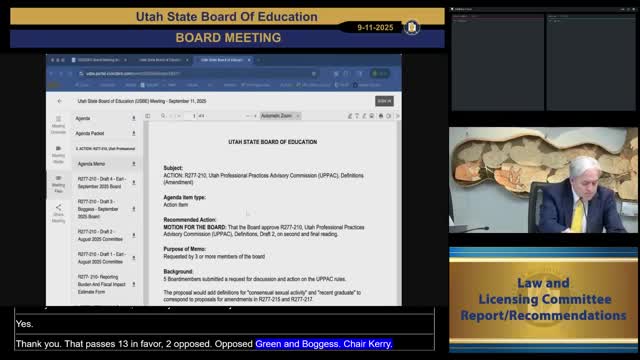
The Utah State Board of Education approved a set of Utah Professional Practices Advisory Commission (UPAC) rules on Sept. 11, voting to adopt revised definitions, disciplinary rebuttable presumptions and procedural rules after days of committee consideration.
Key actions
- R277-210 (definitions): The board approved draft 2 of UPAC definitions with edits introduced in committee. The rule adds language such as a definition for "consensual sexual activity" and a definition of "recent graduate" (an individual within six months of graduating or officially exiting high school). A substitute motion to adopt draft 4 (which would have added a definition of "minor" and clarified "boundary violations" that involve a minor) was discussed; the board approved draft 4 on the floor after additional debate. Motion passed (vote recorded: 11 in favor of draft 4 on the floor earlier; final adoption vote 11-? as recorded in transcript roll calls during the sequence).
- R277-215 (disciplinary rebuttable presumptions): The board discussed and approved draft 3 (later substituted with draft 3) after committee edits. The rule now includes a provision that describes when an educator "engages in a boundary violation with a student or minor"; members debated the language and alignment with other rules. The motion to adopt draft 3 passed after debate.
- R277-211 (UPAC rules of procedure, notification to educators, complaints and final disciplinary actions): Members examined prioritization language for investigations (what must be prioritized by an investigator and what may be prioritized). Board members questioned whether mandatory ("shall") priorities and permissive ("may") priorities were in conflict; staff explained the "shall" section identifies mandatory priorities such as ongoing risk to students, expedited cases requiring a crucial witness, and cases where the presumptive discipline could result in multi-year license loss. The board considered and then voted on amendments; one motion to strike certain lines failed but other edits were carried. The board also instructed staff to return with clarifying text.
Other debated items included adding a requirement that key identified school employees receive comprehensive ESI training that is "research and evidence-based" in addition to foundational training; that amendment was adopted unanimously. Members also discussed definitions of harassment and whether to adopt a new definition; several competing definitions were considered and ultimately the board did not adopt a new standalone harassment definition at this meeting.
Why it matters: The package updates how educator misconduct, boundary violations, and investigation procedures will be handled by UPAC, and clarifies the definitions used to determine disciplinary actions. Several board members asked for additional alignment across multiple UPAK rules (2-17, 2-10, 2-15, 2-11) as part of the five-year review; staff and committee chairs agreed to a working group to reconcile inconsistent phrasing and definitions.
Next steps: Staff will file continuation materials as needed and return with consolidated edits and any task-force recommendations. Several amendments and priority-setting provisions were added; the board asked that additional alignment and clarification be completed before further finalization.
Key actions
- R277-210 (definitions): The board approved draft 2 of UPAC definitions with edits introduced in committee. The rule adds language such as a definition for "consensual sexual activity" and a definition of "recent graduate" (an individual within six months of graduating or officially exiting high school). A substitute motion to adopt draft 4 (which would have added a definition of "minor" and clarified "boundary violations" that involve a minor) was discussed; the board approved draft 4 on the floor after additional debate. Motion passed (vote recorded: 11 in favor of draft 4 on the floor earlier; final adoption vote 11-? as recorded in transcript roll calls during the sequence).
- R277-215 (disciplinary rebuttable presumptions): The board discussed and approved draft 3 (later substituted with draft 3) after committee edits. The rule now includes a provision that describes when an educator "engages in a boundary violation with a student or minor"; members debated the language and alignment with other rules. The motion to adopt draft 3 passed after debate.
- R277-211 (UPAC rules of procedure, notification to educators, complaints and final disciplinary actions): Members examined prioritization language for investigations (what must be prioritized by an investigator and what may be prioritized). Board members questioned whether mandatory ("shall") priorities and permissive ("may") priorities were in conflict; staff explained the "shall" section identifies mandatory priorities such as ongoing risk to students, expedited cases requiring a crucial witness, and cases where the presumptive discipline could result in multi-year license loss. The board considered and then voted on amendments; one motion to strike certain lines failed but other edits were carried. The board also instructed staff to return with clarifying text.
Other debated items included adding a requirement that key identified school employees receive comprehensive ESI training that is "research and evidence-based" in addition to foundational training; that amendment was adopted unanimously. Members also discussed definitions of harassment and whether to adopt a new definition; several competing definitions were considered and ultimately the board did not adopt a new standalone harassment definition at this meeting.
Why it matters: The package updates how educator misconduct, boundary violations, and investigation procedures will be handled by UPAC, and clarifies the definitions used to determine disciplinary actions. Several board members asked for additional alignment across multiple UPAK rules (2-17, 2-10, 2-15, 2-11) as part of the five-year review; staff and committee chairs agreed to a working group to reconcile inconsistent phrasing and definitions.
Next steps: Staff will file continuation materials as needed and return with consolidated edits and any task-force recommendations. Several amendments and priority-setting provisions were added; the board asked that additional alignment and clarification be completed before further finalization.
Don't Miss a Word: See the Full Meeting!
Go beyond summaries. Unlock every video, transcript, and key insight with a Founder Membership.
✓
Get instant access to full meeting videos
✓
Search and clip any phrase from complete transcripts
✓
Receive AI-powered summaries & custom alerts
✓
Enjoy lifetime, unrestricted access to government data
30-day money-back guarantee
