Board tightens emergency safety interventions rule, requires comprehensive evidence-based training
September 11, 2025 | Financial Operations , Utah Board of Education, Offices, Departments, and Divisions, Organizations, Utah Executive Branch, Utah
This article was created by AI summarizing key points discussed. AI makes mistakes, so for full details and context, please refer to the video of the full meeting. Please report any errors so we can fix them. Report an error »
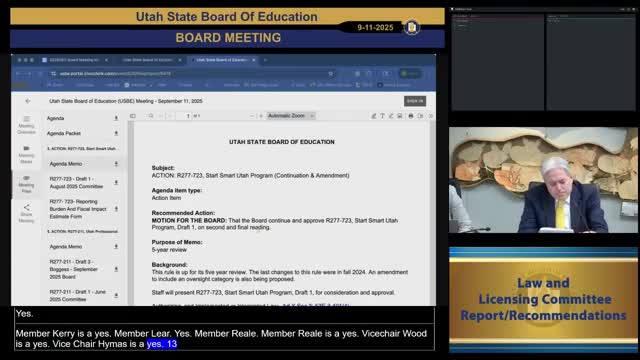
On Sept. 11 the Utah State Board of Education approved R277-608, the emergency safety interventions (ESI) and prohibition of corporal punishment rule, adopting committee edits and several amendments from the floor.
Board members considered multiple amendments intended to clarify situations in which physical restraint or seclusion may not be used: the board adopted an amendment specifying seclusion/restraint must not be used "as a behavioral intervention, as a disciplinary practice, for coercion, retaliation, or humiliation, due to inadequate staffing, or for staff member's convenience." The amendment passed unanimously (member Hall absent for roll call). Members debated whether the phrasing was a typo in earlier drafts; staff confirmed the intent that those listed reasons should never justify an ESI.
Training requirement: The board adopted an amendment that key identified school employees "shall receive comprehensive ESI training that is research and evidence-based in addition to the foundational behavior support training." The board voted to approve that amendment and also asked staff to be careful in selecting training that is evidence-based, and to define "key identified employees" at the LEA level.
Parental notification and timing: The rule was clarified to require that school employees "shall attempt'' to notify parents immediately and no later than 15 minutes after an ESI ends. Legal counsel and staff explained that "attempt" recognizes cases where a parent cannot be reached immediately and that reasonable attempts (call, voicemail, email, text and translation where applicable) constitute compliance.
Definitions and thresholds: Staff explained that the rule uses "immediate danger" and that the definition includes immediate and significant threat that could cause serious bodily injury; the department said that "immediate danger" and "significant threat" are intended to be equivalent for the rule. The board asked staff to ensure report language and public-facing guidance explain these terms to reduce confusion.
Final action: The board approved R277-608 draft 3 as amended. The vote was 11 in favor, 3 opposed; those opposed cited concerns over specific language changes. Staff were directed to update public guidance and reporting details and to publish the revised rule language as adopted.
Why it matters: The rule governs when schools may use seclusion and physical restraint and tightens protections for students (explicitly banning use for staff convenience or as punishment), clarifies parental notification expectations and requires expanded evidence-based training for identified staff.
Next steps: Staff will publish the updated rule text, produce guidance on notification attempts, and provide LEAs with options for evidence-based comprehensive training options.
Board members considered multiple amendments intended to clarify situations in which physical restraint or seclusion may not be used: the board adopted an amendment specifying seclusion/restraint must not be used "as a behavioral intervention, as a disciplinary practice, for coercion, retaliation, or humiliation, due to inadequate staffing, or for staff member's convenience." The amendment passed unanimously (member Hall absent for roll call). Members debated whether the phrasing was a typo in earlier drafts; staff confirmed the intent that those listed reasons should never justify an ESI.
Training requirement: The board adopted an amendment that key identified school employees "shall receive comprehensive ESI training that is research and evidence-based in addition to the foundational behavior support training." The board voted to approve that amendment and also asked staff to be careful in selecting training that is evidence-based, and to define "key identified employees" at the LEA level.
Parental notification and timing: The rule was clarified to require that school employees "shall attempt'' to notify parents immediately and no later than 15 minutes after an ESI ends. Legal counsel and staff explained that "attempt" recognizes cases where a parent cannot be reached immediately and that reasonable attempts (call, voicemail, email, text and translation where applicable) constitute compliance.
Definitions and thresholds: Staff explained that the rule uses "immediate danger" and that the definition includes immediate and significant threat that could cause serious bodily injury; the department said that "immediate danger" and "significant threat" are intended to be equivalent for the rule. The board asked staff to ensure report language and public-facing guidance explain these terms to reduce confusion.
Final action: The board approved R277-608 draft 3 as amended. The vote was 11 in favor, 3 opposed; those opposed cited concerns over specific language changes. Staff were directed to update public guidance and reporting details and to publish the revised rule language as adopted.
Why it matters: The rule governs when schools may use seclusion and physical restraint and tightens protections for students (explicitly banning use for staff convenience or as punishment), clarifies parental notification expectations and requires expanded evidence-based training for identified staff.
Next steps: Staff will publish the updated rule text, produce guidance on notification attempts, and provide LEAs with options for evidence-based comprehensive training options.
Don't Miss a Word: See the Full Meeting!
Go beyond summaries. Unlock every video, transcript, and key insight with a Founder Membership.
✓
Get instant access to full meeting videos
✓
Search and clip any phrase from complete transcripts
✓
Receive AI-powered summaries & custom alerts
✓
Enjoy lifetime, unrestricted access to government data
30-day money-back guarantee
