Board asks superintendent to develop funding requests: UPAK/audit FTEs and transportation among priorities
September 11, 2025 | Financial Operations , Utah Board of Education, Offices, Departments, and Divisions, Organizations, Utah Executive Branch, Utah
This article was created by AI summarizing key points discussed. AI makes mistakes, so for full details and context, please refer to the video of the full meeting. Please report any errors so we can fix them. Report an error »
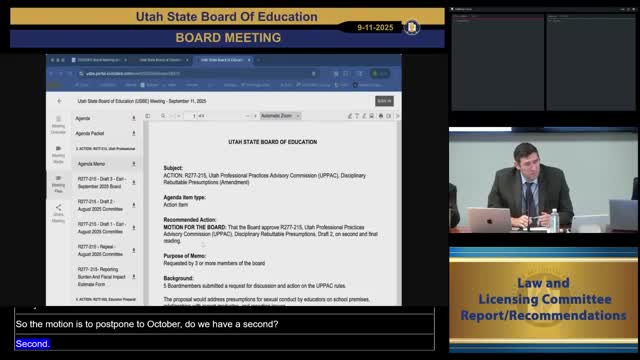
At the Sept. 11 meeting the Utah State Board of Education directed staff to prepare a set of potential funding requests for the 2026 legislative session and to prioritize several items for the governor's pre-budget briefings.
Key funding directions
- UPAK / audit / agency critical FTEs: The board approved an amended request directing the superintendent to modify current UPAC, audit and agency critical FTE funding requests to increase the total number of requested FTEs (the board set a combined target of 17 FTEs) and left specific allocations between UPAC, audit and agency to be determined by the superintendent and board leadership. The board emphasized the hotline volume and increasing investigative workload and asked staff to propose how additional staff would be distributed and costed.
- Pupil transportation: The board asked staff to develop a funding request to increase the state-supported pupil transportation funding level (the "guarantee") and consider policy options to reduce local tax pressure; the motion asked staff to evaluate raising the state match and to return a draft request.
- Additional items for staff development: The board instructed staff to prepare formal funding proposals for (at least) Beverly Taylor Sorensen program continuation, an early mathematics benchmark assessment, support for paraprofessionals K-3, and other items already identified in finance committee backup. Board members emphasized the need for staff to provide full cost estimates, implementation options and policy language so the board can rank priorities at the October meeting.
Why it matters: Board-approved funding requests become the basis for board submission to the governor and later for discussion with legislative leaders. Several items represent direct investments in classroom supports (paraprofessionals, early math benchmarks) and compliance/investigation capacity (UPAC, audit), while pupil transportation is aimed at addressing bus-driver shortages, fuel costs and local levy dynamics.
Next steps: Staff will prepare full funding proposals and cost estimates for the October board meeting, after which the board will submit ranked priorities to the governor's office for pre-budget meetings. The board asked staff to show distributional impacts and implementation timelines for each proposal.
Key funding directions
- UPAK / audit / agency critical FTEs: The board approved an amended request directing the superintendent to modify current UPAC, audit and agency critical FTE funding requests to increase the total number of requested FTEs (the board set a combined target of 17 FTEs) and left specific allocations between UPAC, audit and agency to be determined by the superintendent and board leadership. The board emphasized the hotline volume and increasing investigative workload and asked staff to propose how additional staff would be distributed and costed.
- Pupil transportation: The board asked staff to develop a funding request to increase the state-supported pupil transportation funding level (the "guarantee") and consider policy options to reduce local tax pressure; the motion asked staff to evaluate raising the state match and to return a draft request.
- Additional items for staff development: The board instructed staff to prepare formal funding proposals for (at least) Beverly Taylor Sorensen program continuation, an early mathematics benchmark assessment, support for paraprofessionals K-3, and other items already identified in finance committee backup. Board members emphasized the need for staff to provide full cost estimates, implementation options and policy language so the board can rank priorities at the October meeting.
Why it matters: Board-approved funding requests become the basis for board submission to the governor and later for discussion with legislative leaders. Several items represent direct investments in classroom supports (paraprofessionals, early math benchmarks) and compliance/investigation capacity (UPAC, audit), while pupil transportation is aimed at addressing bus-driver shortages, fuel costs and local levy dynamics.
Next steps: Staff will prepare full funding proposals and cost estimates for the October board meeting, after which the board will submit ranked priorities to the governor's office for pre-budget meetings. The board asked staff to show distributional impacts and implementation timelines for each proposal.
Don't Miss a Word: See the Full Meeting!
Go beyond summaries. Unlock every video, transcript, and key insight with a Founder Membership.
✓
Get instant access to full meeting videos
✓
Search and clip any phrase from complete transcripts
✓
Receive AI-powered summaries & custom alerts
✓
Enjoy lifetime, unrestricted access to government data
30-day money-back guarantee
