County hears detailed briefing on wheel tax, excise surtax and Community Crossings direct distribution
June 12, 2025 | DeKalb County, Indiana
This article was created by AI summarizing key points discussed. AI makes mistakes, so for full details and context, please refer to the video of the full meeting. Please report any errors so we can fix them. Report an error »
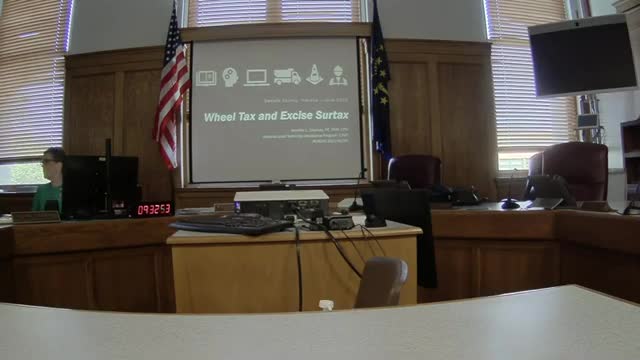
DeKalb County officials on June 11 heard a detailed informational presentation about local option highway-user taxes — commonly called the wheel tax and excise surtax — and how adopting those ordinances affects eligibility for Community Crossings direct distributions.
The presentation by Jennifer Sharkey of the Indiana Local Technical Assistance Program at Purdue University walked the County Council through the two taxes and how the Bureau of Motor Vehicles collects and remits them, and she emphasized a recent state-law change that ties direct Community Crossings funding to local adoption.
“Wheel Tax and Excise Surtax are actually 2 separate taxes, but they must be adopted concurrently,” Sharkey said, explaining that the excise surtax can be set as a flat fee or as a percentage of a vehicle’s excise tax and that the wheel tax is a per-registration flat fee. She told the council that under House Bill 1461 a local unit must have both taxes adopted to qualify for the Community Crossings direct distribution based on lane miles.
Why it matters: the Community Crossings program has historically been a grant process. HB 1461 creates a direct-distribution pathway for units that adopt the local taxes; those direct payments would be distributed by lane‑miles among eligible counties, cities and towns. Sharkey said the direct-distribution pot is projected to be substantially larger in some years and that eligibility requires the local ordinances be adopted ahead of the state’s distribution schedule.
Sharkey gave timeline and revenue estimates for DeKalb County using 2023 BMV registration data. She noted BMV retains a 15¢ branch fee per registration before remitting and laid out illustrative ranges: at statutory minimum excise surtax and wheel-tax rates the countywide collection would be roughly $308,000 annually, and at maximum rates the combined countywide total could approach $2.3 million. She also showed how the local road and street distribution formula (for counties under 50,000 population) splits funds 20% by population and 80% by mileage to cities and towns.
Sharkey cautioned there are many implementation details still to be determined at the state level — for example, whether having an ordinance on the books is sufficient to qualify for the first direct distribution and how soon the State will process eligibility — but she urged local officials to consider adopting ordinances if they want to access the direct-distribution portion of Community Crossings funding in fiscal year 2027 and afterward.
Council members asked several operational questions about exemptions and classifications — for example, whether historic or antique vehicles, buggies, or certain nonprofit vehicles could be excluded. Sharkey said some categories have statutory base fees (for example, vehicles manufactured before 1981 carry a $12 base in the excise schedule) and that local units cannot add exemptions beyond the statutory list; she offered to follow up with the Bureau of Motor Vehicles on specific carve-outs the council asked about.
Sharkey also outlined the mechanics of municipal adoption: Auburn and Garrett (both over 5,000 population) would be eligible to adopt their own ordinances; residents living inside those municipalities would pay both county and municipal local-option taxes if both are adopted.
The presentation included Community Crossings projections cited from legislative fiscal estimates: due to carryover and transfers the direct-distribution pool is projected at about $190 million–$255 million for the state fiscal year beginning July 1, 2026 (fiscal 2027) and lower levels thereafter depending on legislative choices and whether Indianapolis secures a separate matching allocation. Sharkey framed those numbers as estimates and as contingent on how many eligible local units adopt the taxes.
The council did not take any final vote on adoption during the meeting. Sharkey left county staff with the LTAP packet and offered follow-up assistance to run tailored revenue scenarios.
Looking ahead: Sharkey recommended officials decide whether to adopt concurrent ordinances before the September 1 effective-date cutoff to be eligible for January collections in the following year, and to coordinate schedules if municipalities plan to adopt separately. The council signaled interest in receiving more detailed, local-cost estimates and legal guidance before any ordinance vote.
The presentation by Jennifer Sharkey of the Indiana Local Technical Assistance Program at Purdue University walked the County Council through the two taxes and how the Bureau of Motor Vehicles collects and remits them, and she emphasized a recent state-law change that ties direct Community Crossings funding to local adoption.
“Wheel Tax and Excise Surtax are actually 2 separate taxes, but they must be adopted concurrently,” Sharkey said, explaining that the excise surtax can be set as a flat fee or as a percentage of a vehicle’s excise tax and that the wheel tax is a per-registration flat fee. She told the council that under House Bill 1461 a local unit must have both taxes adopted to qualify for the Community Crossings direct distribution based on lane miles.
Why it matters: the Community Crossings program has historically been a grant process. HB 1461 creates a direct-distribution pathway for units that adopt the local taxes; those direct payments would be distributed by lane‑miles among eligible counties, cities and towns. Sharkey said the direct-distribution pot is projected to be substantially larger in some years and that eligibility requires the local ordinances be adopted ahead of the state’s distribution schedule.
Sharkey gave timeline and revenue estimates for DeKalb County using 2023 BMV registration data. She noted BMV retains a 15¢ branch fee per registration before remitting and laid out illustrative ranges: at statutory minimum excise surtax and wheel-tax rates the countywide collection would be roughly $308,000 annually, and at maximum rates the combined countywide total could approach $2.3 million. She also showed how the local road and street distribution formula (for counties under 50,000 population) splits funds 20% by population and 80% by mileage to cities and towns.
Sharkey cautioned there are many implementation details still to be determined at the state level — for example, whether having an ordinance on the books is sufficient to qualify for the first direct distribution and how soon the State will process eligibility — but she urged local officials to consider adopting ordinances if they want to access the direct-distribution portion of Community Crossings funding in fiscal year 2027 and afterward.
Council members asked several operational questions about exemptions and classifications — for example, whether historic or antique vehicles, buggies, or certain nonprofit vehicles could be excluded. Sharkey said some categories have statutory base fees (for example, vehicles manufactured before 1981 carry a $12 base in the excise schedule) and that local units cannot add exemptions beyond the statutory list; she offered to follow up with the Bureau of Motor Vehicles on specific carve-outs the council asked about.
Sharkey also outlined the mechanics of municipal adoption: Auburn and Garrett (both over 5,000 population) would be eligible to adopt their own ordinances; residents living inside those municipalities would pay both county and municipal local-option taxes if both are adopted.
The presentation included Community Crossings projections cited from legislative fiscal estimates: due to carryover and transfers the direct-distribution pool is projected at about $190 million–$255 million for the state fiscal year beginning July 1, 2026 (fiscal 2027) and lower levels thereafter depending on legislative choices and whether Indianapolis secures a separate matching allocation. Sharkey framed those numbers as estimates and as contingent on how many eligible local units adopt the taxes.
The council did not take any final vote on adoption during the meeting. Sharkey left county staff with the LTAP packet and offered follow-up assistance to run tailored revenue scenarios.
Looking ahead: Sharkey recommended officials decide whether to adopt concurrent ordinances before the September 1 effective-date cutoff to be eligible for January collections in the following year, and to coordinate schedules if municipalities plan to adopt separately. The council signaled interest in receiving more detailed, local-cost estimates and legal guidance before any ordinance vote.
Don't Miss a Word: See the Full Meeting!
Go beyond summaries. Unlock every video, transcript, and key insight with a Founder Membership.
✓
Get instant access to full meeting videos
✓
Search and clip any phrase from complete transcripts
✓
Receive AI-powered summaries & custom alerts
✓
Enjoy lifetime, unrestricted access to government data
30-day money-back guarantee
