Fiscal adviser warns council of property-tax losses, offers new income-tax options to replace revenue
June 12, 2025 | DeKalb County, Indiana
This article was created by AI summarizing key points discussed. AI makes mistakes, so for full details and context, please refer to the video of the full meeting. Please report any errors so we can fix them. Report an error »
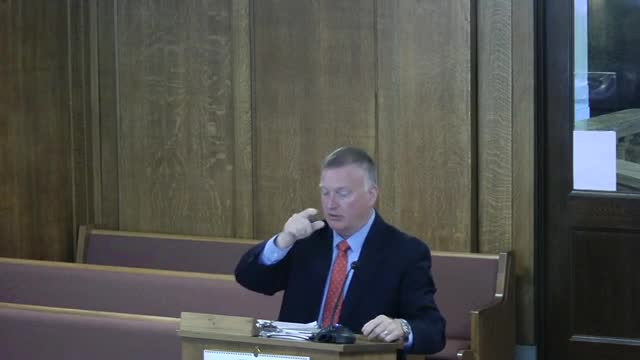
DeKalb County received a long-range fiscal briefing on June 11 that projected the county’s property‑tax base will shrink under recently enacted state changes and that local officials should prepare to use new local income‑tax options beginning in 2028.
Jeff Peters presented the county’s updated fiscal plan and said the state’s reforms — including step‑down reductions to homestead assessments and changes to business personal property reporting — will reduce assessed value and push local tax rates higher while producing larger circuit‑breaker credits.
“What is the result of taking all this assessed value out of the tax base? It is going to drive up tax rate, the levels that we haven't seen for decades,” Peters said. He explained that higher rates plus newly created tax credits and exemptions will cause the county to “net collect fewer property tax dollars” for operations and capital needs.
Peters walked the council through the practical consequences and timelines in the legislation: the largest property‑tax changes are phased through 2031; business personal property reporting will change beginning with the 2027 pay year; and the current local income‑tax framework will be replaced so new local option income taxes can be adopted beginning July 1, 2027 and take effect for distributions in calendar 2028.
How the county can respond: Peters showed modeling indicating the county could replace lost property and other local revenues by using the new county-level income‑tax options. At the county level a 1.2% local income tax for county services is available; other new components (for fire/EMS, and for small cities/towns, libraries, airports or solid‑waste districts) are also authorized with different rate caps. Peters said the new structure is “home‑rule” in effect: county and eligible municipalities can adopt their own rates and those measures are stackable, which will require local coordination.
Peters also warned of administrative and fiscal consequences: the new local income taxes will be reauthorizations requiring annual or periodic action, which could affect bond ratings and the security of debt that previously relied on an ongoing, non‑revocable income‑tax pledge. He recommended the council plan now for revenue replacement, consider whether to adopt the county income options that begin in 2027, and coordinate with cities and local units that may also seek rates.
Peters’ model projects that, absent new local actions, the county’s Motor Vehicle Highway (MVH) fund will consume several million dollars of cash over the coming years; he said options to fill that gap include wheel tax/excise surtax adoption, using part of any new income‑tax revenue for road work, or reallocating general fund resources. He encouraged the council to work with highway staff to prioritize road needs and then evaluate funding tools.
Council members asked questions about timing and practical steps. Peters suggested the county can use the 2026–27 legislative sessions to refine the rules and urged the council to use the July–October 2027 adoption window to enact any new local income taxes before the January 2028 distribution schedule.
No immediate tax vote occurred; Peters said his office will provide further modeling the council can use in budget planning.
Jeff Peters presented the county’s updated fiscal plan and said the state’s reforms — including step‑down reductions to homestead assessments and changes to business personal property reporting — will reduce assessed value and push local tax rates higher while producing larger circuit‑breaker credits.
“What is the result of taking all this assessed value out of the tax base? It is going to drive up tax rate, the levels that we haven't seen for decades,” Peters said. He explained that higher rates plus newly created tax credits and exemptions will cause the county to “net collect fewer property tax dollars” for operations and capital needs.
Peters walked the council through the practical consequences and timelines in the legislation: the largest property‑tax changes are phased through 2031; business personal property reporting will change beginning with the 2027 pay year; and the current local income‑tax framework will be replaced so new local option income taxes can be adopted beginning July 1, 2027 and take effect for distributions in calendar 2028.
How the county can respond: Peters showed modeling indicating the county could replace lost property and other local revenues by using the new county-level income‑tax options. At the county level a 1.2% local income tax for county services is available; other new components (for fire/EMS, and for small cities/towns, libraries, airports or solid‑waste districts) are also authorized with different rate caps. Peters said the new structure is “home‑rule” in effect: county and eligible municipalities can adopt their own rates and those measures are stackable, which will require local coordination.
Peters also warned of administrative and fiscal consequences: the new local income taxes will be reauthorizations requiring annual or periodic action, which could affect bond ratings and the security of debt that previously relied on an ongoing, non‑revocable income‑tax pledge. He recommended the council plan now for revenue replacement, consider whether to adopt the county income options that begin in 2027, and coordinate with cities and local units that may also seek rates.
Peters’ model projects that, absent new local actions, the county’s Motor Vehicle Highway (MVH) fund will consume several million dollars of cash over the coming years; he said options to fill that gap include wheel tax/excise surtax adoption, using part of any new income‑tax revenue for road work, or reallocating general fund resources. He encouraged the council to work with highway staff to prioritize road needs and then evaluate funding tools.
Council members asked questions about timing and practical steps. Peters suggested the county can use the 2026–27 legislative sessions to refine the rules and urged the council to use the July–October 2027 adoption window to enact any new local income taxes before the January 2028 distribution schedule.
No immediate tax vote occurred; Peters said his office will provide further modeling the council can use in budget planning.
Don't Miss a Word: See the Full Meeting!
Go beyond summaries. Unlock every video, transcript, and key insight with a Founder Membership.
✓
Get instant access to full meeting videos
✓
Search and clip any phrase from complete transcripts
✓
Receive AI-powered summaries & custom alerts
✓
Enjoy lifetime, unrestricted access to government data
30-day money-back guarantee
