Committee reviews obsolescence calculations; asks for tax-impact breakdown including wind turbines
August 22, 2025 | Revenue, Joint & Standing, Committees, Legislative, Wyoming
This article was created by AI summarizing key points discussed. AI makes mistakes, so for full details and context, please refer to the video of the full meeting. Please report any errors so we can fix them. Report an error »
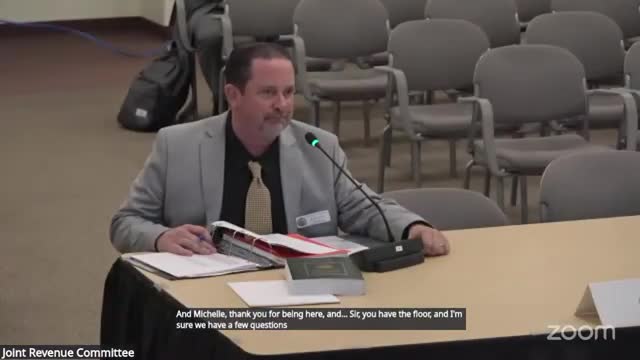
The Joint Revenue Interim Committee heard a briefing on how functional and economic obsolescence is recorded and applied to commercial and industrial property, and members asked staff for clearer tax‑impact figures and documentation practices for unusual cases including inactive wind turbines. Ken Gill, Property Tax Division, Department of Revenue, told the committee he pulled aggregate queries of obsolescence by county and that the figures presented were in fair‑market (full) value rather than assessed value.
The issue matters because obsolescence adjustments reduce taxable value on specific accounts. "This is the amount per county that has been added to individual accounts," Gill said, describing functional obsolescence pulls. Committee members asked for those full‑value numbers to be converted to assessed value and to estimated tax dollars using county mill levies.
Committee members pressed how obsolescence is applied and documented. Gill said appraisers—whether state or county—make obsolescence adjustments during annual appraisals and that appraisers are required to be certified and receive continuing education. "We appraise every property as of January 1 every year," Gill said, explaining the appraisal calendar and review process. He said Department of Revenue staff and county assessors keep documentation and that obsolescence adjustments would be documented in appraisal notes or external files in many offices.
Members raised several recurring operational questions: whether obsolescence is owner‑requested or initiated by appraisers (Gill said it is typically identified by the appraiser but often brought to their attention by the taxpayer), whether documentation is consistently kept (Gill said it generally is, and that examiners and hearings create incentives to document), and whether the appraisal uses the income approach for wind farms. Gill said appraisers consider income approaches for income‑producing assets and confirmed the department can work to provide specifics for wind turbines upon request.
The committee directed staff to provide: (1) a conversion of the obsolescence full‑value aggregates to assessed‑value and estimated tax impact using county average mill levies; (2) representative documentation examples or redacted excerpts showing why obsolescence was applied in a sample of cases; and (3) a short explanation of how appraisers treat wind turbines (income vs. cost approaches) and whether subsidies or other payments affect valuation. Gill also said the department is migrating to a new CAMA/system in the cloud and that the current system was pushed heavily by the recent exemption rollouts.
The committee did not take any formal vote on policy in this session; the items were data briefings and requests for follow‑up.
The issue matters because obsolescence adjustments reduce taxable value on specific accounts. "This is the amount per county that has been added to individual accounts," Gill said, describing functional obsolescence pulls. Committee members asked for those full‑value numbers to be converted to assessed value and to estimated tax dollars using county mill levies.
Committee members pressed how obsolescence is applied and documented. Gill said appraisers—whether state or county—make obsolescence adjustments during annual appraisals and that appraisers are required to be certified and receive continuing education. "We appraise every property as of January 1 every year," Gill said, explaining the appraisal calendar and review process. He said Department of Revenue staff and county assessors keep documentation and that obsolescence adjustments would be documented in appraisal notes or external files in many offices.
Members raised several recurring operational questions: whether obsolescence is owner‑requested or initiated by appraisers (Gill said it is typically identified by the appraiser but often brought to their attention by the taxpayer), whether documentation is consistently kept (Gill said it generally is, and that examiners and hearings create incentives to document), and whether the appraisal uses the income approach for wind farms. Gill said appraisers consider income approaches for income‑producing assets and confirmed the department can work to provide specifics for wind turbines upon request.
The committee directed staff to provide: (1) a conversion of the obsolescence full‑value aggregates to assessed‑value and estimated tax impact using county average mill levies; (2) representative documentation examples or redacted excerpts showing why obsolescence was applied in a sample of cases; and (3) a short explanation of how appraisers treat wind turbines (income vs. cost approaches) and whether subsidies or other payments affect valuation. Gill also said the department is migrating to a new CAMA/system in the cloud and that the current system was pushed heavily by the recent exemption rollouts.
The committee did not take any formal vote on policy in this session; the items were data briefings and requests for follow‑up.
View the Full Meeting & All Its Details
This article offers just a summary. Unlock complete video, transcripts, and insights as a Founder Member.
✓
Watch full, unedited meeting videos
✓
Search every word spoken in unlimited transcripts
✓
AI summaries & real-time alerts (all government levels)
✓
Permanent access to expanding government content
30-day money-back guarantee
