DOI and assessors: pollution and fire‑suppression exemptions trackable but equipment details confidential
August 22, 2025 | Revenue, Joint & Standing, Committees, Legislative, Wyoming
This article was created by AI summarizing key points discussed. AI makes mistakes, so for full details and context, please refer to the video of the full meeting. Please report any errors so we can fix them. Report an error »
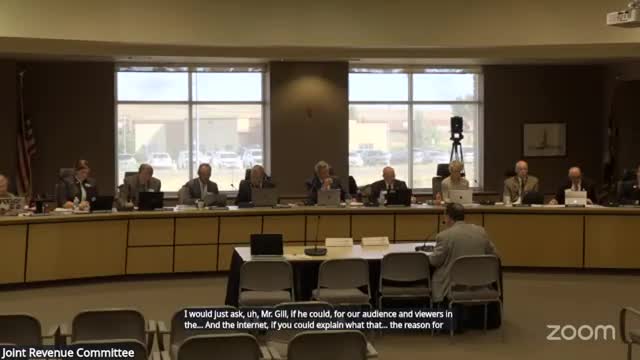
Ken Gill of the Department of Revenue briefed the committee on the pollution control and fire suppression exemptions that are written into statute and largely applied to industrial property. Gill corrected an earlier table and reported the statewide pollution‑control exemption at $7,272,230 and the fire‑control exemption at $4,994,920.
Gill explained the basic eligibility and administrative process: owners apply annually, applications are due to assessors by Feb. 15, and assessors are required to send renewal applications to past applicants. "This is an exemption they have to apply for yearly," Gill said. He noted that exemptions can be partial when a single asset both controls pollution and produces a byproduct used in commerce, and assessors will exempt only the pollution‑control portion.
Committee members asked whether the public can see what types of equipment are exempted and how the exemptions affect the tax base. Department staff and county assessors said company‑level personal‑property details are treated as confidential in Wyoming, though aggregated or anonymized lists of equipment types could be provided. Connoring attendees suggested the committee may want to explore statutory or rule changes to improve tracking of exemptions because other exemptions (churches, schools, government buildings) are not tracked in the same way. Gill and county assessors said pollution and fire‑control exemptions are trackable because they require annual application, and assessors can provide aggregated summaries on request.
The committee asked staff to work on more granular impact calculations and to share data in accessible formats (Excel or CSV). Several county assessors present offered to coordinate with the department to produce anonymized, aggregated lists of equipment classes and the counties where exemptions are claimed. No formal policy action was taken; the committee requested follow‑up data for its next meeting.
Gill explained the basic eligibility and administrative process: owners apply annually, applications are due to assessors by Feb. 15, and assessors are required to send renewal applications to past applicants. "This is an exemption they have to apply for yearly," Gill said. He noted that exemptions can be partial when a single asset both controls pollution and produces a byproduct used in commerce, and assessors will exempt only the pollution‑control portion.
Committee members asked whether the public can see what types of equipment are exempted and how the exemptions affect the tax base. Department staff and county assessors said company‑level personal‑property details are treated as confidential in Wyoming, though aggregated or anonymized lists of equipment types could be provided. Connoring attendees suggested the committee may want to explore statutory or rule changes to improve tracking of exemptions because other exemptions (churches, schools, government buildings) are not tracked in the same way. Gill and county assessors said pollution and fire‑control exemptions are trackable because they require annual application, and assessors can provide aggregated summaries on request.
The committee asked staff to work on more granular impact calculations and to share data in accessible formats (Excel or CSV). Several county assessors present offered to coordinate with the department to produce anonymized, aggregated lists of equipment classes and the counties where exemptions are claimed. No formal policy action was taken; the committee requested follow‑up data for its next meeting.
Don't Miss a Word: See the Full Meeting!
Go beyond summaries. Unlock every video, transcript, and key insight with a Founder Membership.
✓
Get instant access to full meeting videos
✓
Search and clip any phrase from complete transcripts
✓
Receive AI-powered summaries & custom alerts
✓
Enjoy lifetime, unrestricted access to government data
30-day money-back guarantee
